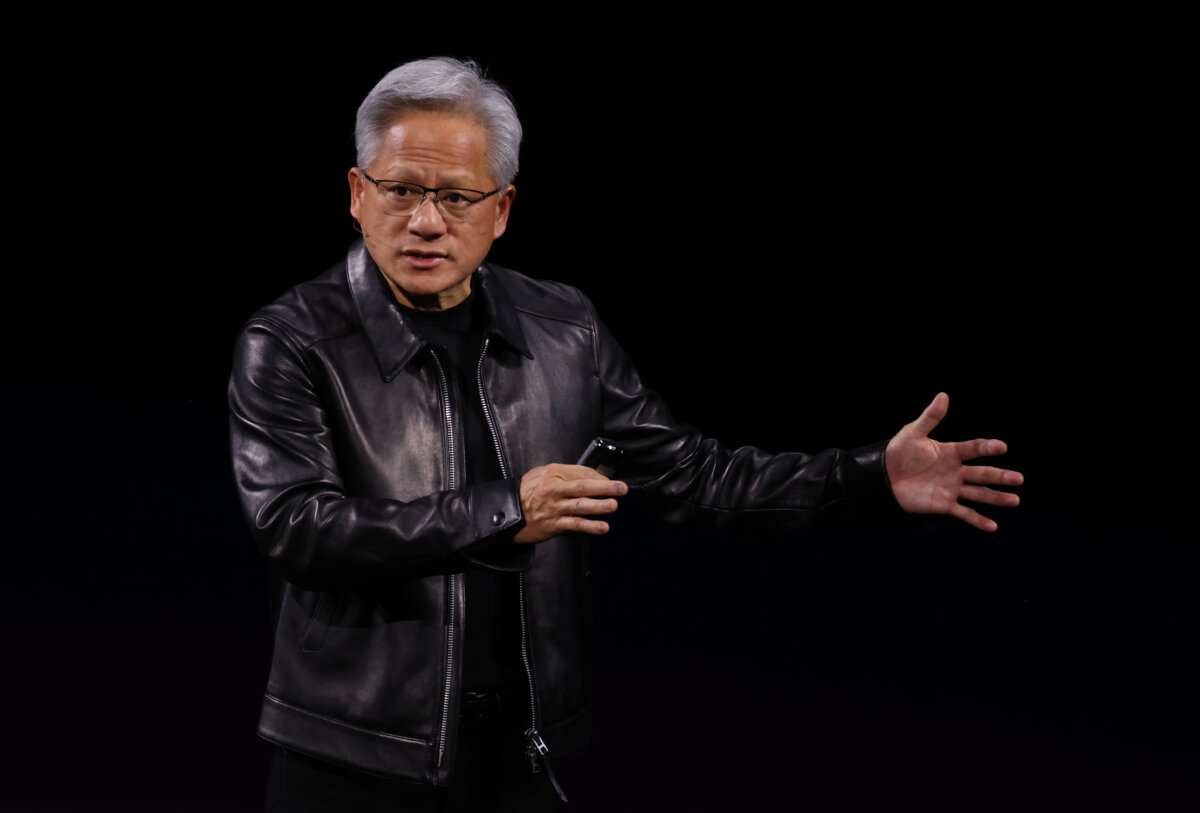

News that Nvidia’s CEO Jensen Huang potentially became a Chinese intelligence target this month has raised fresh concerns about the communist regime’s espionage efforts against the United States and its citizens.
Huang acknowledged in a Nov. 8 message to Nvidia employees that he had an extramarital affair with a woman whom U.S. intelligence suspected of working for Beijing. Nvidia announced on Nov. 8 that its board of directors had initiated an independent probe into reports that Huang was “the target of a foreign intelligence effort.”
President Donald Trump, when asked about the affair at a Nov. 9 briefing, said, “I know the FBI is looking into it in terms of something else, and I think that he’ll be in good shape.”
At the heart of the controversy is Huang Le, also known as Alice Huang, who is not related to Jensen Huang. She’s a former executive at Megaspeed, a Singapore-registered artificial intelligence company and a major customer of Nvidia’s sophisticated semiconductors.
Jensen Huang didn’t name the woman in his Nov. 8 statement, which followed media reporting on his business dealings and interactions with Alice Huang. Citing unnamed sources, a New York Times report published on Nov. 6 stated that Alice Huang was identified by U.S. intelligence officials as having been recruited by China’s Ministry of State Security, the regime’s premier intelligence agency.
The alleged plot followed years of warnings about the Chinese Communist Party’s (CCP’s) espionage operations on U.S. soil.
Key among the human intelligence tactics are honey traps, or honeypots, which typically lure a target with sex or a romantic relationship, then blackmail him to achieve intelligence or political goals.
“The use of romantic or personal relationships for intelligence gathering is nothing new,” Andrew Harding, a policy analyst for China and the Indo-Pacific at The Heritage Foundation, told The Epoch Times via email. “China has employed these types of tactics in intelligence operations.”
‘Long-Term Plan’
One of the most high-profile honey trap cases involves Christine Fang, or Fang Fang, a suspected Chinese operative who entered the United States as a college student in the early 2010s and later cultivated relationships with a number of politicians in California and elsewhere.
Fang approached former Rep. Eric Swalwell (D-Calif.) as early as 2012, when he was a local city council member and running for his first congressional campaign, according to FBI files declassified in August. By 2014, she had raised funds for Swalwell’s reelection campaign.
The case never resulted in charges. The declassified documents show that Swalwell told FBI agents that he had a sexual relationship with Fang before he was elected to Congress. Swalwell has not publicly acknowledged having such a relationship. The congressman resigned in April after sexual assault allegations surfaced involving several women, unrelated to Fang’s case.
Fang returned to China in 2015. The FBI memorandum identifies Fang as connected to the regime’s Ministry of State Security. Her parents, the files state, were senior CCP officials.
Experts say Fang’s case offers a glimpse into Beijing’s strategic planning: a willingness to invest in the long game.
“For the Chinese government, they can plan for 40 years, and they can carry it out step by step,” Zhang Tianliang, a senior fellow at the Consilium Institute and a professor at Fei Tian College in New York state, said on EpochTV’s “American Thought Leaders” in July.
“It’s a long-term plan.”
Defense Contractors
Aside from politicians, individuals with access to military secrets were another “traditional target” of the honey plot tactic, according to Shen Ming-shih, a research fellow at the Taiwan-based Institute for National Defense and Security Research.
He cited a case of a former U.S. defense contractor in Hawaii who in March 2014 pleaded guilty to passing classified military information to a Chinese woman with whom he developed “a romantic relationship.”
Retired Army Lt. Col. Benjamin Pierce Bishop had a top-secret security clearance as a contractor with U.S. Pacific Command.
In 2012, the then-58-year-old emailed secret information about U.S.–South Korea joint training and planning sessions. The recipient was an unidentified 27-year-old Chinese woman who was doing graduate studies in the United States.
Exploitation of ‘Human Weaknesses’
Experts say it’s hard to guard against honey trap efforts, as they are concealed within seemingly legitimate personal relationships or commercial transactions.
“This tactic exploits human weaknesses,” Feng Chongyi, a China expert and an associate professor at the University of Technology Sydney, told The Epoch Times on Nov. 10.
Even when U.S. investigators suspect someone of setting a honey trap for the CCP, Feng said, establishing sufficient evidence for prosecution could be difficult.
Unlike the communist regime, democratic governments in the West cannot interfere with private relationships or restrict legitimate commercial activities without a clear legal basis, Feng said.
“It is extremely difficult to guard against such threats,” he said.
Dorothy Li, Luo Ya, Cathy He, Frank Fang
BOOKMARKS
House Republicans have elected Rep. Jim Jordan (R-Ohio) as minority leader, and Senate Republicans picked Sen. John Thune (R-S.D.) as minority leader for the next Congress, starting in January. Jordan defeated House Majority Leader Steve Scalise (R-La.) in the Nov. 10 vote.
Restrictions on the use of tear gas and other measures by federal officers in Portland, Oregon, were vacated on Nov. 10 by an appeals court. In two rulings, the U.S. Court of Appeals for the Ninth Circuit overturned lower court orders that limited officers’ use of nonlethal munitions against crowds near the Immigration and Customs Enforcement building in Portland.
President Donald Trump clarified his post-midterm immigration policy this week, saying there will be no amnesty for illegal immigrants. “We want to get the worst of the worst, and then we’ll see what happens. … Many of them have good jobs now, they’re productive, some are even paying taxes,” the president said, but still no amnesty.
Senate Minority Leader Chuck Schumer (D-N.Y.) said on Nov. 10 that he is confident he will lead the incoming Democratic majority, shortly after two members of his caucus said they would not support him. Sen. Bernie Sanders (I-Vt.), said he will not support Schumer, and Sen. Elissa Slotkin (D-Mich.) said she’s a no, unless she sees a clear plan.
The House voted not to move forward with a resolution to impeach War Secretary Pete Hegseth on Nov. 10. Rep. Thomas Massie (R-Ky.) introduced articles of impeachment against Hegseth on Nov. 9, accusing the secretary of committing “high crimes and misdemeanors.”
—Stacy Robinson