
In a leafy Raleigh, North Carolina, subdivision, modest split-level houses and raised ranches built in the early 1970s are razed to make way for more luxurious homes on the same lots.
The buyers then flip them for a massive profit, driving up assessed values and local tax bills for the entire neighborhood.
Retired business owner Ed Jones, 91, who moved to the rapidly growing North Carolina community in 1950, said that once-affordable homes for young families and senior citizens in his neighborhood have been wiped out as the lack of affordable U.S. housing approaches critical mass.
“We’re sandwiched between all of these million-dollar homes,” Jones told The Epoch Times. “With the revaluation coming, I’m sure we’re going to have to fight hard. We want to stay here as long as we can.”
Similar complaints have been heard in Florida, where Tampa Bay-area realtor Vincent Arcuri estimates that his average customer is 41 years old, compared with 28 when he began in 1991.
As home values keep rising in the Southeast and across the nation, so does the tax revenue that local governments and school districts collect.
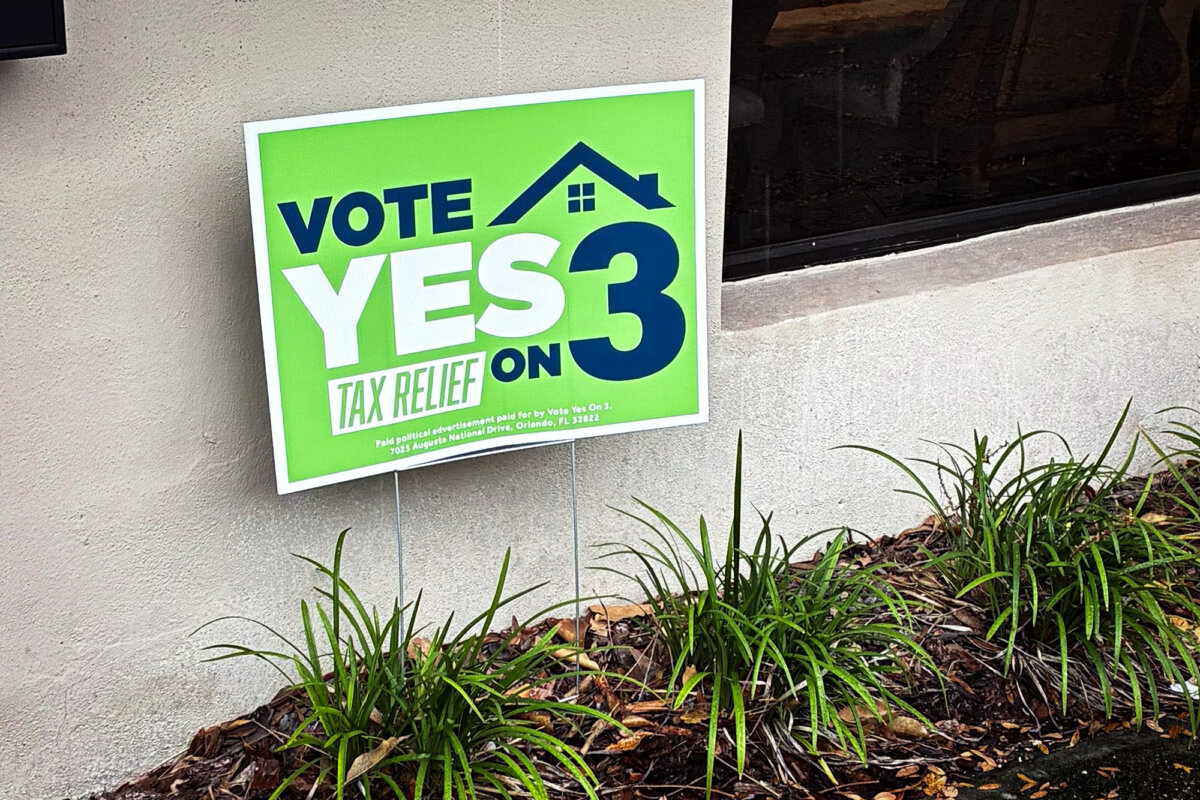
Lawmakers and citizens’ groups, fed up with annual increases that exceed inflation, have introduced property tax limitation ballot measures in seven states in the Nov. 3 elections.
“The anger is legitimate,” said Adam Michel, director of tax policy studies at the Cato Institute, a libertarian think tank. “Property taxes aren’t adjusting to the rest of the system. Something has to give.”
Here’s a look at some 2026 ballot initiatives.
North Carolina
Annual caps would likely be based on inflation and population growth trends across communities, said Brian Balfour, vice president of the John Locke Foundation policy center in North Carolina.
From 2023–2024, property taxes made up 44 percent of county-level revenues and 22 percent of municipal-level (cities and towns) revenues, according to the John Locke Foundation. The money covers local services such as public safety and education.
While there doesn’t appear to be strong opposition to this ballot measure, the North Carolina Budget and Tax Center policy organization cautions that tax caps make local governments more reliant on state funding, fees, and fines.
User charges for specific services such as water or trash collection can’t fund other local functions. When property tax revenues decrease, local leaders are forced to cut hours at public libraries and community pools and other programs that are supposed to benefit the entire community.
“If lawmakers are serious about affordability, they should choose targeted relief, not blunt caps that shift costs and deepen inequities,” the organization’s website states.
Florida
Amendment 3, which requires approval from 60 percent of voters, would exempt primary residences from property taxes on up to $150,000 of assessed valuation in 2027 and $250,000 in 2028, with further amounts based on annual inflation rates after 2029.
Residents who buy a home in the Sunshine State after Dec. 31, 2026, must live there for five years before they can qualify for the tax break.
It also reduces the cap on annual property tax hikes on non-homestead parcels, including rental and commercial properties, to 5 percent annually from 10 percent. The legislation doesn’t pertain to local school taxes.
Florida voters will also decide on a separate amendment that would exempt certain personal property on agricultural lands from taxes.
Wyoming
Initiative 1 would cut property tax bills on primary residences in half.
Homeowners are eligible for the 50 percent assessment exemption if they lived in their current dwelling for at least six months and in the state for at least one year.
The initiative is expected to reduce local government tax revenues by about $92.6 million in 2028 and $95.9 million in 2029.
A proponent, Frederick Harrison, an attorney and former state legislator, told The Epoch Times that Wyoming already collects $2 billion annually from oil, gas, coal, and mineral extractions. Additionally, the planned $17 billion Google data center will contribute millions of dollars more to property tax coffers in the nation’s least-populated state.
He said Laramie County alone has a $147 million fund balance that’s growing by up to $37 million annually.
“What is missing is not money,” he said. “What is missing is a government that has ever been forced to live within its means.”
The main opponents in this fight are public community colleges and law enforcement agencies partially funded by local property taxes. Harrison said public employees paid by state and local tax dollars make up about 20 percent of Wyoming’s workforce.
“Everyone who is against Initiative 1 has a dog in the fight,” he said.
Check out the full story to find out what’s going on in other states.
—Aaron Gifford
BOOKMARKS
The Pentagon is making plans to operate 90 U.S. military bases without relying on traditional water and electrical grids. The plan, called FORTRESS, “is strategic deterrence in action, ensuring our defenses are hardened, proactive, and ready,” Pentagon chief spokesman Sean Parnell said in a post on X over the weekend.
British Defense Secretary Wes Streeting has said the country must be ready for war in 1,000 days, after the government advised citizens to stock up on essential supplies. “Our adversaries’ willingness to harm us is not new. … By 2030, their force strength and war economy could put them in a position to attack,” he said.
A federal judge this past week overturned New York state’s ban on the sale and purchase of body armor, saying it violated the Constitution’s Second Amendment. Check out Jack Phillips’ latest report for more details.
House Minority Leader Hakeem Jeffries (D-N.Y.) signaled that he plans to get Department of War Secretary Pete Hegseth to resign or be removed from his position. “We’re going to hold him accountable in the same way that we held Pam Bondi and Kristi Noem accountable,” Jeffries told MS NOW on Saturday.
No one is sure whether Kamala Harris plans to run in 2028—including herself. ““I go back and forth. I honestly go back and forth. … There’s so many factors,” Harris told CNN’s Edward-Isaac Dovere earlier this month.
—Stacy Robinson