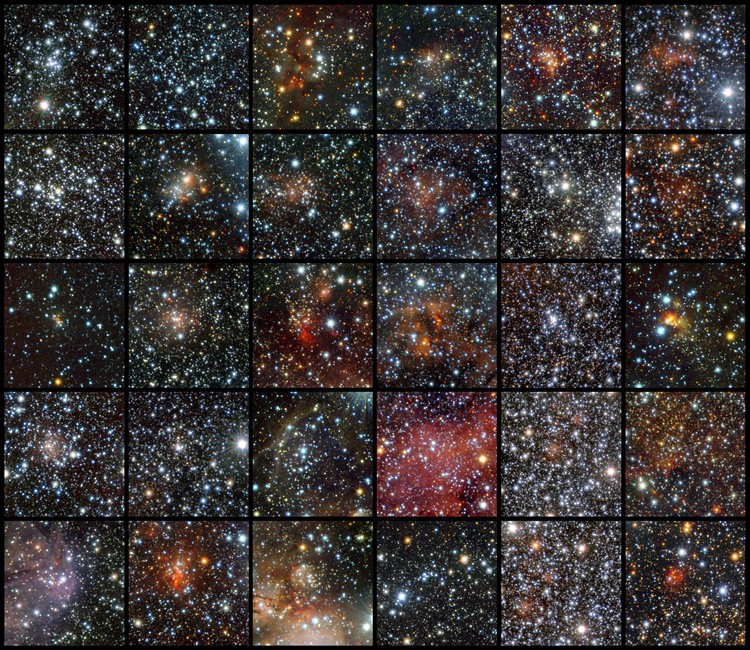
Using the Visible and Infrared Survey Telescope for Astronomy (VISTA) from the VISTA Variables in the Via Lactea program (VVV), astronomers have discovered 96 new open star clusters hidden by dust in the Milky Way.
In previous surveys, images of areas where there should be tiny and faint stars came out with empty sky. However, VVV can overlook the dust and make the tiny stars visible.
“VVV goes much deeper than other surveys," Jura Borissova, lead author of the study, said in a press release.
Using VISTA, astronomers captured images of the youngest stars by concentrating their search in known star-forming areas.
From the images, scientists removed the foreground stars in front of each star clusters to get an exact count of cluster members.
Then astronomers inspected the image to measure the cluster size. For clusters with more members, they also measured the distance, age, and amount of reddening of their starlight caused by interstellar dust between them and Earth.
To date, 2,500 open clusters have been discovered, and it is estimated that 30,000 exist. Now that faint small clusters can be seen for the first time, many investigation opportunities have been opened up.
"We’ve just started to use more sophisticated automatic software to search for less concentrated and older clusters. I am confident that many more are coming soon,” said Borissova.
The findings will be published in the journal Astronomy & Astrophysics. Read the research paper.