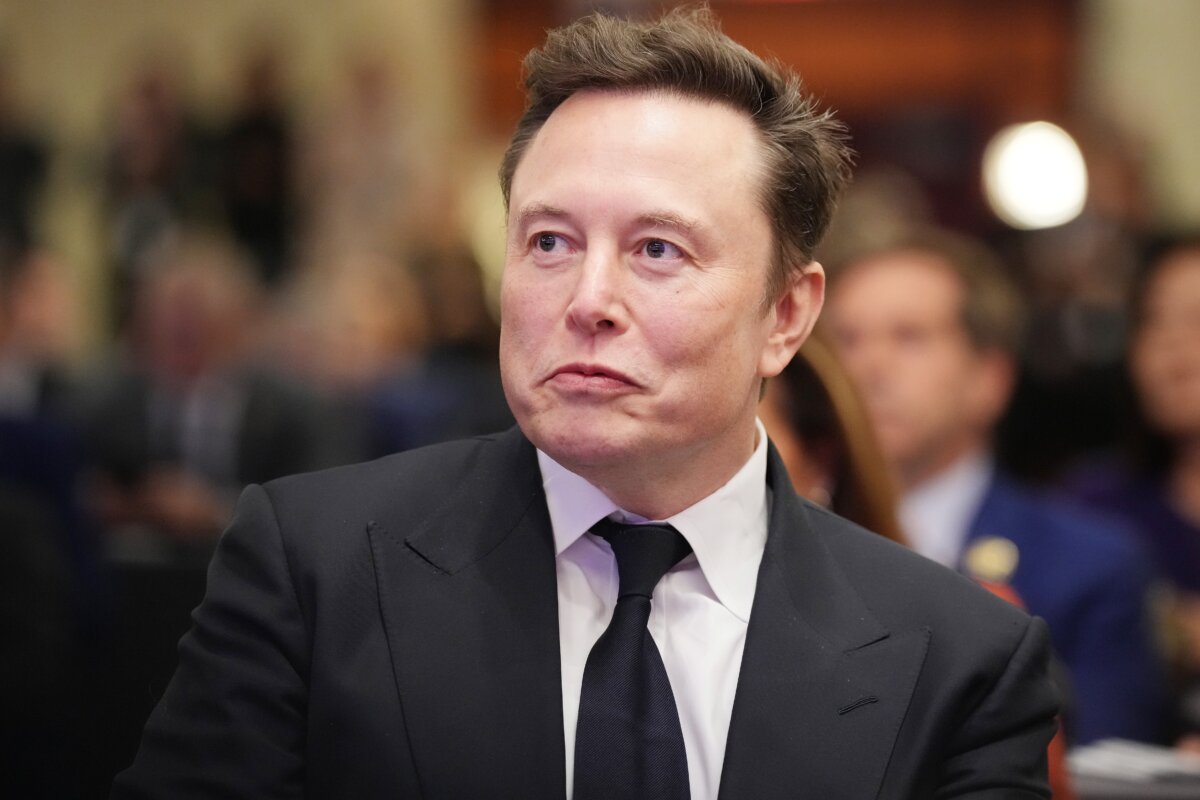

Elon Musk’s feud with President Donald Trump has led the Tesla CEO to announce the formation of a third party—but that effort is much easier said than done.
Third parties in America are almost as old as the Republic itself—as are the difficulties they face in making an impact on the national stage. Nevertheless, non-major parties have played a critical role in American political life, with a pronounced impact on elections across U.S. history.
Experience suggests that Musk could have a tough battle in building the America Party into a viable competitor to Republicans and Democrats.
And so far, he hasn’t filed any paperwork with the Federal Election Commission to make it official, leaving it still unclear how serious the tech billionaire is about the push.
Here’s what he’ll be up against if he moves forward with the idea.
Third parties have long had a reputation in American politics—and not necessarily a good one.
They’re often seen as “spoilers,” or “wasted votes” by supporters of the two major parties. Third-party voters, meanwhile, often describe their vote as conscience-based or as a protest vote.
Thus, legitimacy is a key challenge behind organizing a third party, Richard Groper, a political science professor at California State University–Los Angeles, told The Epoch Times.
“Remember, this country has never had in its history a viable third party that has lasted more than like one cycle,” he said. “So is it going to be kind of a fly-by-night enterprise, or is it going to make a sustained difference in the American polity?”
Adding to these difficulties are some structural aspects of the American system that favored the development and perpetuation of a two-party system.
First, American elections for federal offices—including House and Senate seats—work on a winner-take-all basis, under which seats are awarded by district based on a majority or plurality of the vote. This means that it’s possible for a third party to receive double-digit support statewide but take no seats.
Second, the Electoral College substantially favors a two-party system.
Because elections with more than two major candidates are less likely to reach the required 270 electoral votes, most Americans have preferred to hold their nose and vote for a less favorable candidate considered more likely to win.
Aside from these systemic challenges, Musk’s bid would also face a series of more concrete challenges, starting with funding.
Despite Musk’s vast net worth of nearly $400 billion, U.S. election finance law limits how much he could contribute to the party or affiliated PACs directly: Federal Election Commission Rules cap it at $41,300 in annual contributions to a national party committee, $3,300 to individual candidates, and $5,000 to PACs.
The America Party will need solid candidates, Groper said.
“He’s got to have some real-name people with him on his ticket, some people who have some draw because he has the financial backing,” he said. “He needs good, viable, legitimate candidates.”
Skeptical of Musk’s third-party push, Austin Petersen—a political commentator who mounted a bid for the Libertarian Party presidential nomination in 2016 and a bid for the Republican Senate nomination in 2018—emphasized this point as well.
“It is so difficult to try and find a good person who actually will be able to get votes in a district, because you have to find someone who is already known, well-liked, has a little bit of name ID, has … this chemical soup … of qualities, in order to make a legitimate, credible run.”
Musk’s funding also won’t do much good if he can’t overcome the other major procedural hurdle: gaining access to the ballot in all 50 states.
Under the U.S. Constitution, every state is permitted to handle its federal elections internally, with a few statutory exceptions. That means there are as many election regimes as there are states.
From paperwork to signature requirements to other bureaucratic hurdles, working with all 50 state governments to receive ballot access has long been a key hurdle for third parties.
Musk has indicated that the America Party’s first focus would be on winning a handful of key seats in the U.S. Senate and House of Representatives during the 2026 midterm elections.
These members would “serve as the deciding vote on contentious laws,” Musk wrote on X.
That said, third-party state-level victories aren’t unprecedented: 2020 Democratic candidate Andrew Yang’s Forward Party, founded in 2021, has also managed to win 46 state-level offices so far.
Given that Musk hitched his political identity to the Trump campaign in 2024, he’d face another major hurdle: convincing members of both parties to back the America Party.
Though many of Musk’s ideas—reduction of spending, regulation, and waste in entitlement programs, embracing cryptocurrency, and supporting gun rights—may seem more likely to siphon votes from Republicans, Democrats are also taking the competition seriously.
“I don’t think we should take it lightly or just suspect—as many of these attempts in the past have failed—that it’s going to fail,” DNC Chair Ken Martin told “Endless Urgency,” a Democrat-leaning online show.
“My sense of it is that there’s definitely frustration in both parties right now with a two-party system, and it could be successful,” Martin said, citing Musk’s resources.
And Musk does have some positions that could appeal to centrists and Democrats, such as pushing for the United States to subsidize and develop clean energy and related infrastructure.
Trump, meanwhile, expressed confidence to reporters during a July 8 Cabinet meeting that Musk’s party would “help us.”
“It will probably help. Third parties have always been good for me. I don’t know about Republicans, but for me.”
Other Republicans aren’t so sure.
Sen. Tim Sheehy (R-Mont.) told The Epoch Times that Musk’s push might “require all of us to take a hard look at our spending, our fiscal outlook, and some of the fundamental policies that … are really unpopular with most Americans on both sides.”
Despite the challenges he faces, Musk himself has been blasé about the hurdles.
Responding to a post about these and other difficulties, Musk wrote, “Not hard [to be honest].”
—Joseph Lord, Jackson Richman, and Nathan Worcester
BOOKMARKS
U.S. District Judge Joseph LaPlante blocked Donald Trump’s executive order limiting birthright citizenship on Thursday, in spite of a recent Supreme Court decision restricting the ability of lower courts to issue such nationwide injunctions. The block will be temporarily suspended for a week to allow time for the government to appeal the ruling, the judge said.
The Department of Justice (DOJ) is suing California, alleging the state’s agricultural rules are driving up egg prices across the country. “Through a combination of voter initiatives, legislative enactments, and regulations, California has effectively prevented farmers across the country from using a number of agricultural production methods which were in widespread use—and which helped keep eggs affordable,” the lawsuit says.
Some House Democrats have formed a coalition to address a possible energy crisis, which they say is looming because Trump’s megabill eliminated many clean energy tax credits. The group, called The New Democrat Coalition, has a framework that includes getting rid of coal subsidies and investing in nuclear power.
The DOJ has subpoenaed 20 clinics and doctors allegedly involved in performing transgender surgeries on children. “Medical professionals and organizations that mutilated children in the service of a warped ideology will be held accountable by this Department of Justice,” Attorney General Pam Bondi said in a statement.
Mahmoud Khalil, spokesman for Columbia University students who took over campus buildings last year, is suing the Trump administration for $20 million, even as the government seeks to deport him. Khalil says he was unfairly targeted by the government for his political views, but Department of Homeland Security Assistant Secretary Tricia McLaughlin says Khalil “terrorized Jewish students on campus.”
—Stacy Robinson