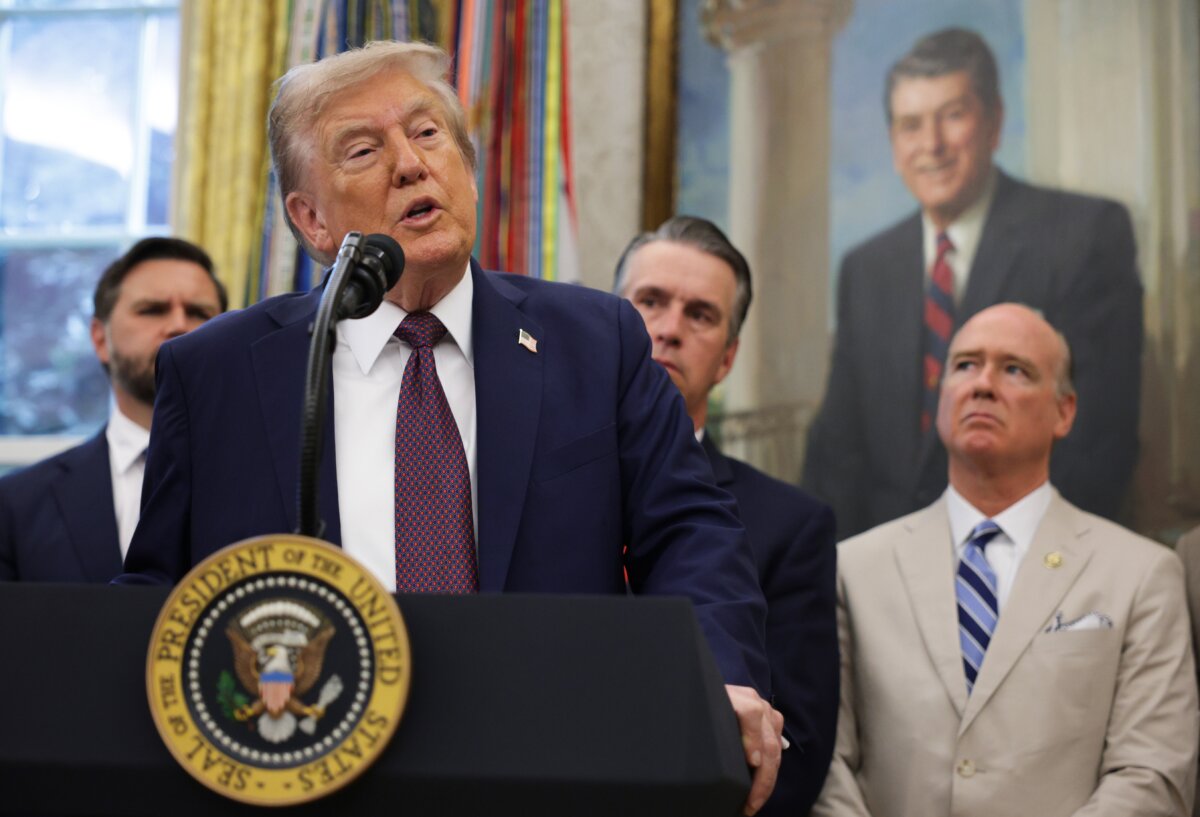

President Donald Trump said on Aug. 30 that he would be making a new foray into federal election rules, promising to sign an executive order that would require identification to vote.
“Voter I.D. Must Be Part of Every Single Vote. No exceptions!” Trump wrote in a post on Truth Social. “I Will Be Doing An Executive Order To That End!!!”
The move would likely build on a March 26 executive order Trump signed earlier this year that would require documentary proof of U.S. citizenship to register to vote in federal elections.
Democrats have expressed opposition to the executive order, saying it exceeds the bounds of his power under the Constitution.
So far, judges who have looked at the issue have indicated they agreed, blocking the administration from implementing broad swaths of the order.
Trump also reiterated earlier calls to end mail-in ballots, although this time he didn’t say whether they would still be the subject of any executive action.
“Also, No Mail-In Voting, Except For Those That Are Very Ill, And The Far Away Military. Use paper ballots only!!!” he said.
The move, like Trump’s promise to push for an end to mail-in ballots, could push the limits of his presidential authority, as states have long been allowed jurisdiction over their elections.
Here’s what to know.
Voter ID laws, which require voters to present a form of identification, have long been a hot-button issue at the national level.
Currently, state laws vary on the topic. Some states have strict laws on the topic, requiring a photo ID to vote, while others that require photo ID permit some flexibility. Others only require some proof of identity, without photo requirements. Others don’t require ID at all.
Trump and other Republicans have called for the adoption of voter ID for years, describing the measure as a common-sense move to ensure that only citizens are allowed to vote in federal elections, and arguing that foregoing such requirements increases the likelihood of fraud.
Democrats’ attitudes on such requirements vary, but many have criticized these laws, arguing that they limit lower-socioeconomic citizens’ access to the ballot box.
Speaking about the issue in July, Senate Minority Leader Chuck Schumer (D-N.Y.) suggested voter ID laws would limit turnout from poor, minority, and Democratic voters.
Republicans have pushed back on these arguments, noting that photo identification is required in various other areas of life, such as driving and employment.
Historically, states have been granted broad discretion over how both state and federal elections are handled, though some laws—such as the Voting Rights Act, the National Voter Registration Act, and laws setting a uniform date for federal elections—regulate the process.
Article I, Section 4 of the Constitution grants states the power to choose the “Times, Places and Manner” of their elections, though Congress is granted the power to regulate the time or manner.
Experts have told The Epoch Times they’re skeptical about Trump’s authority to make broad changes to election laws without Congress’s sign-off.
“The president has no power to dictate to states how they conduct national elections,” Rick Pildes, political science professor at New York University, told The Epoch Times in response to a question about Trump’s call to ban mail-in ballots in all but a handful of cases.
Instead, Congress would likely need to approve such changes through legislation. Though Trump has encouraged reforms, Republicans’ effort to impose proof of citizenship requirements to vote has stalled in the Senate.
The House in April passed the Safeguard American Voter Eligibility (SAVE) Act, which would require voters to produce documents to confirm their citizenship status to register to vote.
The bill has foundered in the Senate, where it would need the support of at least seven Democrats to overcome the 60-vote filibuster threshold.
In March, Trump signed an executive order seeking to impose photo identification requirements at the time of voting.
He said the changes were intended to safeguard “free, fair, and honest elections” against what he described as “fraud, errors, or suspicion.”
“The right of American citizens to have their votes properly counted and tabulated, without illegal dilution, is vital to determining the rightful winner of an election,” Trump wrote in the order.
Trump argued in the document that his goal was to ensure the enforcement of federal laws like 18 U.S.C. § 1015 and § 611, which prohibit foreign nationals from registering to vote in federal elections.
He said that several states have for years failed to properly vet the citizenship status of registrants, while also accusing the Department of Justice of a failure to “prioritize and devote sufficient resources” to the issue.
Trump’s previous effort at modifying election law has faced challenges in court, with judges expressing skepticism about the president’s authority to mandate such changes.
In April, the Democratic Party filed a lawsuit against the order that resulted in a judge temporarily blocking its proof-of-citizenship provisions.
Elias Law Group, which represented Democrats in the case, alleged that the executive order would “disenfranchise eligible voters by adding illegal and unnecessary barriers to the voter registration process.”
“The Constitution couldn’t be clearer—it’s Congress and the states, not the president, who determine how federal elections are conducted,” a representative of the firm said in the statement.
In June, U.S. District Judge Denise Casper also granted a preliminary injunction against enforcement of the order, siding with 19 Democratic attorneys general who had brought suit against the administration.
Casper initially ordered a nationwide ban on the implementation of the order. After the Supreme Court in June issued a ruling limiting nationwide injunctions, she amended the ruling to only apply to the 19 states that had filed the complaint.
It’s unclear how Trump’s new move to address the issue will be structured, given the legal challenges the March executive order has faced.
—Joseph Lord
BOOKMARKS
The U.S. Court of Appeals for the District of Columbia has allowed Donald Trump’s administration to cancel $16 billion in climate grants previously awarded under the 2022 Inflation Reduction Act. The 2-1 decision overturned a lower court decision by U.S. District Judge Tanya Chutkan, who had ruled the Environmental Protection Agency and Citibank were required to disburse the money to climate nonprofits.
Treasury Secretary Scott Bessent says he expects the Supreme Court to uphold Trump’s tariffs, but the administration has a backup plan, just in case. Section 338 of the Tariff Act of 1930 allows the president to impose tariffs of up to 50 percent for five months on foreign goods, under certain conditions.
The president announced on Tuesday that the U.S. military launched a lethal strike against a Venezuelan boat carrying drugs in the Caribbean. “We, just over the last few minutes, literally shot out a boat, a drug-carrying boat, a lot of drugs in that boat,” Trump said during a press briefing.
U.S. manufacturing growth experienced a boom this summer. “The past three months have seen the strongest expansion of production since the first half of 2022, with the upturn gathering pace in August amid rising sales,” Chris Williamson, chief business economist at S&P Global Market Intelligence, said in a statement.
Health officials have launched a public dashboard that tracks organ transplants to make sure they are properly allocated. “Every patient and family waiting for a transplant deserves a fair, transparent, and accountable process,” said Tom Engels, administrator of the Health Resources and Services Administration.
—Stacy Robinson