The end of the year is a time for not only looking back at the past, but also for looking forward into the future.
The Epoch Times presents to you the stories that we understand were big in 2009 and will be big in 2010 and beyond. The Epoch Times publishes in more than 10 languages and in more than 30 countries, a truly global media, and this list reflects that reach. The stories below have global impact.
There were stories that made a splash—heroic acts and fallen heroes, fortunes made and fortunes lost—in 2009, but have little lasting impact on most of the people on the planet. Those stories do not make the list. The stories below have lasting impact.
Next week: The Epoch Times Top News Stories of the Decade 2000-2009
Economic Downturn
A businessman walks past an electric quotation board flashing the Nikkei key index of the Tokyo Stock Exchange. The global economic downtown was one of the top stories of 2009. (Toru Yamanaka/AFP/Getty Images)The story that began with rumblings in 2007 and rose to a loud roar in 2008 transformed into steady moaning and murmuring in 2009. The economy is on the mind of everyone, whether rich, poor, or middle class. The numbness of collecting unemployment benefits—or of benefits running out—weighed on the 10 percent of the population officially unemployed in the United States, and similar percentages in other countries. A whole nation, Iceland, went bankrupt. The high-flying emirate of Dubai needed to get a $10 billion handout from neighbor Abu Dhabi to avoid default. Bailouts, stimulus packages, and credit crunch will be part of the lexicon for a while.
Treaty of Lisbon
Fireworks light up the sky during the ceremony to mark the entry into force of the European Union's Lisbon Treaty, on December 1, 2009 in Lisbon. (Dominique Faget/AFP/Getty Images)The 27 European Union member nations, after debates and rejections and reversals, finally ratified the megalithic Treaty of Lisbon. What does the treaty actually contain? Few know. Yet on the heels of Ireland's referendum thumbs up (reversing the 2008 thumbs down), Europe as a whole gained a face on the world stage: its first permanent president, Herman Van Rompuy from Belgium. The consensus impact: more power for Brussels bureaucrats and streamlined decision making. The milestone in coalescing a single identity from disparate nations also tells, through the rocky ratification process, of the ongoing difficulties in bringing them to act in concert.
Growing International Recognition of Human Rights Abuse in China
Lawyer Carlos Iglesias (second from right) and democracy activist Wei Jingsheng (center) stand with Falun Gong victims of persecution Lu Shiping and Dai Ying (left), and Li Jianhui (right), after testifying before the judge on the cases of torture and genocide, Madrid May 2, 2009. (Victor Liu/The Epoch Times)Two landmark lawsuits, in Spain and Argentina, highlighted the severity of the Chinese regime's genocide and torture campaign against an estimated 100 million Falun Gong practitioners. An Argentinian judge issued arrest warrants for the top responsible leaders, Jiang Zemin and Luo Gan. An eyewitness to the gruesome procedure of removing organs from live Falun Gong practitioners stepped forward, adding another piece of evidence to those previously reported by The Epoch Times. Human rights abuses in China were in the spotlight as the world observed 50 years since the regime's Tibetan takeover, 20 years since the Tiananmen Massacre, and 10 years since the persecution of Falun Gong began.
Health Care Reform in the United States
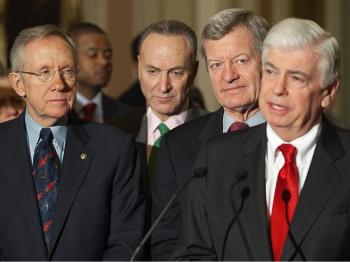
Democratic Senators, Majority Leader Harry Reid of Nevada, Charles Schumer of New York, and Max Baucus of Montana, listen as Christopher Dodd of Connecticut delivers remarks to the media after the U.S. Senate passed the national health care legislation. (Paul J. Richards/AFP/Getty Images)Significant health care reform bills were passed in both chambers of the U.S. Congress this year, paving the way for the largest health care overhaul in the United States in 40 years. Significant changes in the health care industry are coming. The bill proposes to provide coverage for all Americans at a time when approximately 30 million Americans are uninsured. The cost of the proposals over 10 years: $1.2 trillion in the House version and $871 billion in the Senate version. Whatever form the bill takes finally, reform will cause economic waves in the world's largest economy, and thus the world's economy.
Islamic Militants on the March in Afghanistan and Pakistan
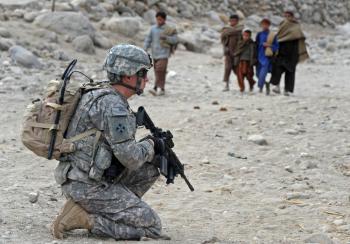
A U.S. soldier on patrol in Nuristan Province, Afghanistan on December 27, 2009. (Tauseef Mustafa/AFP/Getty Images)Early in 2009, observers speculated on whether the nuclear-armed nation of Pakistan was doomed to fall apart in the face of a growing insurgency by Taliban militia. In September, a report by the U.S. commander in Afghanistan acknowledged Taliban gains there as well, leading some U.S. politicians to call for withdrawal. Pakistani armed forces went on the offensive, while the United States stepped up Predator drone attacks on militant leaders in Pakistan. After months of deliberation, U.S. President Obama approved a “surge” of troops into Afghanistan and a change in strategy modeled on the counterinsurgency strategy used successfully in Iraq.