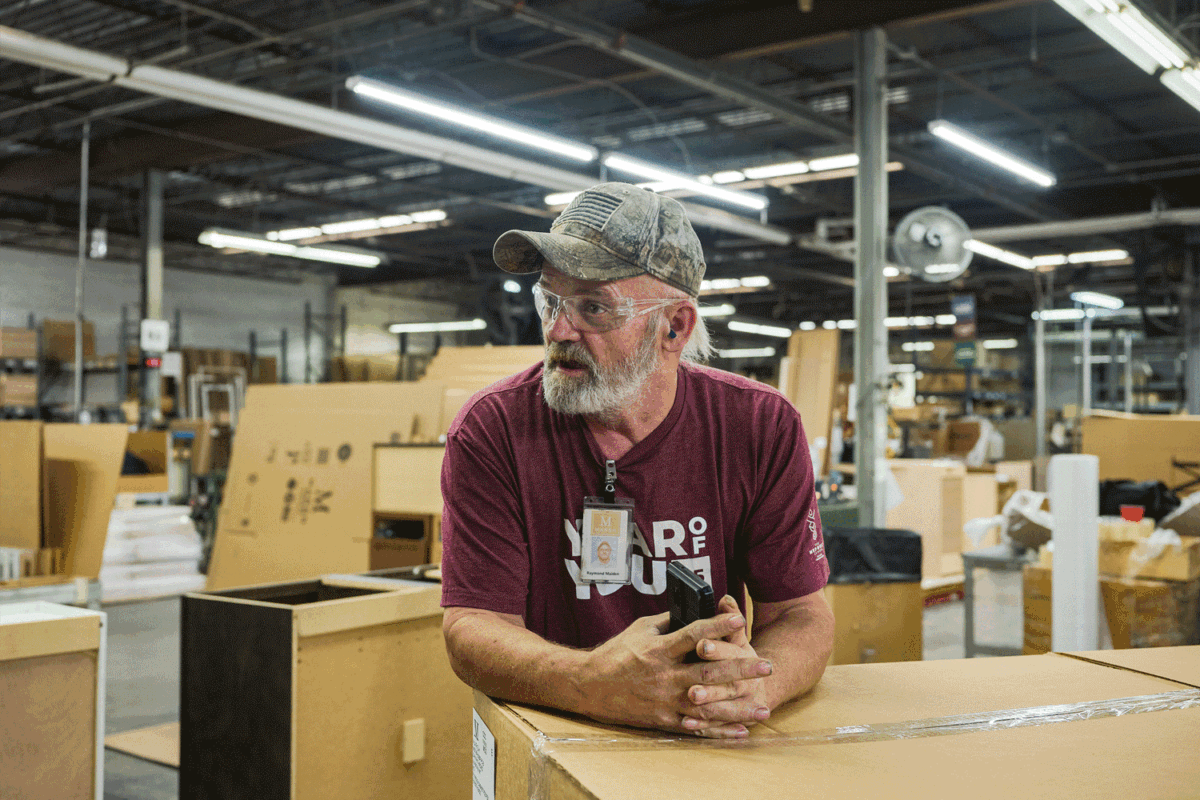

HIGH POINT, N.C.—U.S. kitchen cabinetmakers are sounding a hopeful note for the future of domestic production as new tariffs on cabinets take effect.
“We look forward to rejuvenating this venerable old cabinet industry that we’re so proud of,” Edwin Underwood, president and chief operating officer of Marsh Cabinets, told The Epoch Times.
The family-owned business in High Point, North Carolina, has been in operation for almost 120 years.
President Donald Trump’s 25 percent tariffs on imported kitchen cabinets and vanities took effect on Oct. 14, and will increase to 50 percent next year.
Trump had “the fortitude to poke the bee’s nest,” addressing a challenge that has affected countless industries for decades, Underwood said.
That challenge is posed by imported products that flood the U.S. market at prices that domestic manufacturers cannot afford to match. Marsh Cabinets has been losing business to imported products on a daily basis, according to Underwood.
Like Marsh, Wellborn Cabinet, headquartered in Ashland, Alabama, has been buffeted by the flood of imports.
The resulting decline in demand for U.S.-made cabinets forced Wellborn to freeze hiring several years ago. And a large investment in a new factory near Ashland has become a major concern for the company.
It is now struggling to use the plant and fill its production capacity, Wellborn co-owner Stephen Wellborn told The Epoch Times.
“If this tariff situation doesn’t work, that is going to end up being a very bad investment for us,” he said.
While Underwood, Wellborn, and other U.S. cabinet manufacturers are hopeful that new tariffs will level the playing field for the largely family-owned industry, they suggest that even higher tariffs may be needed.
“We need to see the 25 percent stick … and ultimately, to level the playing field, it needs to be more than 50 percent,” Underwood said.
Wellborn said, “We were actually asking for 100 percent, and that would have made a significant difference.”
Unmatchable Prices
For years, the cabinet industry has been unable to compete with foreign imports, which are sold at prices that U.S. manufacturers cannot match, according to Underwood.
Wellborn experienced this firsthand as foreign importers began stocking U.S. warehouses with cabinets to ensure quick delivery, then directly targeting the same kitchen and bath dealers his company supplies.
The imported products were priced 50 percent to 60 percent lower than similar products from Wellborn.
“There’s absolutely no way we can cut our prices that much, because when somebody is subsidizing and dumping product into an industry, you can’t compete with it,” he said.
China’s Market Takeover
Take a look at the cabinets lining U.S. kitchens and there is a good chance that you will see “made in China.”
You might also see Malaysia, Indonesia, Cambodia, Thailand, and, increasingly over the past half decade, Vietnam. That does not mean that those cabinets did not originate in China.
China and Southeast Asian nations collectively account for more than half of all U.S. kitchen cabinet imports, according to import data from the International Trade Commission.
Imports of Chinese kitchen cabinets were near zero before 2001, but by 2010, China became the world’s No. 1 exporter of all goods.
In 2018, the first Trump administration imposed tariffs on Chinese kitchen cabinet imports, starting at 10 percent in September 2018 and increasing to 25 percent in May 2019.
Those tariffs successfully reduced direct Chinese imports by $700 million, according to International Trade Commission data.
In February 2020, the U.S. government imposed antidumping and countervailing duties on Chinese imports.
Antidumping duties on China were meant to “rebalance” the playing field. However, this remedy was successfully circumvented by China via transshipment and misclassification schemes, leading to a massive, unsustainable surge of imports from neighboring Asian nations, according to Underwood.
Despite new tariffs intended to level the playing field, Underwood said he remains concerned about the extent to which foreign companies are manipulating prices to undercut the domestic industry.
—Sylvia Xu; Stacy Robinson
BOOKMARKS
Pentagon staff will now need approval from higher-ups before consulting with members of Congress, according to a recent memo by War Secretary Pete Hegseth and his deputy, Steve Feinberg. “Unauthorized engagements with Congress by [Department of War] personnel acting in their official capacity, no matter how well-intentioned, may undermine department-wide priorities critical to achieving our legislative objectives,” the memo said.
North Carolina legislators have passed a bill to redraw its congressional map, potentially shifting one district from Democratic to Republican. The change is a continuation of an ongoing national redistricting fight, as both sides grapple for advantage in the 2026 midterms.
The Centers for Disease Control and Prevention’s weekly publication, Morbidity and Mortality Weekly Report, is on hold because of the shutdown. Find out how the University of Minnesota and the New England Journal of Medicine are stepping in to fill that publication’s role by reading Zachary Stieber’s latest report.
A recent study shows that Florida’s school cell phone ban may be responsible for a slight improvement in test scores and student behaviors. Check out Aaron Gifford’s latest report to find out more.
California Gov. Gavin Newsom is deploying members of the National Guard to assist at food banks, in case food stamps lapse during the government shutdown. Those funds are projected to run out in November, if the government remains closed.
—Stacy Robinson