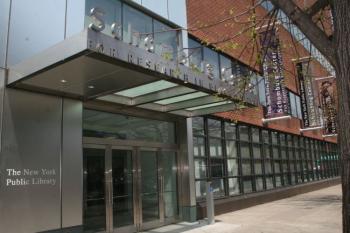
The center was established to collect, preserve, record, and educate the public about the richness and diversity of the peoples of African descent, from past to present to future. It started in a modest four-story building at 103 W. 135th St. It is now a three-building complex at the corner of Malcolm X Boulevard and 135th Street and an integral part of the Harlem community.
The landmark building itself is impressive, boasting a modern façade that seems to belie its humble roots, a spacious research facility, and 340-seat auditorium. More than a library, the Schomburg Center also represents historical changes in Harlem. Because of its unique contents and mission, in 1978 the center was placed on the U.S. National Historic Register of Historic Places.
The History
The Schomburg Center’s history begins with the New York Public Library (NYPL) and a local librarian. In 1924, Ernestine Rose, then assigned to the 135th Street branch in Harlem, founded an organization dedicated to collect information about the African-American community. This first collection became the Division of Negro Literature, History, and Prints. In 1926 the NYPL obtained the private collection of African artifacts of Arturo Alfonso Schomburg.
Arturo Schomburg, a Puerto Rico-born scholar and bibliophile of African descent, embarked on a personal crusade to disprove a teacher’s contention that black people had no history. He began to collect historical and cultural artifacts, eventually amassing an impressive private cache of over 10,000 items reflecting the diversity and extensive history of ethnic African people in the United States and around the world. His collection included books, manuscripts, artwork, and other objects of cultural significance. Schomburg became the curator for the Division in 1932, serving in that position until his death in 1938. In 1940, the Division of Negro Literature, History, and Prints was renamed in his honor.
The original repository for the collection on 135th Street was built in 1905 and later proved too small and unsuitable for the burgeoning collection of artifacts. In 1966, then curator Jean Blackwell Hudson, expressed the need to properly preserve the collection and in 1972 it was transferred to New York’s Research Libraries division and housed in its current facility.
A Culture in Danger
Hudson’s concern was prompted by documented neglect and a lack of equitable financial support for the facility that housed the early collection. The trouble for the Schomburg Center was a local reflection of the greater Civil Rights movement and the racial tensions in New York City at that time, particularly in Harlem.
In the 1960s a group of concerned citizens formed the Citizen Coalition to Save the Schomburg, staging demonstrations and holding press conferences to force the NYPL and the public at large to recognize the value and significance of the Schomburg Center and to rally support for positive change. More recently, in 2007 the NYPL system considered changing the site of the Schomburg. However, the Coalition to Save the Schomburg again mobilized an effort to keep the Center and its place in Harlem history and the community intact. Even as late as last year, with concerns of relocation resurfacing, the future of the Schomburg Center as a Harlem gem has been in jeopardy.
During these turbulent times and despite numerous setbacks, the collection continued to grow. By 1987 it included 5 million artifacts. It now boasts over 10 million cultural and historical artifacts.
These disturbing but important times are also reflected in the current exhibit, Harlem Views/Diasporan Visions: The New Harlem Renaissance Photographers.