
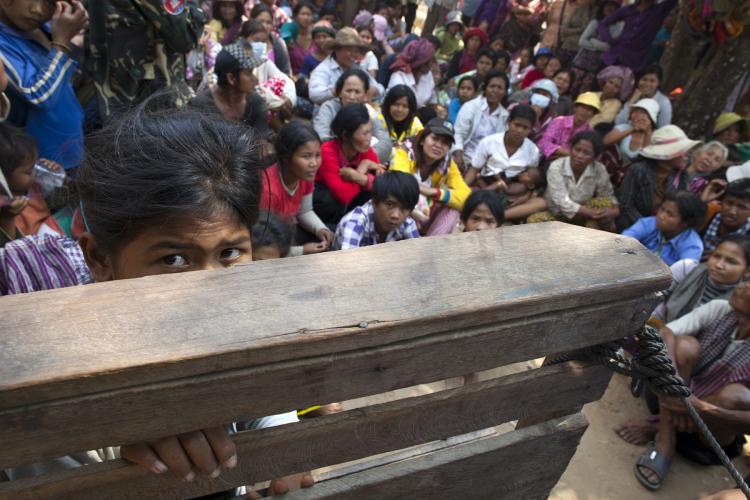
In February, clashes sparked over the 11th century Khmer temple Preah Vihear that sits on the Thai-Cambodia border. In late April, another battle erupted 93 miles down the border near the Ta Krabey and Ta Moan temple complex across from the northeastern Thai province of Surin. At least 18 people have been killed and some 90,000 people displaced in the fighting.
The conflict has abated for now, but neither government has withdrawn its troops and both sides remain on high alert.
Thailand rejects a 1962 ruling of the International Court of Justice (ICJ), which bestowed Preah Vihear Temple and 1.8 square miles of surrounding area to Cambodia. The territory juts into Thailand with the only convenient road access being from the Thai side of the border. The existing dispute was exacerbated in 2008, when Preah Vihear was granted UNESCO World Heritage status.
Thailand, stronger both economically and militarily, wants to solve the dispute bilaterally; Cambodia wants international mediation, hoping to tip the scales in its favor.
Thai historian professor Charnvit Kasetsiri doesn't hold out much hope for ASEAN’s ability to do anything.
“Too bad, ASEAN can do very little, and it will take a long, long time. ASEAN is and will continue to be seen as 'paper tiger',” wrote Charnvit via e-mail from Bangkok.
However, Pou Sothirak, adviser to the Cambodian government, told an ASEAN Institute of Strategic and International Studies conference in Phnom Penh that if the dispute was not resolved, other member nations would revert to settling it by force.
“The border clashes between Cambodia and Thailand are now threatening the very existence of ASEAN—if this now develops into a full blown war, ASEAN must do something right,” warned Sothirak, quoted in Phnom Penh Post on May 6.
The concern for ASEAN, according to Ou Virak, president of Cambodian Center for Human Rights, is that if it is seen as ineffectual in resolving the conflict, it will impact how the bloc is perceived by other countries, particularly foreign investors.
Ou Virak thinks ASEAN’s best course of action is to send an economic warning to both governments.
“Perhaps the best course of action open to ASEAN in its efforts to end this dispute is to show both governments how they too will lose out economically in the long run, if this issue is not conclusively resolved,” says Ou Virak.
Motives Abound
Ostensibly, the conflict is over competing claims of ownership over ancient temple ruins. However, many analysts argue that cultural relics are pawns in the game of domestic Thai politics, as much as anything else.
“It is not so much about the temple or the disputed land. It is more of Bangkok elite's politics, which abuses [a] nationalism claim in order to gain power. It is a classic example of power play,” wrote professor Charnvit Kasetsiri via e-mail from Bangkok.
Kasetsiri is making reference to Prime Minister Abhisit Vejjajiva’s Democrat Party government, which is aligned with the nationalist People’s Alliance for Democracy (PAD), also known as the “yellow shirts.” The PAD was responsibly for ousting the government of Thaksin Shinawatra, whose supporters will face off against Abhisit in upcoming elections.
In November 2009, the fugitive Thaksin—was convicted in absentia of a conflict of interest and sentenced to two years in prison—was appointed economic adviser to the Cambodian government.
“So it is more of a domestic politics spilled over the border,” according to Charnvit.
Read more…Thai-Cambodia Conflict






