
On Nov. 23, Nvidia announced that its board unanimously voted to reinstate Jensen Huang as CEO, less than two weeks after he resigned due to multiple reports of extramarital affairs.
One of those reported relationships was with a suspected Chinese spy, according to The New York Times.
President Donald Trump urged Nvidia’s board to reinstate Huang, in what was seen as a rare executive branch intervention in the corporate governance of a public company.
According to the president, the move was essential to protecting the nation’s “geniuses.” He also raised the possibility that China could recruit Huang.
Readers, however, are divided on the issue, and worry about the CEO’s relationship, particularly when it comes to safety.
When asked what mattered most in judging Huang’s return, the largest segment of readers (about 30 percent) said national security.
One quarter of those who responded said America’s position in the AI race was the top concern. And about 14 percent said the role of federal officials in negotiating his return was the most concerning.
Huang’s Impact
This week, Trump acknowledged the possibility of pardoning Huang if needed, though he said he thought it wouldn’t be necessary.
The president, however, encouraged the CEO to tell the truth when he speaks to three House committees on Dec. 1 and the Senate Banking Committee on Dec. 3.
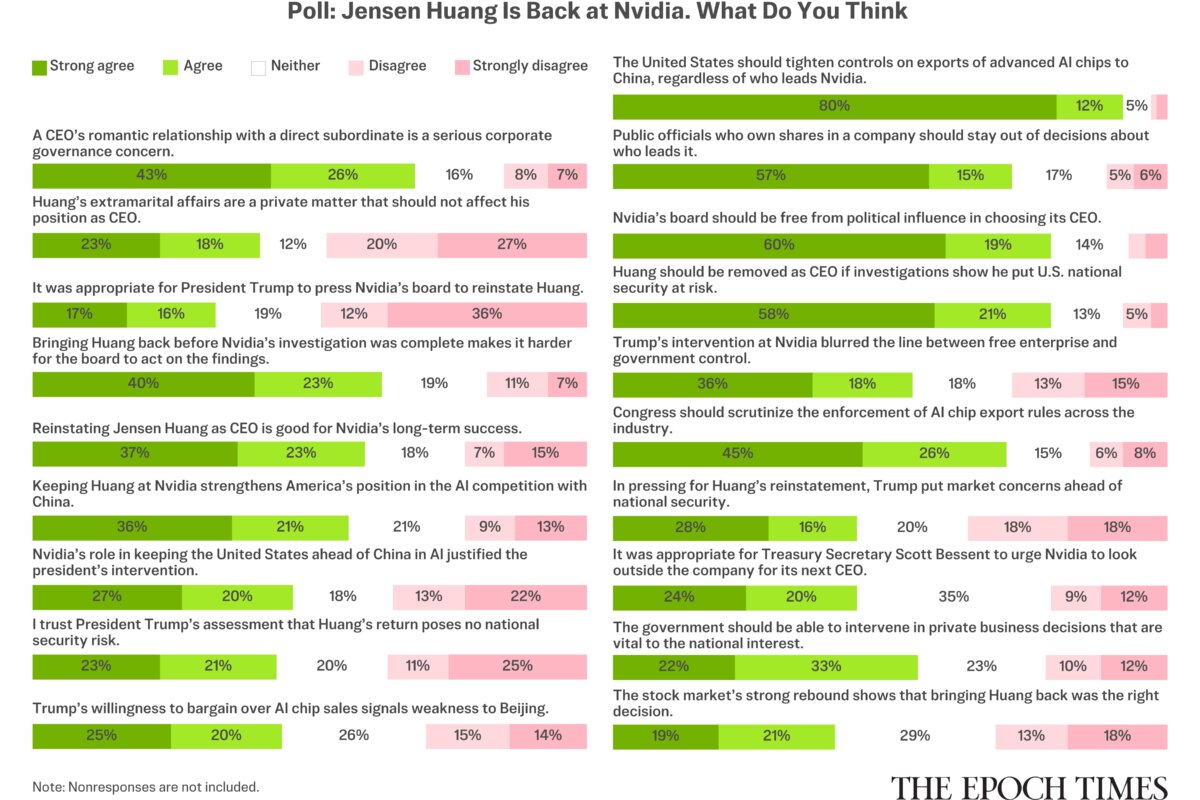
Of those polled, 69 percent agree that a CEO’s romantic relationship with a direct subordinate is a serious corporate governance concern.
Forty-one percent agree that Huang’s extramarital affairs are a private matter that should not affect his position as CEO, but 47 percent disagree.
“Huang’s behavior was inappropriate at best, and very possibly put our nation’s security at risk, said one reader. “I am a Trump supporter, but am getting very frustrated by decisions he makes without adequate explanation. This one smells bad.”
One-third (33 percent) agree that it was appropriate for Trump to press Nvidia’s board to reinstate Huang, but 48 percent disagreed.
Sixty-three percent of readers believe that bringing Huang back before Nvidia’s investigation was complete makes it harder for the board to act on the findings, but 60 percent believe that reinstating Huang as CEO is good for Nvidia’s long-term success.
Around 57 percent of readers believe that keeping Huang at Nvidia strengthens America’s position in the AI competition with China.
One reader stated, “If we lose Huang, a genius in AI, China will surely lure him to set up a company in Beijing. Remember [Wernher von] Braun. If we didn’t lure him out of Germany, the world would be very different!”
National Security Concerns
When supporting Huang’s reinstatement, Trump framed the move as vital for American security due to the AI race with China.
Of readers polled, just under half (47 percent) believe that Nvidia’s role in keeping the United States ahead of China in AI justified the president’s intervention. Thirty-five percent disagree with the same premise.
“This was a planned attack by China,” said one reader. “They are laughing in our faces. … Trump most certainly knew exactly what was going on the whole time.”
Similarly, 44 percent of readers trust Trump’s assessment that Huang’s return poses no national security risk.
When asked if they believe that Trump’s willingness to bargain over AI chip sales signals weakness to Beijing, 45 percent agree, and another 26 percent neither agree nor disagree.
However, 92 percent agree that the United States should tighten controls on exports of advanced AI chips to China, regardless of who leads Nvidia.
A large majority (72 percent) believe that public officials who own shares in a company should stay out of decisions about who leads it.
“There are many capable CEOs; Huang is not irreplaceable,” said one reader. “This was about stock prices, not national security or the AI race.”
Nvidia and Free Enterprise
Governmental influence on the private market was another cause for concern.
When asked if Nvidia’s board should be free from political influence in choosing its CEO, 79 percent agreed. The same percentage believe that Huang should be removed as CEO if investigations show he put U.S. national security at risk.
However, over half (54 percent) believe that Trump’s intervention at Nvidia blurred the line between free enterprise and government control.
Seventy-one percent of readers said they agree that Congress should scrutinize the enforcement of AI chip export rules across the industry.
When asked if Trump put market concerns ahead of national security when pressing for Huang’s reinstatement, 44 percent agree, and another 20 percent neither agree nor disagree.
Asked if it was appropriate for Treasury Secretary Scott Bessent to urge Nvidia to look outside the company for its next CEO, 44 percent agree, and 35 percent neither agree nor disagree.
“Freedom of the corporation to take its own decision keeping in mind the best interests of its shareholders,” said one reader. “Relationship between two consenting adults should be none of the business of the state.”
Over half of those polled (55 percent) said they believe the government should be able to intervene in private business decisions that are vital to the national interest.
Only 40 percent of those polled believe that the stock market’s strong rebound shows that bringing Huang back was the right decision.
“In this case, corporate governance has been a disaster,” said one reader. Another weighed in, saying this situation “sets very bad precedent,” and that every company should “have clear line of succession.”
The Epoch Times conducted this reader survey on Nov. 25–26, 2026, by email and social media, generating 856 responses.