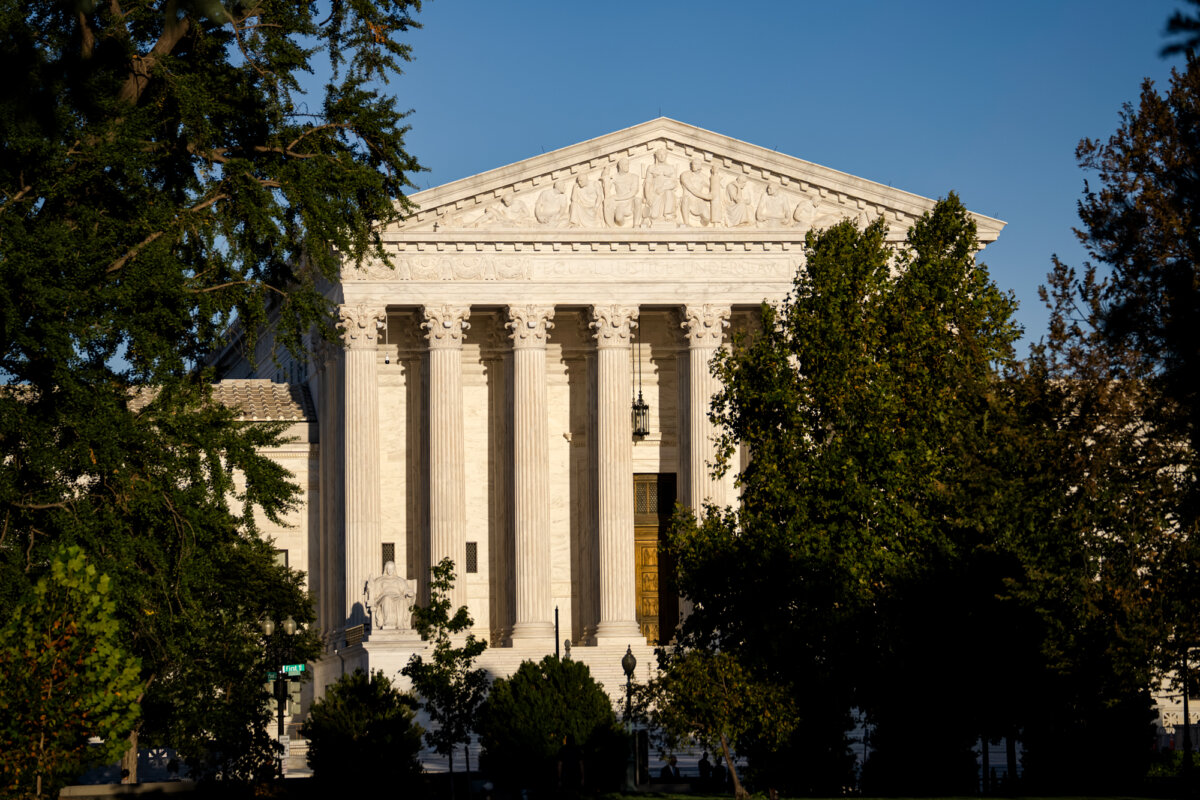

The Supreme Court is back for its 2026–2027 session this week, and will hear cases involving climate change lawsuits, proof-of-citizenship in voting, and more.
Here are some of the top cases to watch:
‘Assault Weapons’ Bans
The justices on Dec. 2 will consider whether Connecticut’s and an Illinois county’s bans on so-called assault weapons violate the Second and 14th Amendments.
Oral argument in the cases, known as Viramontes v. Cook County and Grant v. Higgins, is expected to address whether the laws comply with the Supreme Court’s decision in New York State Rifle and Pistol Association v. Bruen. In that case, the court said gun restrictions must be consistent with how the country historically regulated firearms.
Two federal appeals courts upheld the laws, treating AR-15-style rifles as akin to military weapons that governments historically may prohibit.
Challengers, including activist groups and the Justice Department, say Americans now own an estimated 20 million to 30 million AR-15-style rifles, making them among the most commonly owned long guns in the country.
Catholics Sue Over Colorado Preschool Funding
Catholics are asking the Supreme Court in St. Mary Catholic Parish v. Roy to revisit one of its more controversial principles on religious neutrality.
For years, the Supreme Court has said that state laws can be constitutional even if they incidentally infringe on someone’s religious exercise. In Employment Division v. Smith, the court said that could be the case if the law was “neutral” and “generally applicable.”
What that means has been debated in multiple cases. During oral argument on Nov. 3, the court is expected to consider whether Colorado betrayed this principle with its universal preschool program, which requires recipients to enroll children regardless of race, sexual orientation, and other factors.
Climate-Related Lawsuits
In Suncor Energy v. Commissioners of Boulder County, the Supreme Court considered on Monday whether local governments can use state laws to sue fossil fuel companies over the effects of so-called climate change.
The Colorado City of Boulder and Boulder County alleged that companies such as Suncor and Exxon violated multiple state laws by worsening residents’ lives while knowing about climate-related effects.
Suncor and Exxon told the Supreme Court the case was flawed because it relied on state law surrounding things such as public nuisances and consumer protection. Applying those laws to “climate change” would allow Colorado to step on the federal government’s power to regulate emissions, they argued.
Citizenship Proof in Elections
The Supreme Court on Dec. 8 will consider whether Arizona can require proof of citizenship from voters and remove noncitizens from voter rolls before an election.
The U.S. Court of Appeals for the Ninth Circuit said those two measures conflicted with federal law. More specifically, it pointed to the National Voter Registration Act (NVRA), which directs states to treat its voter registration form as equivalent to a federal mail form.
Rather than requiring proof of citizenship, the federal form merely requires people to attest to their citizenship under penalty of perjury.
Detention and Third-Country Removal
Two immigration cases will test how far the government can go in holding people during removal proceedings and in choosing where to send them once an order is final.
In Rhoney v. Barbosa da Cunha, granted on Oct. 1, the Supreme Court will consider whether the Immigration and Nationality Act requires detention, without a bond hearing, of noncitizens who are present in the United States after entering unlawfully.
Separately, on Dec. 9, the justices will take up Department of Homeland Security v. D.V.D., a challenge to removals to countries never named in the removal order. A federal judge in Massachusetts required written notice and a meaningful chance to raise persecution or torture claims before such a removal. The Fifth Circuit largely agreed.
On Sept. 29, the justices stayed that judgment—over the dissent of Justices Sonia Sotomayor, Elena Kagan, and Ketanji Brown Jackson—and agreed to formally consider the case.
They asked the litigants to address jurisdiction, class-wide relief, and whether the department’s third-country removal guidance violates the Immigration and Nationality Act, due process, or the torture protections.
For more cases and deeper analysis, check out the full story.
—Matthew Vadum, Stacy Robinson, Joseph Lord, Troy Myers, Jeremy Lott, and Sam Dorman
BOOKMARKS
President Donald Trump told reporters on Monday that the U.S. military withdrew long-range bombers from the UK. “We had an idea that there might be a threat,” Trump said.
Government officials pushed back against a Biden-era plan to label parents who protested school policies as “terrorists,” a report revealed on Monday. “Stupid, stupid, stupid,” one attorney said in an email criticizing the plan.
Ukrainian President Volodymyr Zelenskyy said his country will intensify attacks on Russian oil refineries, but will not target civilians. Read all about it in Victoria Friedman’s latest report.
Three scientists have been awarded the 2026 Nobel Prize in Physiology or Medicine for their work in studying the brain. Dr. Karl Deisseroth, an American psychiatrist, and two German biophysicists, Peter Hegemann and Georg Nagel, received the prize on Oct. 5 and will share $1.2 million equally.
A spokesman for the Kremlin has responded to “various rumors and speculation” about reports of a possible outbreak of plague in Siberia. That comes after the death of a laboratory worker at the Anti-Plague Research Institute of Siberia and the Far East.
—Stacy Robinson