
South Korea, in violation of the United Nations Refugee Convention, deported three Falun Gong practitioners back to China this July, where they may face imprisonment and torture. This is the latest in a string of such deportations and is believed to be due to pressure from the Chinese Communist Party (CCP).
Li Xiaoce, the spokesperson for the Global Mission to Rescue Persecuted Falun Gong Practitioners, told The Epoch Times in a phone interview that in the past two years, the South Korean government has forcefully deported a total of 10 Falun Gong practitioners to China on six separate occasions, five of them ethnic Koreans.
“When we told this to the governments and organizations of various countries, they were all shocked and showed great concern. There is not a single country in the world that assists the CCP to this extent,” Li said.
Li said others have asked him if the South Korean government has arranged these deportations out of fear of the Chinese regime. He believes the South Korean government does not act out of fear, but out of a desire to flatter the Chinese regime by assisting it in the persecution of Falun Gong.
When South Korea forcefully deported two Falun Gong practitioners in July 2009, 23 U.S. legislators sent a joint letter to the South Korean government, asking them to not let this happen again. However, four more incidents of deportation followed, with more people deported each time, according to Li.
“The decision by President Lee Myung-bak’s government to deport Falun Gong practitioners has damaged South Korea’s image in the international community,” Li said.
Violating International Law
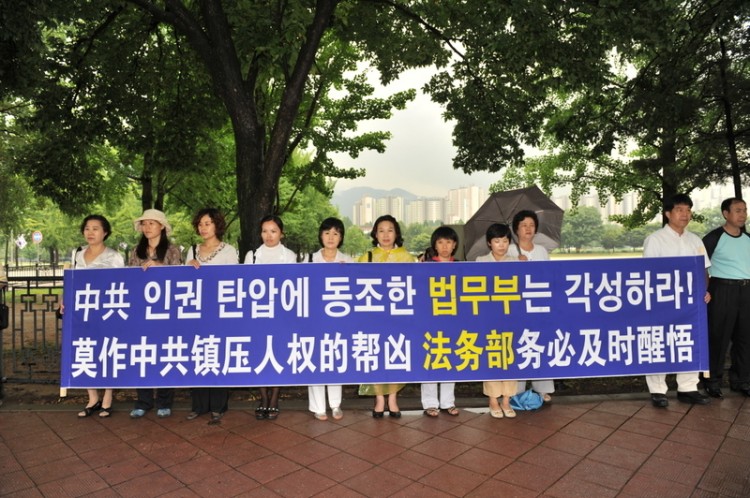
Li supplied transcripts to The Epoch Times from a press conference he organized earlier this year in front of the Korean government building complex in Gwacheon.
Theresa Chu, the Asia director of the American Human Rights Lawyers Association and one of the speakers, said the United Nations clearly states in its Convention against Torture and Other Cruel, Inhuman or Degrading Treatment or Punishment that no country must send someone back to an area where he or she might face torture.
“The torture methods the CCP has used on Falun Gong practitioners are widely known; sending them back [to mainland China] is like murder. South Korea should not commit such an international human rights violation,” Chu said.
David Matas, a renowned international human rights lawyer from Canada said the CCP violates the Refugee Convention and forcefully deports North Korean refugees, but South Korea—a democratic country—also violates the convention by deporting Falun Gong practitioners.
Matas said this is why it’s very important for the South Korean people to oppose the decision to deport Falun Gong refugees.
Also speaking at the press conference was Taiwanese lawyer Kenneth Chiu, who said it is common knowledge that the CCP persecutes Falun Gong practitioners. Chiu addressed the questionable legal basis for the deportations.
Chiu also explained that according to Articles 1 and 33 of the Refugee Convention, people who have been given refugee status can’t be deported, and these two articles also cannot be altered by any individual country. In other words, the South Korean government is in clear violation of the convention.
Chiu pointed out that many Korean legal professionals are of the opinion that, based on the law, the sentences given to Falun Gong refugees are too harsh and very likely due to foreign factors, such as pressure from the CCP.
Chiu also said the South Korean court has violated Article 76, Section 8 of the Immigration Control Act. The article says that those who have not received refugee status, especially those awaiting verification, can be permitted to temporarily stay by approval of the President.
Next…Officials Visits from China