
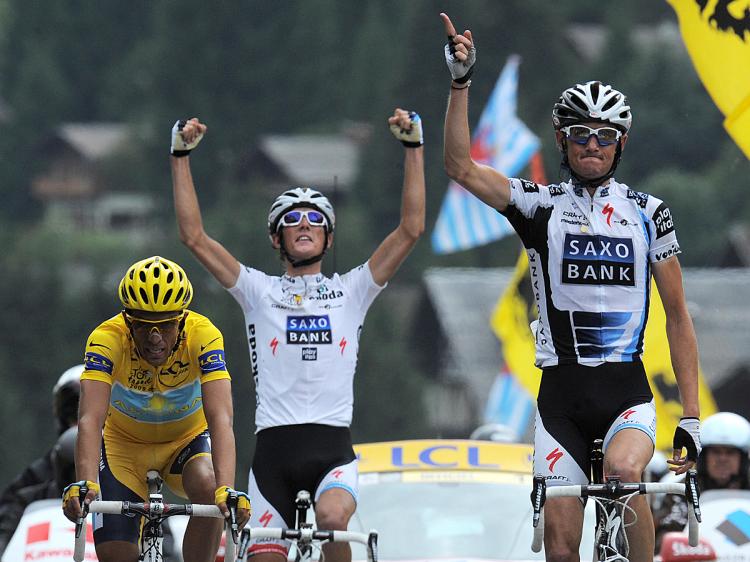
Frank Schleck capped a powerful mountain-climbing performance with a Tour de France stage win, crossing the line just ahead of Alberto Contador and brother Andy Schleck after many miles of all-out combat on the slopes of the French Alps.
Frank and Andy Schleck worked together to control Stage Seventeen of the 2009 Tour de France, attacking repeatedly up the steep climbs. They both rode tremendously, but they could not shake Alberto Contador, who matched their every move.
Lance Armstrong sacrificed his own GC position to guard Garmin rider Bradley Wiggins. Wiggins, a good time trialist, was too close to the leaders in overall time, and Lance opted to lose time himself rather than advance and pull Wiggins along.
When Wiggins finally tired, Armstrong attacked and dropped him, charging down the road to the finish line, gaining back time the whole way.
Alberto Contador kept the yellow jersey; the Schleck brothers moved into second and third. Lance Armstrong fought his way back to finish fourth in the General Classification.
While Armstrong made a personal sacrifice to benefit the team, Alberto Contador sacrificed a team member in an effort to gain personal glory.
Near the top of the final climb, Contador attacked, hoping to cross the peak ahead and coast downhill to a stage victory. However, he couldn’t shake the Schleck brothers. He did succeed in dropping teammate Andréas Klöden, who was in fourth place overall at the time. Klöden is quite good at time trials, as is Lance Armstrong; Contador is the Spanish Time Trial champion. If these three had entered Wednesday’s time trial stage not too far down, Team Astana could well have taken all there podium positions in Paris, something no team has accomplished since 1914.
Teammate Levi Leipheimer, who had to withdraw with a broken wrist after a crash in Stage Twelve, explained Astana’s position at the start of the race; “They have first and second in the classification and Andréas is fourth they want to try to keep that especially with the time trial coming tomorrow and the three of them being great time trialists. All they need to do is stay together as long as possible. They don’t need to be aggressive or try any crazy tactics.”
Contador had no reason to attack; so long as he stayed even with the Schleck brothers, he would lose no time and would keep the yellow jersey. The Schleck brothers were done attacking; they could see that they couldn’t crack Contador. If Contador had been content to follow, and perhaps contest the final sprint, Klöden would have finished second in the overall classification, four minutes ahead of Bradley Wiggins. Because he couldn’t match Contador’s attack, Klöden dropped to fifth overall, just nine seconds ahead of Wiggins.
The Schleck brothers are relatively weak in time trials. Their only hope for improvement comes on the final racing stage, up the slopes of Mont Ventoux on Saturday.
It seems likely that Alberto Contador will win the 2009 Tour de France. He is an amazing climber, and the final stage is steeply uphill. The Schleck brothers will not catch him unless he simply wears out and cracks, which seems unlikely.
Lance Armstrong is not out of the running, but it is very possible that he sacrificed his Tour chances in order to allow Contador to stay ahead. But one can never count Lance out. He has showed he still has the ability to accelerate tremendously, late in a climbing stage. If Contador falters on Mont Ventoux, Lance will be waiting.
Hills Too Steep to Walk Up
Stage Seventeen, 169.5 km from Bourg-Saint-Maurice to Le Grand-Bornand was one of the toughest stages in the Tour. With five categorized climbs, all very steep (and the last two, absolutely ridiculously steep) it is guaranteed that everyone will suffer here. It is probable that all the leaders will attack, and many of the top riders who need to make up time will try to drop the competition with sudden accelerations.
The climbs are short compared to the Cols du St. Bernard—but some are much steeper, with the worst two being the last two. This stage would be decided not by speed, but by suffering; the rider who could hurt himself more, and more often, would drop the others on the climbs and reach the finish line first
Most of the major attacks were predicted for the slopes of the Col de Ronme, an 8.8 km rated at 8.9 percent average incline. Some of the higher-incline ramps on this road would be difficult even to walk up, let alone race a bike over. Astana rider Levi Liepheimer said he had researched the climb, and that in places it had twelve- and thirteen percent grades. “Alberto Contador said it was a hard climb,” he said, “and if Alberto says it’s a hard climb, you know it’s really something special.”
Lance Armstrong predicted that the Col de Romme would be the make-or-break point in the stage.
“I think the Col de Romme is clearly the most dangerous. Right from the get-go, it’s nasty. It’s steep right from the bottom nine k[ilometers], nine percent. Then the combo of that and Colombière, which has a very short descent in the middle, basically amounts to just one big long steep climb
There will be the normal attacks in the beginning up the Roselend and Saisies but the real fireworks will be at the end.”
It was here that the Schleck brothers in particular were expected to make their move.
“I think now everyone has their sights focused on Wiggins because of the TT [time trial] tomorrow,” Armstrong said. “I know the Schlecks are trying to get rid of him, because they are not confident in their TT skills—or not as confident as, certainly he is. They’ll be very, very aggressive today.
Armstrong said he doubted he would ride for the win today (he won a stage here in 2004): “It’ll probably be a break. I expect we’ll let someone go and that’ll hold ‘til the finish.”
Garming rider agreed that his teammate Bradley Wiggins was a serious threat in the time trials. “If we get through today he is going to throttle people tomorrow. I feel bad for people who are starting ahead of him, because it is going to be demoralizing.”
Bad Weather for a Hard Stage
The day dawned cool and drizzly, breaking into intermittent rain about five kilometers in, to add just a bit more to the riders’ misery. The rain made the descents even more dangerous
The race itself started immediately uphill, climbing the 18 km Cat. One Cormet de Roselend right from the starting line.
After a few tentative efforts by Linus Gerdemann, a group of ten riders attacked, opening a minute gap. This group included Franco Pellizotti, Jurgen Ven Den Broek, Denis Menchov, David Zabriskie, Ruben Perez-Moreno, Gorka Verdugo, Jose Luis Arrieta, Sandy Casar, Rémi Pauriol, Rigoberto Uran, Syvlvain Chavanel, Geoffroy Lequatre, Pierre Roland, Maxime Monfort, and Marzio Bruseghin joined before the breakaway got too far ahead. Egoi Martinez, Amets Txurruka, and Christophe Kern tried to bridge across.
Then Thomas Voeckler and Thor Hushovd (!) attacked the peloton. Thor Hushovd is known as one of the best descenders in the bicycling world, but he is a sprinter, not a climber. The story is, that Team Columbia sprinter Mark Cavendish, who lost the green jersey when he was penalized for blocking in Stage Fourteen, gave a newspaper interview saying Hushovd never really won the jersey and didn’t deserve it.
While the referee’s call at the end of Stage Fourteen was questionable, the wisdom of such an interview was even more so. Hushovd used the interview as motivation to capture intermediate sprint points along the stage, increasing his lead over Cavendish and showing himself to be a better all-around bike racer, as well as a powerful sprinter.
Hushovd went right past the escapees and took the lead in the race, trying to gain an advantage over the climb so he could be at the front for the intermediate sprints. Pellizotta, Kern, and Chavanel chased after him.
Back in the peloton, Saxo Bank took control, raising the pace to put pressure on the other riders. As Astana had been doing in previous stages, Saxo Bank wanted to raise the pace high enough to exhaust any weaker riders and impede any attacks, so that when their leaders decided to go, they would have an easier time of it.
Hushovd had a one minute lead over the chase group at the peak of the Col des Saisies, the second climb of the day. This was perhaps the most humorous moment of the race: a world-class sprinter winning top points in the “King of the Mountains” competition. The peloton was another four minutes behind that.
Heavy rain hit the roads just before the riders came through on the descent down the Col des Saisies road, leaving the surface extremely slick.
Hushovd nearly crashed on this part of the descent, but survived through excellent bike-handling and amazing luck, turning only a few inches from the guard rail.
Denis Menchov did crash over this section of road, bringing down Amets Txurruka. Both riders were able to proceed, though Txurrukla was considerably slowed. Menchov crashed again shortly thereafter.
Hushovd was taking extreme chances on the descent, opening the gap to two minutes over the chase group of Franco Pellizotti, Jurgen Ven Den Broek, Denis Menchov, David Zabriskie, Egoi Martinez, Ruben Perez-Moreno, Gorka Verdugo, George Hincapie Maxime Monfort, Jose Luis Arrieta, Sandy Casar, Rigoberto Uran, Christophe Kern, Rémi Pauriol, Marzio Bruseghin, Thomas Voeckler, Syvlvain Chavanel, Pierre Roland, Carlos Barredo, and Linus Gerdemann.
At the base of the third climb, the Cat. Two Côte d'Araches, the peloton was six minutes behind Thor Hushovd.
Hard Sparring on the Col de Rommes
Thor Hushovd’s amazing run casme to an end at the base of the Col de Rommes as Carlos Barredo rode him down and passed him. Hushovd didn’t care; he was smiling broadly as rider after rider passed him; he had won the green jersey, and showed his skill. He was happy. Jurgen Van Den Broek then joined Barredo in the stage lead. Barredo couldn’t match his pace. Van Den Broek surged ahead.
Sastre made the first attack at the start of the Col de Rommes. Thomas Voeckler joined him. but the Schlecks kept pace high and kept them close and soon rode them down.
Frank Schleck attacked with Armstrong right on his wheel, Contador them followed then Andy Shcleck attacked with Contador and Rigoberto Uran following him
The race leaders passed through the chase group; the riders who gambled on escaping had underestimated the Col de Rommes.
Armstrong and Wiggins charged back to to the lead group. Now all the best riders were climbing together.
Andy Schleck attacked yet again Contador and Klöden stayed right on him; Rigoberto Uran stayed briefly, then dropped.
Armstrong slowed for a moment and weaved a bit; Wiggins almost hit him. While they were sorting themselves out, Frank Schleck kicked, pushing on to join his brother. Wiggins and Armstrong didn’t respond.
Now it was the two Schleck brothers, Contador and Klöden. Twenty seconds back, Armstrong stayed on Wiggins, looking very relaxed. Christian Vande Velde pulled himself up to his teammate Wiggins, followed by Vincenzo Nibali.
Armstrong attacked, with Wiggins on his wheel. This dropped Vande Velde and Nibali.
Armstrong didn’t want to bring Wiggins with him, because he didn’t want Wiggins to stay high in the GC. Wiggins then realized he needed to pick up the pace, and started working to close the gap. However, Wiggins couldn’t keep the pace. This allowed Vande Velde and Nibali to rejoin.
Up front, the Schlecks were unable to crack Contador. Contador and Klöden seemed to be riding easily, while the Schlecks were working hard.
Fight Continues up the Columbière
The final climb up the Col de Columbière started with three kilometers at five percent grade, with the final five kilometers kicking up to ten percent. The Astana riders let the Saxo Bank riders do all the work, content to ride the wheels of the Schlecks. What all the leaders wanted, was to drop Wigginss, so he did not have a chance to catch them in the time trial. Armstrong looked eager to attack, but seemed to be writing for the steep road, so he could drop Wiggins. Vande Velde fell off, unable to keep the pace.
Contador and Klödens might have been waiting for a chance to attack also, knowing the Schlecks were doing all the work.
Halfway up the climb, Andy Schleck picked up the pace; Contador and Klödens answered easily.
Two kilometers from the summit, Contador attacked. The Schlecks managed to catch him, but Klöden fell off; this was not the best move for Contador to have made at that time. Contador’s desire to win a stage, hurt his team’s chances, and also cost himself aid on the descent.
Contador kept looking over his shoulder, realizing he had made a mistake but unable to fix it. Contador apparently did not have another attack in him, so his effort served nothing but to hurt the team.
When the road got really steep, Armstrong attacked. Wiggins couldn’t answer; neither could Nibali. Armstrong showed how a real team rider rides to help his teammates as well as himself. Armstrong knew Astana could have all there podium places in Paris if they rode wisely.
Armstrong was riding effortlessly. He crested the peak and took off quickly into the fast, technical descent to the finish.
Vincenzo Nibali managed to catch Armstrong on the descent, but Wiggins was lost.
The Schleck brothers and Contador rode to the finish together. Contador didn’t contest the sprint, content to keep close with the Schlecks so as not to lose any time.
Frank Schleck crossed the line first, winning the stage. But what mattered was that the leaders finished three minutes ahead of Bradley Wiggins, creating a buffer going into tomorrow’s time trial.
Armstrong and Nibali caught Klöden; the three finished together, with Nibali outsprinting Armstrong by a few inches, and Klöden a few seconds behind.
Shake-Up in the General Classification
Alberto Contador retained the yellow jersey, but the two Schleck brothers moved into second and third. Lance Armstrong dropped to fourth, and Andréas Klöden to fifth.
Armstrogn and Contador are better time trialists than the Schleck brothers; if Armstrong can make up a minute and a half, he can retake second place. If Klöden can manage the same advantage, Astana could have a fair shot at sweeping the Tour in Paris.
|
Stage 17 Results |
|
General Classification After Stage 17 |
||||||||
|
|
Rider |
Team |
Time |
Gap |
|
Rider |
Team |
Time |
Gap |
|
|
1 |
Frank Schleck |
Saxo Bank |
4:53:54 |
|
1 |
Alberto Contador |
Astana |
72:27:09 |
|
|
|
2 |
Alberto Contador |
Astana |
4:53:54 |
2 |
Andy Schleck |
Saxo Bank |
72:29:35 |
+2:26 |
||
|
3 |
Andy Schleck |
Saxo Bank |
4:53:54 |
3 |
Frank Schleck |
Saxo Bank |
72:30:34 |
+3:25 |
||
|
4 |
Vincenzo Nibali |
Liquigas |
4:56:12 |
+2:18 |
4 |
Lance Armstrong |
Astana |
72:31:04 |
+3:55 |
|
|
5 |
Lance Armstrong |
Astana |
4:56:21 |
+2:18 |
5 |
Andréas Klöden |
Astana |
72:31:53 |
+4:44 |
|
|
6 |
Andréas Klöden |
Astana |
4:56:21 |
+2:27 |
6 |
Bradley Wiggins |
Garmin |
72:32:02 |
+4:53 |
|