
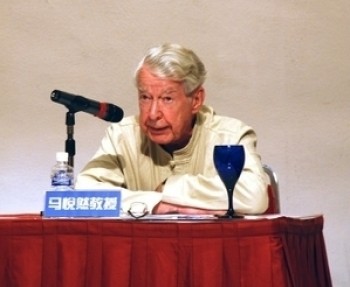
Malmqvist and his Taiwanese wife Chen Wenfun railed against a triumvirate of forces: the author, the professor, and the Chinese media as a whole. In letters to two Chinese heavyweights in mid-May he called Zhang Yiyi a “little liar”; he deemed the actions of the highly-regarded Tsinghua University professor of journalism and communications Li Xiguang as “contemptible”; and he saved his sharpest jabs for China’s media culture, one that he says makes up fake news, toes the Party line at the expense of truthfulness, and lacks ethical standards.
After all was said and done Malmqvist, a member the Swedish Academy and a prolific scholar, announced on May 19 that he was severing his relationship with Chinese officialdom in all its guises, including the Chinese Embassy in Stockholm. He made the decision to burn those bridges, he wrote, after discovering that state-run Chinese websites had done so much to propagate the bribery myth, presumably in an attempt to defame him as payback for his support for inconvenient Chinese artists and dissidents.
Storm in a Teacup
For an accusation that has been disseminated extensively across the Chinese-language Internet, the rumor had modest beginnings.
It started with the idiosyncratic author Zhang Yiyi in April. The now-deleted microblog post Zhang had written on Sina Weibo claimed that Malmqvist had accepted a $600,000 bribe in return for the translation of a few of his works and consideration for the Nobel Literature Prize.
Zhang is known for his outlandish remarks: he had previously mused about undergoing surgery to look like the English playwright William Shakespeare, and claimed to have proposed marriage to Chinese A-lister Li Xiang. One recent post on his blog suggests canceling the traditional Dragon Boat Festival; another notes that he is suing Malmqvist for 1.8 billion yuan ($278 million) because the Swede had called him a “liar.”
But state media were happy to reprint his bribery claims. The ruling Communist Party that controls these outlets has developed a loathing of Nobel Prizes and their judges over the years; charges of corruption against Malmqvist fit the official agenda neatly.
A senior judge for the Nobel Literature Prize, Malmquist had unceasingly lobbied for the award to go to Chinese-French novelist and playwright Gao Xingjian (who has been deemed persona non grata by Chinese authorities and whose works are banned in the mainland) until he became the first Chinese to win the Nobel Literature Prize in 2000. Beijing has similarly been rankled by the awarding of the Nobel Peace Prize to the Dalai Lama in 1989, and more recently to Chinese literary critic and human rights activist Liu Xiaobo in 2010.
Malmqvist also joins democracy protesters every June 4 in front of the Chinese embassy in Stockholm, to commemorate the 1989 Beijing massacre.
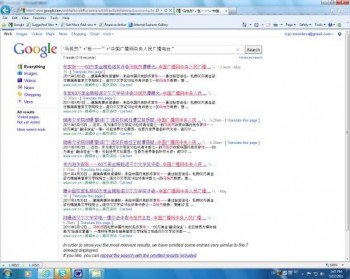
An April 30 CNR story, as syndicated on the news section of Sina.com, China’s largest web portal, first recited the Malmqvist bribery rumor, vaguely sourced to “Swedish media reports.”
“Swedish Academy Exposed of ‘Translation-Gate,’ Nobel Prize’s Authority Now in Doubt,” a headline from another CNR article, reposted on Sina, trumpeted on May 15. The report asserted that the incident “shocked the international literary community and ignited an uproar in the Western world,” while “foreign media urged Malmqvist to resign from his position as Nobel judge.”
Malmqvist’s wife Chen Wenfun told the Chinese newspaper Southern Metropolis Daily in a later interview that the reports had no solid sources for the bribery accusation and were grasping at straws.
“Those Chinese websites all claimed that ‘Western media have reported this news,’ yet none of them were able to provide the name or the link to a foreign media outlet as reference,” Chen said.
The Epoch Times was unable to find the reports about the bribery alleged by CNR in either Swedish or English; both CNR articles were removed from the website but are still visible on aggregators.
The news, which quickly traveled to the Chinese-speaking community overseas, also drew doubts from an acquaintance of Malmqvist, the secretary-general of the Swedish Independent Chinese PEN Center, where Malmqvist serves as an honorary director.
PEN Center’s Zhang Yu, a distinguished Chinese writer, wrote in an opinion article published in the Chinese edition of The Epoch Times that Malmqvist takes the initiative to translate works that meet Nobel standards, as he did for Gao.
“I have never heard of him collecting money from the authors for translating their works,” Zhang wrote on May 18.
After conducting Internet research Zhang also said that he could not find any of the “Western media reports” cited by CNR. But he discovered seven articles on the supposed bribery published by CNR and widely republished by other Chinese news sites between April 30 and May 15. Many of these were later taken down.
Continued on the next page: Rumor finally went viral







