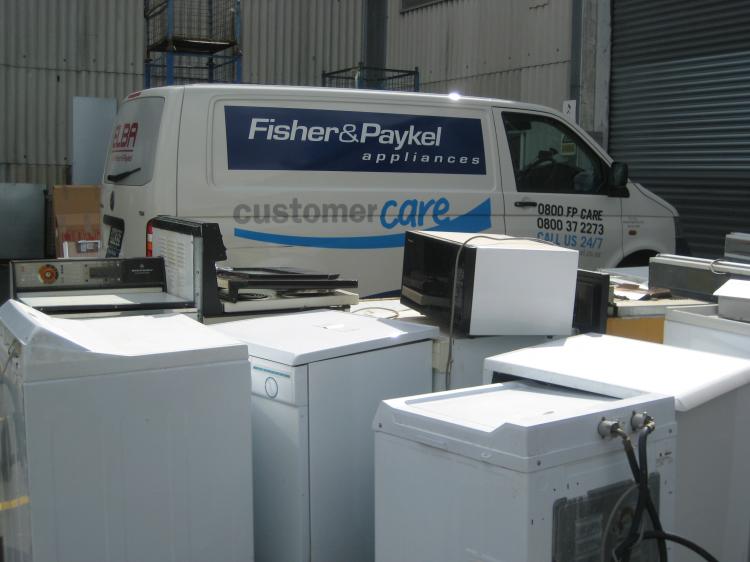
While some trade exhibitors were arguing the merits of "butter conditioners," senior executives from Fisher & Paykel were taking notes on designing products for ease of disassembly, recyclable content and energy efficiency, said George Gray, Fisher & Paykel Recycling Manager.
An average of 30,000 appliances each year end up in the disassembly plant in East Tamaki.
Fridges are degassed and plastic, glass, steel, aluminum and copper are stripped out and recycled.
About 70 percent of a refrigerator's weight is recyclable compared to 95 percent of a stove's weight.
With a "cradle to grave" policy, Fisher & Paykel is not only recycling trade-ins from its own product sales, but they have a free drop-off service for fridges, washing machines, freezers, stoves, dishwashers and microwaves from local residents.
Fisher & Paykel have teamed up with ECCA (Energy Efficiency and Conservation Authority) to encourage people in the Auckland, Wellington and Christchurch areas to turn in fridges or freezers that are over 10 years old, with ECCA picking up the cost.
“That is another incentive … to get a lot of those old machines off the power grid sucking up all the power.”
Occasionally the plant takes in an "antique" appliance whose final resting place will be the company's museum.
“A 1949 Chamberson fridge … manufactured in New Zealand, came in still working,” said Mr. Gray.
“(At) 20 degrees it was using 181 percent more power than a current fridge, and it was worse as you turned the outside temperature up.”
A 1940's A.E. Gala Limited washing machine brought out from England by its owner was dropped at the plant and was promptly carried off to the Fisher & Paykel museum.
The buzz word at Fisher & Paykel is energy efficiency, says Mr. Gray. The designers go through the disassembled appliances in the recycling yard looking for clues to build more efficient appliances. The staff are always hunting for new ways of improving the grounds and the work environment.
“We send all our in-house computers to Sims E–Recycling to be disposed of in an environmental way. Compact fluorescent lights from within the F&P plant containing mercury are sent to Interwaste for recycling.”
Mr. Gray thinks that being raised in the Shetland Islands taught him to be energy wise-over there you made do with what you had because there were no shops, he said.