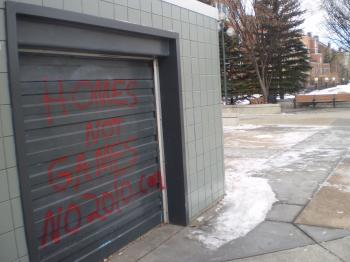
Just as with other big events like G8 summits and WTO conferences, the 2010 Winter Olympics has become a rallying point for social activist groups who are planning a five-day “convergence” in Vancouver for the occasion.
The wide range of activists including anti-poverty, First Nations, labour, environmental, and anti-war groups will gather to protest what they see as the corporate greed of the Olympic movement as well as globalization and capitalism.
Chris Shaw, a neurological researcher at the University of British Columbia and a member of the Olympic Resistance Network (ORN), a coalition of activist groups, has opposed the Games since Vancouver’s bid was in its early stages.
A street medic who is a reservist with the Canadian Forces, Shaw is a spokesman for the Olympics watchdog 2010watch.com and author of the 2008 book “Five Ring Circus: Myths and Realities of the Olympic Games.”
“The Olympics is one more aspect of multinational control where this foreign entity comes into your town and starts telling you how to run your life and making your government do it, and quite frankly a lot of people don't appreciate that,” he says.
Critics claim the Olympics are largely a scheme to enrich developers while threatening equality and justice by exacerbating poverty, curtailing civil liberties, and driving up taxes. Activists are also protesting the fact that the Games are being held on unceded land that rightly belongs to local First Nations.
Shaw says if issues such as aboriginal treaties and poverty had been addressed—“if we didn’t have 3,000 homeless living on our streets”—such a broad range of groups likely wouldn’t be preparing to protest.
The extensive traffic restrictions alone, he says, will have a detrimental effect on local businesses.
“We're looking at massive traffic closures and if you run a small business you're just utterly screwed if you're not downtown. So no one can get to you, no one can park in front of you, no one can even necessarily bike to you. So a lot of businesses are going to take a massive hit.”
Millions in investments
Opponents argue the B.C. government shouldn’t be spending millions on the Games, which begin on Feb. 12, while at the same time making significant cutbacks on social spending. Vancouver’s Downtown Eastside is the poorest postal code in Canada, while British Columbia has the highest poverty rate in the country.
But Olympics organizers say the sporting event will benefit the poor and local businesses through redevelopment and other economic spinoffs.
“We're going to have the attention of the world here for this period of time and I think it's forced Vancouver to look at itself critically,” says Vancouver city councillor Geoff Meggs, a supporter of the Games.
Meggs says that although the “big corporate presence” that is part and parcel of the Games has attracted some criticism, Vancouver stands to reap a number of benefits.
These include an increase in tourism and a focus by Olympics organizer VANOC on environmentalism and sustainability. There was also an effort to lessen the social impact, he says.