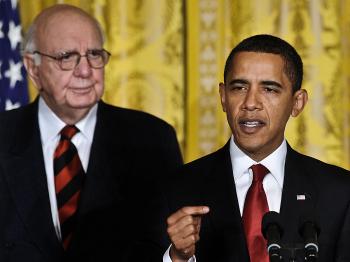


The committee, called the Economic Recovery Advisory Board, will meet periodically and seeks to provide the Obama administration with independent advice and observations on how to proceed with the spiraling recession.
Volcker led the Fed from 1979 to 1987, during the Jimmy Carter and Ronald Reagan administrations.
Other board members named by President Obama include Austan Goolsbee, a professor at the University of Chicago, William Donaldson, Chairman of the SEC, Jeffrey Immelt, CEO of General Electric, Jim Owens, CEO of Caterpillar, among other experts from business and academia.
The board’s formation underscores a need for independent and fresh economic policies as the United States grapples with a deepening recession and mounting job losses.
The Bush administration and former Treasury Secretary Henry Paulson Jr. devised a $700 billion troubled asset relief program (TARP) that has already poured billions into struggling banks. $350 billion of the funds remain at the disposal of President Obama’s team.
The U.S. Senate is currently working to approve a new economic stimulus and spending package that also aims to stimulate economic growth and investment. Partisan differences have hindered the passage of the bill, but Senate leadership and the President are hopeful that the bill will pass.
Taxpayers Shortchanged?
In a new report analyzing rollout of the TARP program, the Congressional Oversight Panel (COP) claimed that the U.S. Treasury Department under former Sec. Paulson overpaid for financial assets from banks by about $78 billion.
Released last Friday, the report, entitled Valuing Treasury Acquisitions, concludes that “Treasury paid substantially more for the assets it purchased under the TARP than the market value of those assets at the time the deal was announced,” according to a COP statement.
The Treasury paid $254 billion for financial assets worth only $176 billion, the report concluded.
“Last fall, Treasury sold the American public on the TARP program by claiming that it would help banks while protecting taxpayers. Secretary Paulson described the transactions as ‘at or near par’—that the value the assets Treasury received was roughly equal to the money being spent,” Elizabeth Warren, the Chair of the COP, said in a statement. “But that didn’t happen. Treasury got less than it spent.”
“It’s time to explain what’s happened so that we can have a good, old-fashioned debate about whether this is the smartest way to spend our money,” she concluded.
The report said that the Treasury department may have had valid reasons to make its purchases at the prices paid. The value of these financial assets may eventually far exceed the prices paid or may decline to become worthless, COP said.
The new economic advisory board may advise the Obama administration on how to spend the remaining $350 billion in TARP funds.
Payroll Tumbled in January
A separate report last week showed that the U.S. employment rate rose to 7.6 percent, the highest since 1992, and companies eliminated a combined 598,000 jobs, the largest decline since December 1974.
The job losses came from all industry sectors—including banking, retail, media, and manufacturing—as businesses scale back activity and consumers scale back spending. U.S. factories trimmed 207,000 positions last month.
Analysts believe that millions more may lose their jobs before we see signs of recovery.
On a conference call with analysts, Macy’s Inc. CEO Terry Lundgren said, “This is a time when nothing should be considered a sacred cow.”
Macy’s slashed 7,000 jobs last week.