
The purpose is to remove the motivation for non-nuclear countries to seek nuclear arms and prevent nuclear material from falling into the hands of terrorist organizations. Under the new policy, even a biological attack against America would not trigger nuclear retaliation.
“The United States is declaring that we will not use or threaten to use nuclear weapons against non-nuclear weapons states that are party to the Nuclear Non-Proliferation Treaty and in compliance with their nuclear nonproliferation obligations,” said President Obama about the change in policy in an official White House statement released on April 6.
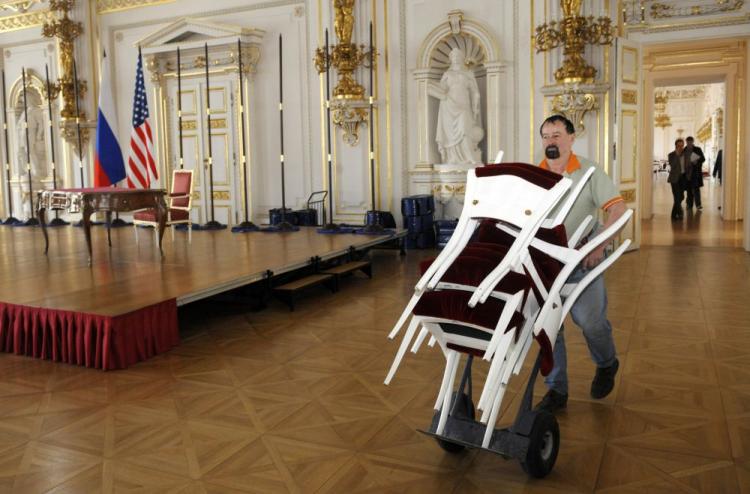
The new policy will be formalized when he signs a new Strategic Arms Reduction Treaty (START) with Russian President Medvedev on April 8 in Prague.
Obama announced the impending policy change during a press briefing late last month, calling it “the most comprehensive arms control agreement in nearly two decades.”
The new pact will replace the START-1 treaty that Presidents George H. W. Bush and Mikhail Gorbachev signed in 1991. It expired in December 2009 amidst public promises from both countries to make big reductions in their nuclear arsenals.
After returning to the United States, Obama’s administration will focus on working with 46 other countries to secure any vulnerable nuclear material over the next four years for what has been dubbed the Nuclear Security Summit.
On April 12 and 13, the United States will host 46 countries for the Summit at the Washington Convention Center in Washington, D.C.
As part of the summit, Obama also plans to host a number of bilateral meetings with leaders from Armenia, China, Germany, India, Jordan, Malaysia, Pakistan, South Africa, and Kazakhstan.
One leader notably absent will be the U.K.’s Prime Minister Gordon Brown, since a general election has just been called there.
During a White House press briefing on Tuesday, Press Secretary Robert Gibbs discussed the treaty and next week’s summit.
“This has always been—and the president believes always should be—a bipartisan issue,” said Gibbs, who added that the president came to the issue largely through friendships with several influential people, including Sen. Dick Lugar, the most senior Republican member of the Senate, former Secretaries of State George Shultz and Henry Kissinger, former Secretary of Defense William Perry, and former Sen. Sam Nunn.
“I think the president hopes that Democrats and Republicans can work together to reduce the threat of nuclear weapons and ratify this treaty this year with the type of majorities that we’ve seen done so in the past,” added Gibbs.