

NEW YORK—Gov. Andrew Cuomo ratified the Power NY Act on Aug. 4, uniting energy companies and environmental justice advocates alike in support of what’s being hailed as a historic shift to renewable energy.
Following quickly on the heels of the Power NY Act, New York Independent Systems Operator (NYISO), the nonprofit responsible for managing the state’s energy flow, joined Sen. Charles Schumer on Monday to announce plans for a $74 million statewide Smart Grid initiative.
Smart Grid refers to the use of cutting edge technology to reduce wasteful loss of energy as it flows through the sprawling power grid. The technology serves a variety of purposes, including managing the mass of data from a tangled network of power points to make better distribution decisions.
Between these two recent measures, energy waste will be greatly reduced in the state and incentives to use renewable energy will have more residents and business owners washing their hands with water from solar-thermal tanks, running their heat on hydroelectric power, or tapping wind energy, fuel cells, and anaerobic digestion to power their many devices.
“New York State has a goal of generating 30 percent of our energy from renewable energy sources by the year 2015, and the state is on target to meeting that goal,” reports Dayle Zatlin of the New York State Energy Research and Development Authority (NYSERDA).
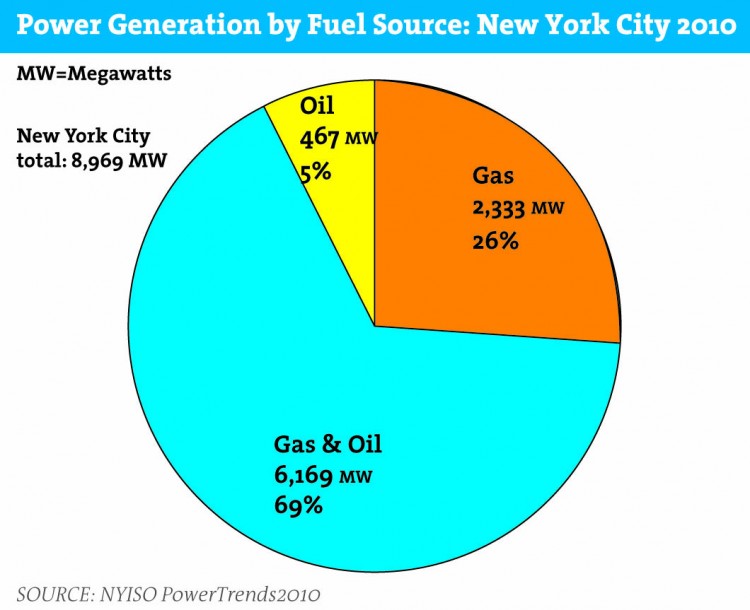
In 2003, Article X pertaining to power plant siting laws expired, leaving New York without siting legislation and without the means to build either nonrenewable or renewable energy facilities.
The new law creates a state oversight board specifically for siting facilities, rather than leaving the process up to various local authorities, as pre-2003 legislation did. By streamlining the process, plants can get up and running more quickly.
“It condenses the time frame, but I think it raises the bar of making a case of why you need to build a plant and why it serves a public need,” said Jackson Morris of the Pace University Climate and Energy Center, in a taped interview with City Hall News in June when the bill passed the Senate.
“The new law encourages investments in clean power plants and affords communities more opportunities to meaningfully participate in the siting process,” reports the governor’s office.
The Power NY Act requires the Department of Environmental Conservation to regulate carbon dioxide emissions from plants. With this measure, New York joins only a few other trailblazing states with such requirements.
Bringing it Home
As renewable energy finds a firmer foothold in the facilities that power the state, incentives to implement it at the home and business level are helping weave a network of sustainable power.
Power NY includes “on-bill” legislation, which provides low-interest loans for energy efficiency improvements in homes and businesses. The loans are paid off in installments on the monthly electric bill.
The loans have an interest rate of 3.4 percent to 3.99 percent and are made more accessible by allowing for a higher debt-income ratio if the applicant can demonstrate regular utility and mortgage payments.
The most common improvement, says Zatlin, is installing better insulation. Projects like this performed on a large scale could give a substantial boost to the green jobs market.
The loans add to a list of other incentives in place from NYSERDA. To promote the use of solar panels, New Yorkers receive a 30 percent federal tax credit and a 25 percent state credit up to $5,000 to defray installation costs.
Next…NYSERDA hands out $2 million a month in incentives for solar panel installation






