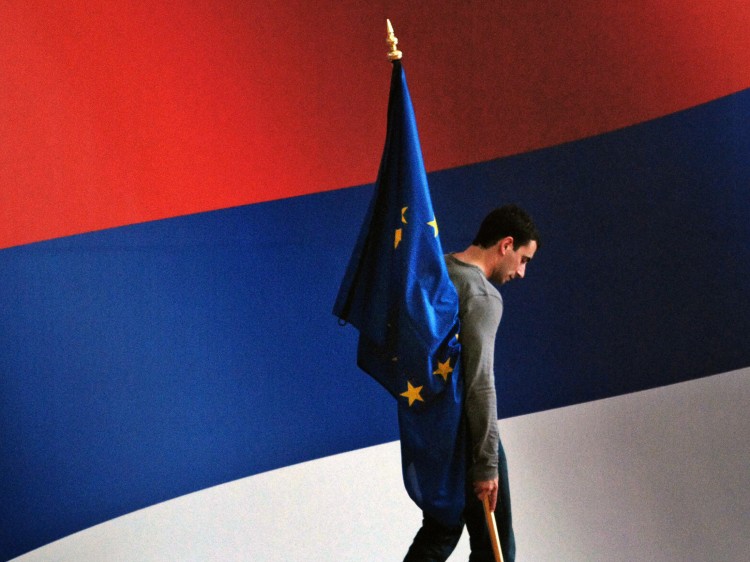

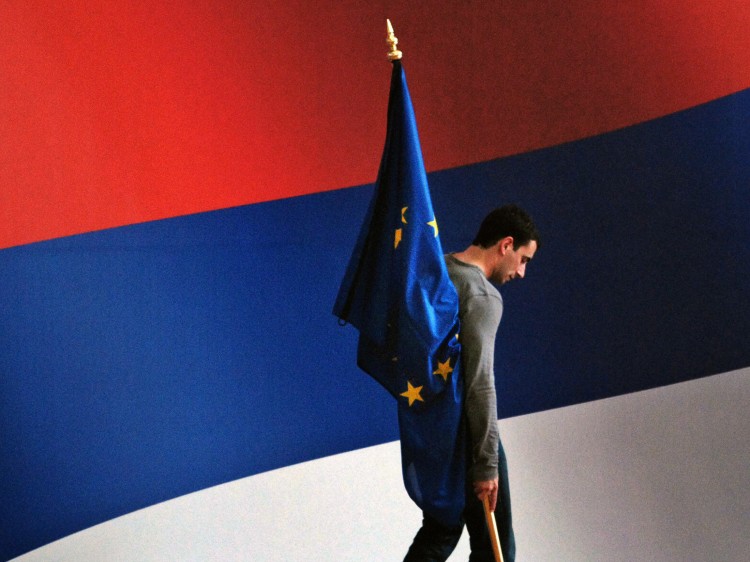
Almost unnoticed at last week’s European Union summit—dominated as it was by the eurozone crisis—Croatia and the EU signed a Treaty of Accession, paving the way for the union’s 28th member to join in July 2013.
At the same time, Serbia was given the disappointing message that its hoped-for candidate status will not be decided upon until February 2012.
The difference between the two western Balkan states highlights the issue of who can and who cannot join the EU “club,” and on what grounds, officially and unofficially.
The short of it is that to enter the EU, history, culture, and geography matter—and political reality does not always match up with the union’s inclusive rhetoric.
Expansion Fatigue
In the swirling storm of the eurozone crisis and the public displays of division within its ranks, the idea of enlarging the union has suddenly become less palatable for many member countries.
“There is an issue of ‘enlargement fatigue,’ although it is hard to quantify,” said Desmond Dinan, professor of public policy at George Mason University in Arlington, Va. Irish-born Dinan is a long-time expert observer of the EU and a former adviser to the European Commission in Brussels.
The idea that any European country that wants to should join is a product of the Cold War, Dinan said. Back then, the European Economic Community (the predecessor of the EU) held out its promise to the Eastern European countries behind the Iron Curtain and shrouded it in lofty pan-European rhetoric.
Today, the reality is less romantic. Apart from the economic crisis, the union is becoming large and unruly, with huge differences between richer and poorer countries. Many think the 2007 enlargement, which included Bulgaria and Romania, was premature and are reluctant to include economically weak and potentially politically unstable countries.
The public row within the EU “heartland” lately, with Britain becoming increasingly obstinate and Euroskeptic, has also made many people think about the implications of further enlargement, Dinan noted.
Gordana Delic, director of the Balkan Trust for Democracy of the German Marshall Fund of the United States, went even further in her description of the mood within the EU toward enlargement. “It used to be a positive thing—’unification’ and something that increased the EU’s leverage in the world—but now it is seen as a burden,” she said. “Accepting Croatia into the union was seen as an unpleasant, but necessary duty.”
The Prospects
Of the nine countries currently considered candidates or potential candidates for the EU membership, seven are found in the Western Balkans. Croatia is acceding; Macedonia and Montenegro are “candidate countries”; and Serbia, Bosnia and Herzegovina, Albania, and Kosovo are “potential candidates.” Of the potentials, however, Serbia is seen as the only “real” candidate at the moment.
Delic, who is a Serbo-Croatian, finds the EU’s attitude toward the Balkans disappointing. The EU should be interested in making sure that Russia and China do not strengthen their position in its backyard, which may happen if the accession procedure drags on or seems hopeless, she argues.
Yet there is a lingering stigma on the Balkans that they are unstable. Those Balkan states that have succeeded in getting accepted—Slovenia in 2007 and newly approved Croatia—have done so by working hard to distance themselves from that Balkan image, said Dinan.
Geographically, the two countries are on the outskirts, with Slovenia having a strong connection to Austria. But Serbia and Montenegro, situated in the heart of the Balkan region, can’t adopt this strategy very well.
Nevertheless, both experts believe that the Western Balkans will continue in their European endeavors. “What else can we do?” asked Delic. “We are surrounded by the EU, and we have to deal with EU standards in everything we do.”
Both experts also predict a prolonged accession process. For Macedonia and Montenegro, problems mainly lie within the framework of the official economic and political criteria. For Serbia, one of the biggest barriers is Kosovo.
Serbian Dilemma
The main reason Serbia’s candidacy status was postponed is the country’s alleged involvement, or lack of cooperation, in the current unrest in the northern part of Kosovo.
In the long term, however, the whole issue of Serbia accepting Kosovo’s independence may be a serious stumbling block. Serbia still considers Kosovo part of its territory, and even among the most EU-friendly Serbs, this is an extremely sensitive and emotional topic.
Whether the issue of recognizing Kosovo’s independence is an official or unofficial criterion is also unclear. While some member states think it is a must, others—such as Greece, Spain, and Slovakia—do not even recognize Kosovo themselves. The issue was only broached “orally” at the summit, noted Delic, indicating its complicated status.
Dinan thinks that Serbia, although not yet an official candidate, has good chances of becoming a member eventually. Apart from the fact that most Serbs want this, most of the EU wants it, too.
There is an interesting analogy between Serbia’s role in the Balkans and post WWII-Germany, Dinan pointed out. The key to peace in Europe following World War II, it was understood, was a resolution of the German issue. Integration into Europe was seen as an essential part of Germany’s rehabilitation. Germany also agreed, accepting its responsibility for the war. Today, the key to peace in the Balkan region is an integration of Serbia and its neighbors into the EU.
Nonetheless, Dinan highlighted that Serbia is still very nationalistic and its thinking is not totally inline with the EU club.
“The Serbs still don’t get it,” he said. “They still don’t understand that the EU is more than an organization of rules and regulations and conditionality. There is an ethos of European integration, which requires countries to look differently at their past, accept responsibility, and be willing to move beyond.”
Delic, however, says many Serbs find this view unfair, because they feel they have already taken responsibility for the conflict.
“I think Serbia has done a tremendous lot,” she said. “President Tadic has apologized to all involved countries. Many of the reconciliation projects originate from Serbia and are supported by Serbia. There is a genuine need to reconcile for the people of Serbia. It’s not forced; it’s natural. We have extradited all the war criminals. How can anyone say we haven’t done enough?”