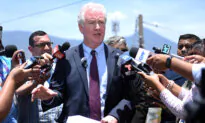
A diverse group of city and federal officials, press and visitors, veterans and civilians, supporters and recipients, had assembled for the grand opening of the new six-story, 56-unit affordable housing development for veterans who are homeless or at risk of homelessness. It is the first veterans’ residence of its kind in New York in 17 years. That was the official story.
However, the latest marvel in the Jericho Project Veterans Initiative turned out to be a series of stories about the people involved, and the lives touched by what Fordham Village Program Director Louis Burns called an “audacious goal, the goal to end veterans’ homelessness.”
The event was at once solemn and celebratory. There were honored guests whose support and contributions were publicly recognized and honors for those who had pledged and lost their lives defending the nation. It was a perfect advent to the upcoming Memorial Day weekend.
The Jericho Project and the Veterans Initiative
The Jericho Project started out in 1983 as a soup kitchen in a church basement on the Upper West Side. The mission was to end homelessness at its roots. The strategy was to create a community that inspired individual change, fostered sustainable independence, and motivated homeless men and women to reach their greatest potential. All that is eloquently presented in Jericho Project’s history on their website.
A story within the story for the day was that of Tori Lyon, executive director, of the Jericho Project since 2005. She had barely gotten through the first paragraph of her welcoming statement and it was obvious she was visibly moved by the proceedings and the assemblage. The Veterans Initiative was her “child.”
“In 2003 while I was attending a conference on homelessness, I was shocked by the statistics for veterans in the larger picture of the homeless population,” she said. There was a Veterans Affairs (VA) representative at this conference and she asked if the VA wasn’t doing something about it. She was told the VA’s mission didn’t include residential help, that it mainly provides clinical services.
She felt strongly that the government should take care of the troops; however, if they did not, the community would provide. In 2006, she shared her vision and, with federal and local support, Jericho Project’s Veterans Initiative was born.
The Mission Comes First

In his official capacity he spoke of the importance of public-private partnerships in the community that make organizations like Jericho Project and its Veterans Initiative successful. He introduced a member of his staff, a Navy lieutenant commander, citing how the power of an adoptive U.S. service member family and a supportive community facilitated her greater potential from her humble beginnings as a Vietnamese orphan.
“The mission comes first,” he said, introducing the uninitiated to the warrior code. He gravely relayed the story of a veteran that gave his life so that the colonel could be before us that day, because the mission came first. The colonel had pledged his commitment to caring for the soldier’s family as repayment for this sacrifice, a commitment echoed in the initiative.
“We stumble, but don’t fall,” he said. Jericho Project’s Veterans Initiative offers that supportive shoulder. With that in mind, Col. Sutherland encouraged a call to action, increased public awareness, and a commitment to community service.
“The government can’t do this,” he said. “The community can.” Like the warrior’s code to never leave a fallen comrade behind, the mission of the Veterans Initiative was important to the community in its service to the veteran.
A Surprise Announcement
Dr. Roscoe C. Brown Jr., is a World War II veteran, Tuskegee Airman, and director of the Center for Urban Education Policy at the City University of New York. Dr. Brown was an honored guest at the event and is on the Jericho Project Veterans Advisory Council. He is an active member of the community, a New York City Treasure, and is credited with being an Air Force fighter pilot who shot down a German jet fighter early on in World War II.
Advisory Council member and South Dakota State Sen. Larry Pressler, the first Vietnam veteran elected to the U.S. Senate, had a personal message for Dr. Brown. He good-humoredly relayed thanks from former senator and 1972 presidential nominee George McGovern, a bomber pilot, to Dr. Brown, the fighter pilot, for saving his life during the war.
After the introduction, Ms. Lyon proudly announced that the community room at Fordham Village was being named the Red Tails Community Room, in honor of the Tuskegee Airmen and Dr. Brown. The Tuskegee Airmen collectively received the Congressional Gold Medal and Brown briefly served as a Tuskegee commander, though not during combat.
Read More…Why it Works