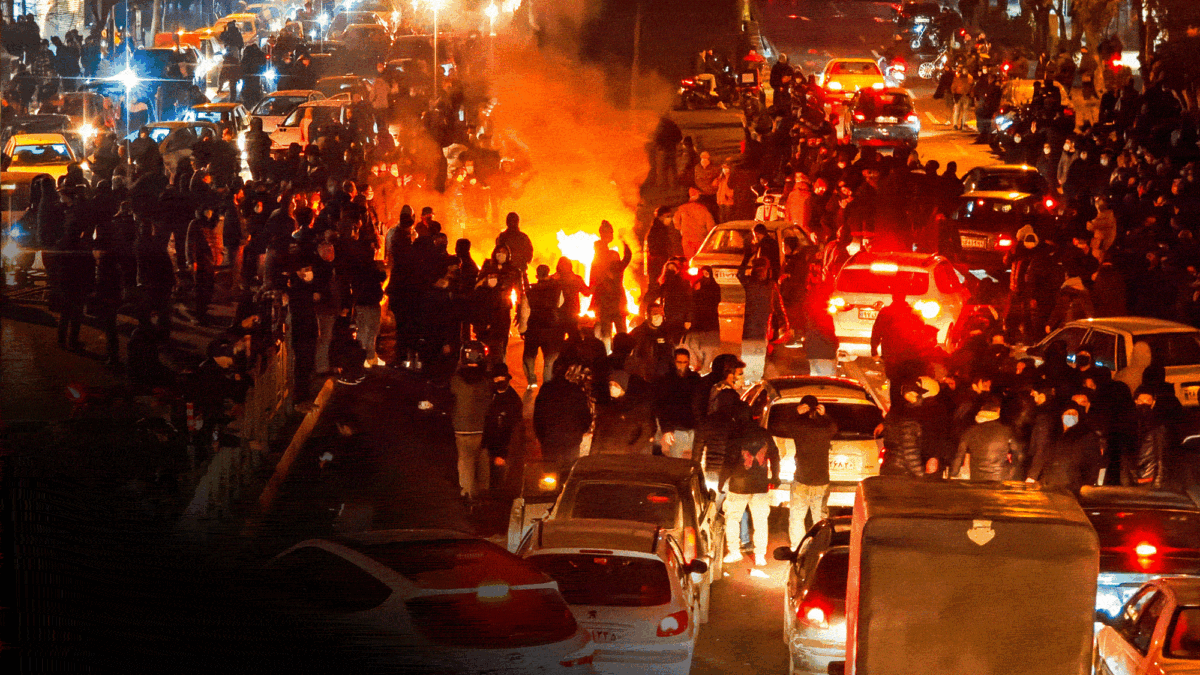

Nights in Tehran, Iran, are increasingly violent, an Iranian woman who recently left the country told The Epoch Times.
She said security forces often move through crowds on motorcycles, firing indiscriminately. In the mornings, she’s seen bodies in public areas and blood on the streets.

Those same streets, which fill with crowds each day by late afternoon, resemble “front lines,” and the sound of gunfire filters into people’s homes, she said. The woman, who asked not to be identified for safety reasons, said she had traveled to Tehran to visit family shortly before the protests began. She has left the country to return to the Netherlands.
The current protests are far larger and more intense than previous unrest, she said, including the unrest following the 2022 death of Mahsa Amini. Amini was a Kurdish Iranian woman whose arrest and subsequent death sparked protests across the globe.
The mood in Tehran is quiet and heavy, she said, with people looking exhausted and sad.
As protests in Iran against the regime stretched beyond two weeks, U.S. President Donald Trump issued his strongest and most direct message yet in support of protesters, urging them to “take over [their] institutions” and “save the names of the killers and abusers.”
“Help is on the way,” he wrote in all caps.
In a post on Truth Social on Jan. 13, Trump said he will not hold meetings with Iranian officials until the killing of protesters stops and warned that those responsible will “pay a big price.”
Iran’s protests have spread across the country as residents face a sixth consecutive day of a near-total internet shutdown.
Government agents in some areas are going door to door and removing satellite dishes from homes, according to reports by the Associated Press. Satellite television is widely used in Iran, and many families rely on it to access foreign news not available through state-controlled media. These actions, combined with the internet blackout, have made it increasingly difficult for people inside the country to communicate or share information.
The communications clampdown has also made it challenging to assess the actual death toll, which is feared to be much higher than estimates, which vary widely.
London-based news channel Iran International reported on Jan. 13 that after a two-day, multisource verification process involving information from senior security and government sources, eyewitnesses, hospital data, and medical professionals, it has concluded that at least 12,000 people have been killed, mainly over two consecutive nights in early January.
According to the outlet, the deaths resulted from a coordinated operation carried out primarily by Islamic Revolutionary Guard Corps and Basij forces, not from spontaneous clashes. Sources indicate that the operation was conducted under direct orders from Iranian leader Ali Khamenei, with the approval of Iran’s top governing bodies, Iran International reported. Many of the victims were younger than 30.
The U.S.-based Human Rights Activists News Agency reported on Jan. 12 that at least 2,586 people had been killed and that thousands more had been arrested.
“In addition, 579 other reports of deaths remain under review,” the group stated online.
An Iranian official confirmed to Reuters on Jan. 13 that at least 2,000 people have been killed, blaming “terrorists.”
Even by conservative estimates, the death toll from the current protests is the highest from any round of unrest in Iran in decades.
In recent days, images and video footage circulating online have shown large numbers of bodies at forensic facilities in Iran as families gather to mourn and identify the dead. The footage has increased international concern over the scale of the clampdown on protesters, and European Commission President Ursula von der Leyen called the rising death toll “horrifying” in a Jan. 12 social media post.
“The European Union has already listed the Islamic Revolutionary Guard Corps in its entirety under its human rights sanctions regime,” Von der Leyen said.
Several European countries, including Spain, France, and Belgium, have summoned Iranian ambassadors in protest, and European Parliament President Roberta Metsola announced on X that she had banned Iranian diplomatic staff and representatives from all European Parliament premises.
Meanwhile, Iranian President Masoud Pezeshkian blamed the deadly violence on what he described as terrorists and rioters, and organized a pro-government rally on Jan. 12. He claimed that the killings were carried out by armed groups and denied responsibility by state security forces.
Trump issued his first public response to events in Iran on the sixth day of the protests.
“If Iran [shoots] and violently kills peaceful protesters, which is their custom, the United States of America will come to their rescue,” Trump wrote on Truth Social on Jan. 2. “We are locked and loaded and ready to go.”
The next day, the United States arrested former Venezuelan leader Nicolás Maduro at his residence in Caracas, Venezuela, and transferred him to the United States to face prosecution.
In the days that followed, prominent figures, including Sen. Lindsey Graham (R-S.C.) and exiled Iranian Crown Prince Reza Pahlavi, expressed hope that Trump would take similar decisive action against Iran.
Pahlavi posted on X on Jan. 12: “The president is a man of action and a man of peace. Now, he can act to bring about the greatest peace the world has ever seen: by helping Iranians finally end this criminal regime.”
Pahlavi has emerged as a central figure in the protest movement, and his name is widely chanted both inside and outside the country.
Trump has continued to voice support for protesters. On Jan. 11, he told reporters that Iranian officials had expressed interest in negotiations. He raised the possibility of talks, while also warning that the United States could respond to the killing of protesters.
On Jan. 12, the president announced a 25 percent tariff on any country that conducts trade with Iran.
The next day, Trump said there would be no negotiations with Iran’s Islamic regime.
However, on Wednesday, Trump indicated that some communication had taken place, suggesting that Iran was backing off from threats to rapidly try to execute the more than 10,000 Iranian citizens arrested in relation to the protests.
He made clear, nevertheless, that a military response would remain on the table.
—Shahrzad Ghanei and Joseph Lord
BOOKMARKS
Cuba is on the verge of economic collapse, with no immediate relief on tap from longtime patron Russia or Cuba’s biggest trading partner, China. The Epoch Times’ John Haughey reported that the situation is only getting more dire for the Cuban regime as Mexico seems poised to sever its tenuous ties with the communist-run island.
The United States is pausing immigrant visa processing for 75 countries, The Epoch Times’ Jackson Richman reported. Somalia, one of the included nations, has been in the spotlight recently amid welfare fraud in Minneapolis, much of it allegedly committed by members of the Somali community.
Ukrainian opposition party leader Yulia Tymoshenko has been served with a criminal notice of suspicion on allegations she offered improper benefits to members of Parliament in exchange for directing how they vote, The Epoch Times’ Tom Ozimek reported. Tymoshenko, a former prime minister, described the case as politically motivated.
Presidential peace envoy Steve Witkoff announced on Wednesday that the second phase of Trump’s Gaza peace plan was underway, The Epoch Times’ Ryan Morgan reported. The presidential special envoy said the next part of the peace plan will see the demilitarization of Hamas and the start of reconstruction efforts.
The U.S. Supreme Court voted Wednesday to allow a Republican congressman to challenge an Illinois law that allows the counting of ballots for two weeks after Election Day, The Epoch Times’ Matthew Vadum reported. The 7–2 decision could make it easier for candidates to sue over election laws.