
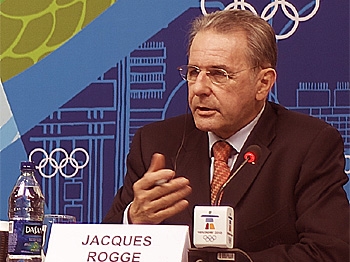
Russia's drug-tainted athletics program was the top focus during a press conference at the Vancouver Olympics main media center on Tuesday when several reporters asked about the issue.
IOC President Jacques Rogge told reporters that the matter was under the jurisdiction of the World Anti-Doping Agency (WADA) and though he had spoken with Russian President Dmitry Medvedev about Russia's repeated violations, Rogge described IOC's voice in the matter as “symbolic.”
“We have indeed been alerted by the number of positive cases,” Rogge said. “I spoke to President Medvedev and I insisted on the need to have strong action on doping. He promised he would launch that and he was very explicit in public declarations after that.”
The only athlete to test positive for doping in Turin in 2006 was Russian biathlete Olga Medvedtseva who won silver before being stripped of her medal. A minor controversy has surrounded Russia's decision to field her again. Medvedtseva, who took gold in Salt Lake City in 2002, served a two-year suspension and Rogge said she is now free to compete.
Recently, Russian female skier Alyona Sidko, who took bronze in 2006, was disqualified by the Russian ski federation for doping. The International Ski Federation disqualified two other Russian female skiers last month for doping as well.
Russia began its own anti-doping agency in January 2008 relatively late given it is among Olympic super powers. WADA has told the new agency it should rely on experts from the Norwegian Anti-Doping Agency.
The IOC held a press conference on anti-doping efforts for the 2010 games on Tuesday.
Over 2,000 samples will be taken, up 25 to 40 percent from last year, said Arne Ljungqvist, chairman of the IOC medical commission and Vice President of the World Anti-Doping Agency.
But he said that the number of samples was not important.
"What is important is to doing the right test at the right time."
Olympic athletes can be tested at any time from the opening of the Olympic Village to the closing ceremonies, whether they are in Canada or a training facility elsewhere in the world, he said.
Ljungqvist added his concern to Rogge's about Russian athletes repeatedly testing positive. He said he would like to see the new Russian anti-doping agency get good funding, support, and remain independent.
He said his concern about Russia was related to that country hosting the 2014 games in Sochi.
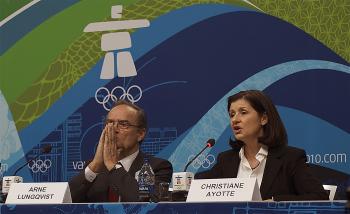
"Are there designer substances over there? For sure," she said.
But she said Russia was not the only violator, and that "pseudo-scientists" had set up in the United States for the sole purpose of making undetectable substances.
"Russians, again, are not the only athletes doping."
Samples taken during the Vancouver games will be kept for eight years to be tested against known and unknown substances in the future. After Beijing, several athletes were caught when nine samples retested positive for CERA, which increases endurance by stimulating production of oxygen-rich blood cells.
Ljungqvist, WADA VP, said the testing in Vancouver would be of the highest quality possible but it would be naive to think there would not be some cheaters who slipped by.
"No system is foolproof," he said.
But he also said that the games are getting cleaner despite new drugs being produced.
Pharmaceutical companies have helped by alerting the IOC and WADA to drugs in clinical trials that may already be reaching the black market through illicit channels and used for performance enhancement.
"There are such substances today, that we know of, that are being produced," said Ljungqvist.
"Those athletes using such substances should know that we may analyze for it, if not here in Vancouver, in one or two years time. If you get free today, you may be identified tomorrow," he said.