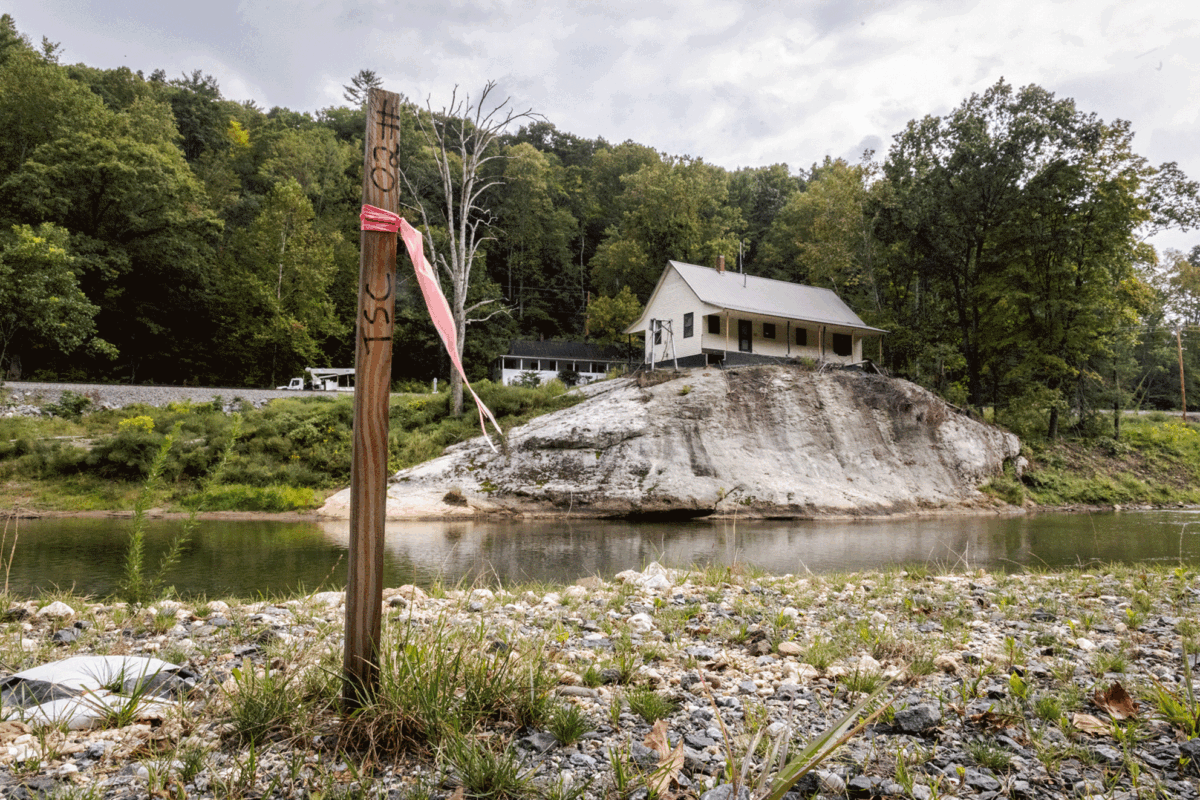

GREEN MOUNTAIN, N.C.—Dave Keister, 57, still lives in a Recreational Vehicle near where his home and motorcycle shop once stood, across the road from the North Toe River in North Carolina.
The mid-September sun glistens on the river, a picture of tranquility as leaves drift down from towering trees on a cool breeze. It flows peacefully today, in stark contrast to the hell and high water it unleashed a year ago.
Keister stands among a jumble of vintage motorcycles surveying the aftermath that changed his life.
“I’m starting from scratch,” he said.
After months of wrangling with paperwork and bureaucrats, Keister received a check from the Federal Emergency Management Agency (FEMA) for $42,000 in July.
It was far less than what his home and motorcycle shop were worth, but he says it’s a start. He isn’t the only one still struggling.
Residents of Yancey County, which got 31 inches of rain, the most in the state according to the federal government, told The Epoch Times they were frustrated by the slow recovery.
Some people gave up on getting help.
But there was a silver lining for people here, especially in the Double Island neighborhood by the river. Neighbors came together and formed new bonds that hadn’t existed before.
Helene, a Category 4 hurricane, struck Florida on Sept. 26, 2024, leaving a trail of death and disaster as it traveled northward into North Carolina.
It caused 108 deaths in the state, widespread flooding, power outages, downed trees, and road closures. A year later, some of those roads still require repair.
Helene brought life-threatening wind gusts farther inland than most hurricanes because of its speed and size, according to a 2024 National Hurricane Center Tropical Cyclone Report.
Mt. Mitchell in Yancey County clocked the highest wind gusts in North Carolina at more than 105 miles per hour, according to the report.
The North Toe River in Yancey County rose an estimated 30 feet above normal, according to the report. Eleven people in the county died from the storm.
FEMA has provided more than $500 million in direct hurricane relief to North Carolina residents, according to a Sept. 15 press release from its parent agency, the Department of Homeland Security (DHS).
It has spent more than $3 billion on debris removal in what DHS Secretary Kristi Noem called “one of the largest debris missions ever.”
Keister, who has experience as a rescue worker, said the storm nearly took his life. He attributes his survival to prepping for the storm and remaining calm.
As the river rose, Keister watched the water creep into his downstairs area. He could hear the wind whipping outside.
The water flooded the first floor of his home and climbed toward the second story. Keister said that in the time it took him to walk across the length of the second story and get out the back door, the water was past his ankles.
He grabbed his dogs and made it outside, heading to his car, which he’d parked on higher ground. He’d just got his dogs inside when, out of the corner of his eye, he saw something big moving.
He picked up his phone and turned on the video, only to realize it was his house floating by.
Keister made it to his car and drove it up a steep mountainside; wet and cold, he passed the night in fitful sleep.
The next morning, he began making his way to his neighbors to check on them. At one house, only the stone chimney remained where his friend had lived.
His neighbor was one of four area residents whose bodies were never found. Keister put up a cross at the site in his memory.
—Darlene McCormick Sanchez; Stacy Robinson
BOOKMARKS
A gunman opened fire on an Immigration and Customs Enforcement (ICE) field office in Dallas on Wednesday, killing one detainee and leaving two others injured. The shooter died by a self-inflicted gunshot, leaving behind ammunition imprinted with anti-ICE messages, authorities said.
A new gene therapy may show promise for patients suffering from Huntington’s disease. The treatment, piloted by a company called uniQure, appeared to slow the disease’s progression by 75 percent over three years.
Dr. Ben Carson was named a national adviser to the U.S. Department of Agriculture on Wednesday and will focus on nutrition, health, and housing. “There is no one more qualified than Dr. Carson to advise on policies that improve Americans’ everyday quality of life, from nutrition to healthcare quality to ensuring families have access to safe and stable housing,” USDA Secretary Brooke Rollins said in a statement.
The United States is still opposed to a two-state solution for the ongoing conflict between Israel and Hamas in Gaza. Secretary of State Marco Rubio said there will be recognition of a Palestinian state unless Israel is involved in the negotiation process.
War Secretary Pete Hegseth has eliminated the Defense Advisory Committee on Women in the Services, a 74-year-old committee that advised the Pentagon on women’s issues. “The committee is focused on advancing a divisive feminist agenda that hurts combat readiness, while Secretary Hegseth has focused on advancing uniform, sex-neutral standards across the Department,” Pentagon press secretary Kingsley Wilson said.
—Stacy Robinson