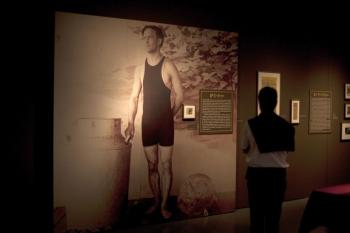

Houdini, the son of a rabbi, was born Ehrich Weiss in Budapest, Hungary, in 1874. In 1878, his family migrated to Appleton, Wis., and later moved to New York. He tried to run away with the circus at the age of 12, but returned home to help support his family.
His dream was only delayed, not forgotten. He was a circus performer in the 1890s before becoming a stage magician and illusionist.
The exhibit explores the life and lasting impact of the famed illusionist. None of the magic is lost—Houdini’s secrets are not revealed. His innovation and skill are celebrated, as well as his lasting impact. Inspired by the magician, 26 recent works of art are also on display.
Contemporary magicians such as David Blaine and David Copperfield acknowledge that they have walked a path paved by Houdini, who advocated for the magic profession. Houdini served as president of the Society of American Magicians from 1917 to his death in 1926.
“For him, sometimes the difficult thing was keeping the handcuffs on,” said Blaine at the exhibit preview on Monday, according to the New York Times.
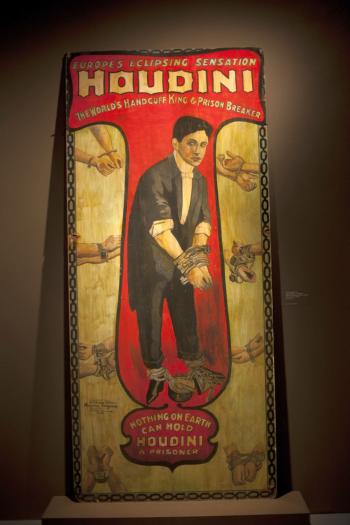
The 1953 movie, “Houdini,” starring Tony Curtis, portrayed the magician’s death as a failed escape from the Chinese Water Torture Cell. This added to the fable and lore surrounding the magician’s demise. Houdini is buried in Queens in the bronze casket crafted for his buried alive stunt.
The Jewish Museum exhibit is the first major art museum exhibition to examine Houdini’s life, mystique, and cultural legacy. The 163 objects, including personal artifacts as well as tools of his trade set up as they would have been on the early 20th century stage, carry visitors through the life and legend of the master magician.