
Published this month in the journal Frontiers in Ecology and the Environment, the study examined the tree holes that birds and mammals use for nesting in Canada around the world.
Most animals can’t carve out their own tree holes and rely on those already formed by damage and decay—a process that can take several centuries.
Tree holes are created either quickly by woodpeckers or more slowly as trees age and begin to decay, a team of researchers from the University of British Columbia found.
Birds like owls, songbirds, and parrots, and mammals such as flying squirrels and opossums make homes in tree cavities because they offer a safe environment for sleeping, reproduction, and raising young. Insects, snakes, and amphibians will also make use of tree holes.
The researchers found that in South America, Europe, Asia, and Australia, more than 75 percent of the holes used by birds and mammals were created by damage and decay.
“When wildlife depends on decay-formed cavities, they are relying on large living trees,” says lead researcher Kathy Martin, a professor in the Faculty of Forestry at UBC and also a senior research scientist with Environment Canada.
“Most trees have to be more than 100 years old before decay cavities begin to form and often several centuries old before large cavities or many cavities develop in one tree.”
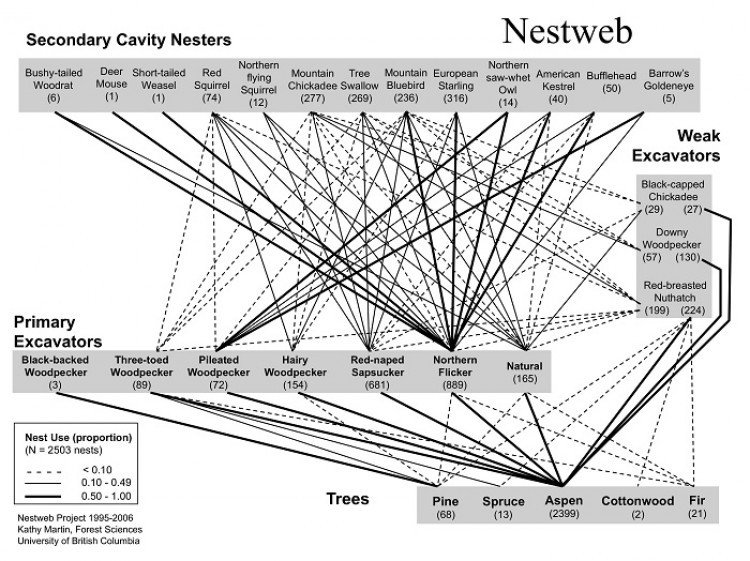
In North America however, the team found that woodpeckers and other excavating creatures are responsible for creating up to 99 percent of tree cavities used by birds and mammals for habitat. Therefore, in North America the tendency is that fewer mature trees are used as habitat, since they are less reliant on the process of decay.