
The CCP is credited with having caused 80 million deaths in China. Of those 80 million, 40 million may be laid directly to the account of Mao.
Mao could not tolerate anyone differing from his opinions, and he launched several campaigns aimed at eliminating his rivals, from the anti-Bolshevik campaign in 1927 to the Cultural Revolution in 1966.
During the civil war with the Kuomintang, Mao gave orders to besiege Changchun. 400,000 starved to death.
Mao’s disastrous Great Leap Forward campaign caused at least 30 million deaths from a famine suffered when the nation was at peace and crops were plentiful.
In the ten-year-long Cultural Revolution, Red Guards treated Mao like a prophet and sought to impose revolutionary purity on the country. A large but unknown number of people were killed and China’s cultural heritage was decimated.
Mao was also a tyrant in his private life. In The Private Life of Chairman Mao, his long-time personal physician, Dr. Li Zhisui, describes how Mao used his power to have sex with an endless parade of young women and lived in luxury like an emperor.
In the service of bolstering the CCP’s legitimacy, a series of TV and film actors have hidden from the Chinese people the moral monster who was the historic Mao.
Gu Yue
Foremost among these actors was Gu Yue. Gu was born in 1937 and he joined the CCP army in 1949, at the young age of 12. Because of his uncanny resemblance to Mao, he was chosen in 1978 to play the role of the “great helmsman.” He went on to portray Mao in 84 films or TV series, winning best actor twice at the Hundred Flowers Awards.
His death was unexpected and had about it something mysterious.
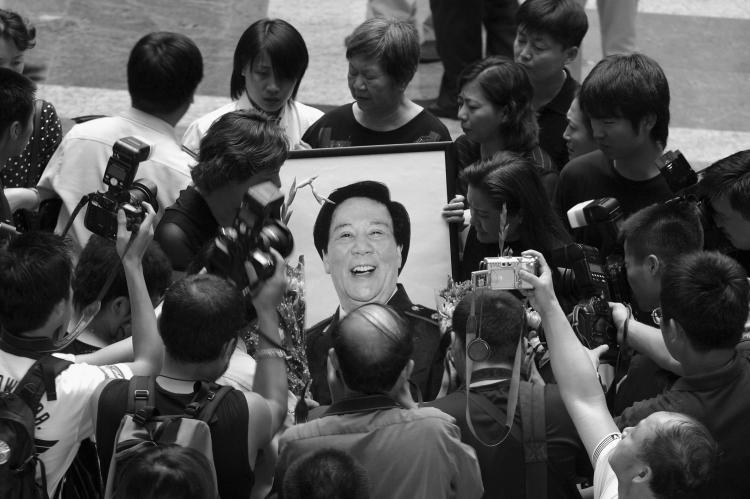
On July 2, 2005, Gu died at the age of 68 after a visit to a sauna in Guangdong Province. At the sauna, he felt chest pains. His family members called an ambulance. When the ambulance arrived, Gu saw a doctor. He held the doctor’s hand and said, “I’m done. I’m done.” Although the doctor tried to resuscitate him, Gu’s body turned gray and he died shortly after.
His death caused wide speculation in the media. Some questioned why Gu died suddenly even though he was in good physical condition and had no history of heart disease. The bodies of many people who die of congestive heart failure turn purple, yet Gu’s body turned gray.
Wang Lixian
Wang Lixian was Vice Chairman of the workers’ union at the Dalian Deta Holding Co., Ltd. He had wanted to portray Mao for a long time and had obtained audio and visual recordings to help him perfect his imitation of Mao. He also sought people with the right connections to help get a job portraying Mao. He was considered the most likely to take up the baton of chief Mao impersonator after Gu’s death.
Wang died in a car accident on Oct. 2, 2006 at the age of 52, approximately one month after filming his first TV series as Mao. Wang was on a bus touring Taiwan. In the accident, Wang and 5 other tourists were killed, and his wife was seriously injured.
The cause of the accident was said to be brake failure, but, according to officials with the transportation department in Taiwan, the tour bus did not show any physical evidence of having braked. The tires looked normal. There was no oil leakage from the brakes, and no skid marks on the road. The records in the bus showed that it suddenly sped up to more than 100 km per hour (62 mph). The bus driver then lost control before the bus plunged into a vineyard.
Ma Yufei
Ma was a regent of the Feimingweiye Film and TV Cultural Arts Broadcasting Center in Beijing. Ma was said to have attended many events memorializing Mao.
A friend of Ma Yufei wrote in a blog that one day a hairdresser discovered Ma’s resemblance to Mao and cut Ma’s hair according to Mao’s style. With a mirror held in front of him, Ma Yufei was shocked to see Mao looking back at him in the mirror. He then went to study acting at the Beijing Film Academy. He worked hard to imitate Mao’s demeanor, using photos, video, and audio clips he had gathered.
After Ma Yufei played Mao Zedong for the first time in the CCTV series Li Lisan, his career as a Mao impersonator blossomed. He starred in several TV series as Mao, including Daughter of Water, and Mao Zedong in His Youth. Just before his death, he was in the planning phase of a TV series called Mao Zedong in Beidaihe.
On Oct. 6, 2008, while on tour in Heilongjiang Province, three people, including Ma Yufei and a Zhou Enlai impersonator, were killed in a traffic accident near Suihua City en route to Harbin City.
He Mingzhi
He Mingzhi, from Sichuan Province, was a healthy and successful businessman before he was chosen to play Mao Zedong.
He Mingzhi’s first role as a Mao impersonator was in the 1995 TV drama Battle in Laiwu. Later, he played Mao in multiple TV dramas including Praise of the Long March, Shen Hong, and A Soldier’s Hometown.
Ms. Zhao, He’s cousin said, “Actually, with his health condition, he could have lived well into his 80’s.” as cited by hudong.com, a Chinese wiki site.
However, in 2007 after portraying Mao in a few dramas, he started to have liver problems. In 2009, after he brought to life a “glorious” Mao in the TV series Founders, he went through liver transplant surgery.
According to news.xinmin.cn and 163.com, on July 29, 2009 He Mingzhi performed a 300 word long speech by Mao in the Sing a Red [Communist] Song event in Chongqing City. Right after the performance, he started to sweat excessively. When he got back to Chengdu City, he was taken to hospital with a high fever and died that night. He Mingzhi was only 51 years old.
Chinese culture has the concept of karmic retribution, according to which individuals pay for the harm they have caused. Perhaps karmic retribution helps explain the sudden deaths of those who have helped convince the Chinese people that Mao was a “great and glorious leader.”
Recently, many individuals who have promoted the Chinese Communist Party, both in China and in the West, have come upon bad luck. This article is one in a series describing such cases.
Views expressed in this article are the opinions of the author and do not necessarily reflect the views of The Epoch Times.







