

In October last year, a young Indigenous Australian girl quietly addressed the nation about ending the disparity between Indigenous and non-Indigenous Australians.
“If a huge effort is made, the gap between my people and other Australians can be closed in one generation,” Madeleine Madden, 13, said in a 3-minute call that was broadcast across all the major Australian television networks, digital and print media reaching over six million people.
“Maddy” was speaking on behalf of GenerationOne, a grassroots movement initiated by mining magnate Andrew “Twiggy” Forrest and his wife Nicola, with the aim of bringing Indigenous and non-Indigenous Australians together to end the gap between the two groups – in one generation.
Well-presented and articulate, Maddy is a good example of what GenerationOne aims for – to facilitate training and employment for Indigenous Australians and, in doing so, to change stereotypes and create new role models for Aboriginal people.
A member of the Eastern Arrernte, Kalkadoon, Bundjalung and Cadigal Aboriginal communities, Maddy grew up in Sydney and, as the daughter of curator Hetti Perkins and granddaughter of long-time Indigenous activists Chicka Madden and Charles Perkins, she had strong role models to inspire her.
“I think I’ve got the campaign gene from my grandfather; he inspired me,” Maddy told the media following her nationwide call.
Bridging the Gap
It is Bridging the Gap Day on March 31 and the statistics still show the disadvantages for Indigenous Australians. Three times as many Indigenous people, as opposed to non-Indigenous, are unemployed; less than half of young Indigenous Australians are achieving a Year 12 qualification, compared to 84 per cent in the wider community; and a shocking 25 per cent of Indigenous men will live to see their 65th birthday, compared to 74 per cent of non-Indigenous.
Tania Major, the Young Australian of the Year in 2007 and spokesperson for GenerationOne, says the statistics cannot be ignored, but Australians, both Indigenous and non-Indigenous, need to hear the good news stories too.
“We have got some fantastic young people and their inspirational stories,” she told The Epoch Times, adding that the repetition of negative statistics to the exclusion of positive information “hinders personal progress because the only enforcement they get in the media is negative”.
Ms Major, a Kokoberra woman from the remote community of Kowanyama in Cape York, Queensland, has a degree in Criminology and was the youngest person to be elected to the former administrative body, the Aboriginal and Torres Strait Islander Commission (ATSIC). She says GenerationOne looks to bridge the gap between Indigenous and non-Indigenous communities by making Aboriginal success stories more accessible for both communities.
“The inspiring part for me is when you look at Aboriginal success stories, you see the Noel Pearsons, the Tania Majors, the Marcia Langtons, the Cathy Freemans, but we forget the middle people. We forget those actually who are on the ground, in their communities doing their jobs and those wanting the best themselves,” she said.
“GenerationOne has given them a voice and highlighted their individual achievements, and their success stories, which they rightly deserve.”
Australian Employment Covenant
Ms Major said attitudes to Indigenous Australians became more positive after the Australian Government under Kevin Rudd apologised to Indigenous people, resulting in a groundswell of good will.
Australians by and large want to do something to help, she said, making the timing right for the movement.
GenerationOne is working in conjunction with sister organisation Australian Employment Covenant to create a demand for 50,000 sustainable jobs to be filled by Indigenous Australians. Over 100,000 people have already signed up to help, with small and large businesses offering employment and training for Indigenous people.
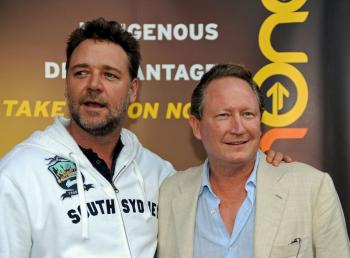
Twiggy Forrest, the initiator of the scheme, launched GenerationOne at the Sydney Opera House in March last year to a fanfare of celebrities, including James Packer, Lindsay Fox, Russel Crowe and Cate Blanchett.
One of Australia’s richest men, Mr Forrest has openly shared that one of the greatest influences on his life was the Aboriginal manager and stockman he grew up with on his family property in Western Australia. He believes it comes down to perception and self-belief, attitudes he believes will change with more Indigenous people participating in the workforce and creating positive role models.
“I know Aboriginals can be leaders like any white man. I know Aboriginals can become professional and reliable and wonderful to work with like any white man,” he told the Western Australian Sunday Times.
“If we can get everyone believing in Aboriginal people, then we’ll stop putting up with the strategy whereby we throw money and not good hard opportunity and good hard training at them instead.”
GenerationOne website – http://generationone.org.au/







