
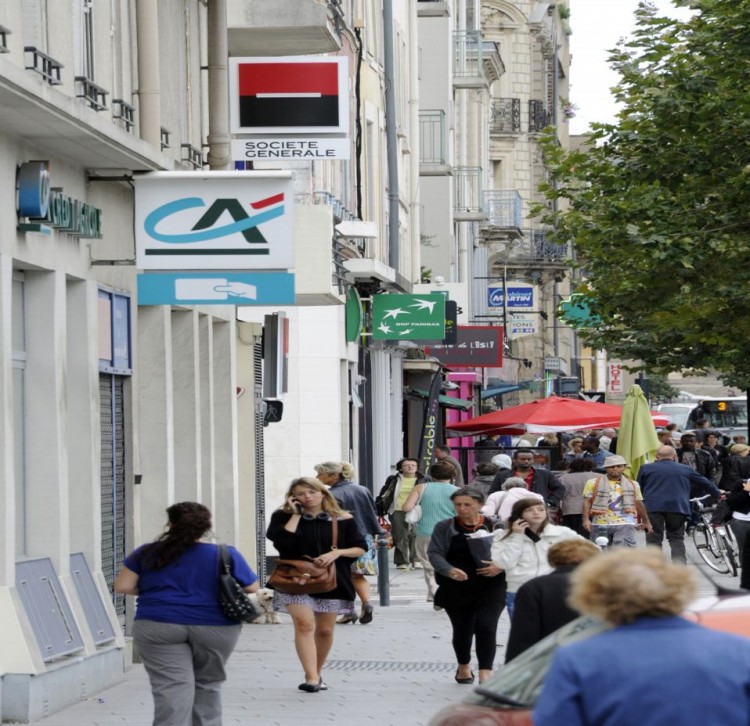
The banking and regulating authorities have officially rejected the suggestion of an urgent need of money to recapitalize French banks. In spite of these affirmations, the three main French banks are still being pressured in the market place. Share prices of BNP Paribas, Societe Generale, and Credit Agricole have lost between 45 percent and 50 percent of their value in the third quarter, and have dropped more than 60 percent from their peak values for the same period.
In August, Christine Lagarde, managing director of the International Monetary Fund, called on the other European banks for an urgent recapitalization so that French banks would be strong enough to face the risks represented by low economic growth and public debt. She added, “It is essential to limit the risk of contagion.” Announced without the slightest details, those words rang hollow and exacerbated the perceived risks surrounding French banks.
The Recapitalization Question
The rumors of a recapitalization plan of up to 10 billion to 15 billion euros proposed by the director of the treasury have been denied. “There is no such plan,” declared the governor of Bank of France, Christian Noyer, in an interview with the Journal du Dimanche. He went on to point out that the French banks “have a large capital base, equivalent to the other European banks, and they are competitive.”
Valerie Pecresse, the minister of the budget and spokesperson for the government, during the “Grand Jury” show on RTL radio station, confirmed, “There is no plan for the recapitalization of our banks,” and she added, “Obviously the government works hand in hand with the banks, because the government shoulders the banks.” She reiterated her confidence during an interview on Europe 1 radio station on Sept. 28, confirming, “At this moment, our banks remain strong.”
Downgraded by Rating Agencies
These statements haven’t stopped the downgrading of the French banks by rating agency Moody’s. Ratings for the moment have been lowered from the level of “medium” to “weak” AA for Societe Generale and from “strong” to “medium” AA for Credit Agricole.
These new ratings come with cautions and a negative outlook, which indicates the risk of further lowering of the ratings within a short period of time. Moody’s argues that Credit Agricole has significant exposure to the Greek debt crisis, especially its 8 billion euro loan to its subsidiary company the Emporiki Bank of Greece. BNP Paribas’s rating remains unchanged at “medium” AA, nevertheless a negative watch status has been maintained taking into account the frailty of the current marketplace.
Short Term Liquidity Pressures
Simultaneously, concerns have been voiced regarding withdrawals of liquidity from French banks by major European groups. The withdrawal of 500 million euros by the German conglomerate Siemens AG from Societe General was confirmed in September, even though the official reason given was an underperforming investment, this news reinforced the mistrust of French banks.
Also, a reduction in the exposure of U.S. Money Market Funds (MMF) to the European banks, and in particular the French, that are very dependent in the short term on dollar financing, has revealed another risk for French banks.
Counterparties reduced their exposure to French banks by 19 percent in August, and 34 percent since May, according to a study by Fitch Ratings, carried out on the 10 biggest U.S. MMFs and published last week. In addition, these MMFs have equally reduced the maturity of their exposure to seven days, which will constrain the French banks to adjust their business models by increasing the turnover of their refinancing, and diversifying their sources of funding.
The concerns regarding French banks’ solvency and their liquidity translate into a lack of confidence from the markets. The volatility of the French banks’ equity should continue in the months to come until a more permanent solution to the sovereign debt crisis is found.