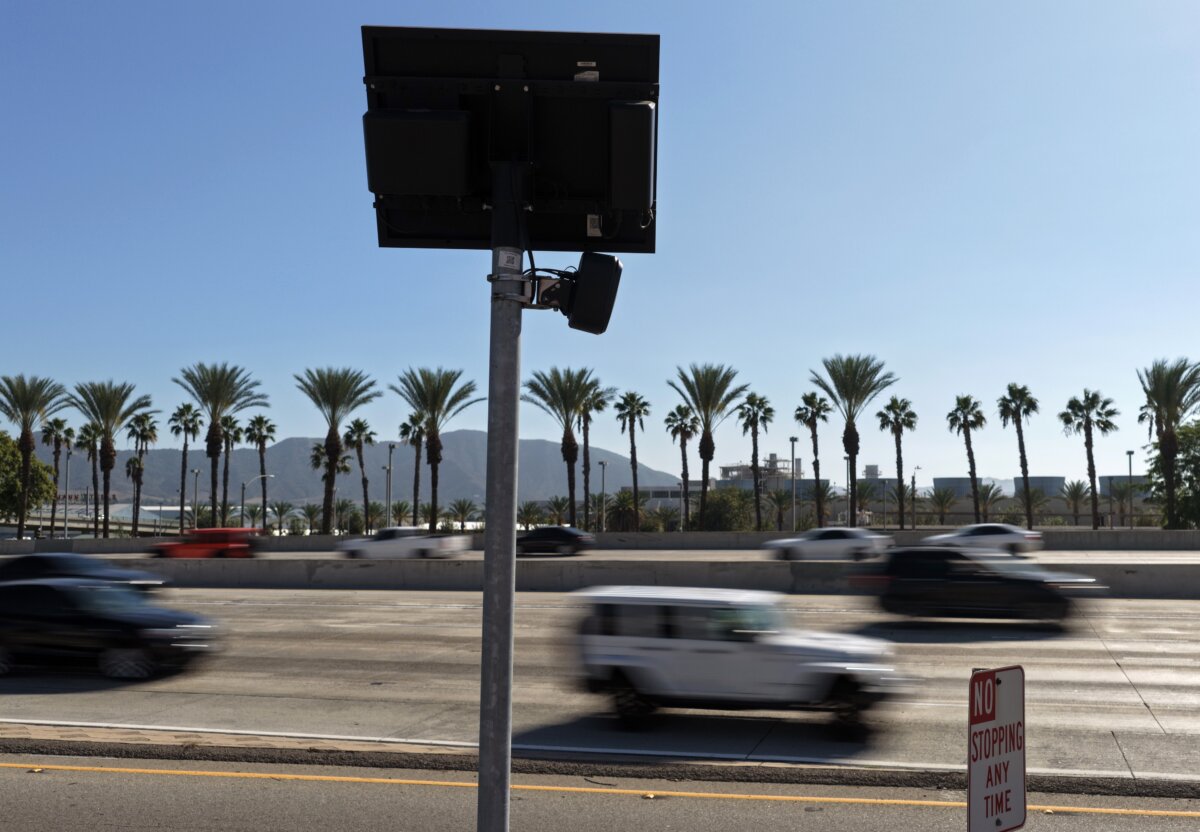

In many parts of the United States, Flock Safety surveillance cameras are on the way out as citizens and municipalities push back against what they see as an unconstitutional overreach in the new technology.
But as new alternatives are silently phased in to replace them—by competitors such as Axon Enterprise and Motorola—experts and watchdogs say these companies could raise even more concerns than Flock.
The Los Angeles Police Department is currently planning to roll out a 10-year contract with Axon Enterprise, a $235 million arrangement that would equip America’s second-largest metropolis with more than 1,600 license plate readers.
The new technology is “designed to preserve its value in criminal investigations, missing-person cases, and other serious public safety matters while strengthening privacy and accountability,” the Los Angeles Police Department told The Epoch Times in an email.
The department cited data safeguards, a 90-day limit for accessing “routine searchable data,” multiple command approval layers for older data, and an absolute one-year limit to access data from the cameras.
Motorola, best known for its telecommunications hardware, has also been moving to break into the police technology market.
The multi-billion-dollar tech giant already has its foot in the door, having spent decades building up land mobile radio networks and 911 emergency dispatch consoles.
Unlike Flock, neither of these services offer an automatic nationalized database for their data. Axon focuses on individual police departments, which can elect to pool their data with other law enforcement agencies. Motorola sells subscription services that allow law enforcement to access data not captured by the agency. Data collected through Motorola is also sold to auto finance and insurance companies, recovery agencies, and other commercial customers.
For municipalities, Flock, Axon, and Motorola offer a potential melding of technology and traditional surveillance tech to reduce crime and make roadways safer.
But the cameras they operate have boosted a growing artificial intelligence-powered surveillance network accessible by thousands of U.S. law enforcement agencies, which critics say runs afoul of the Fourth Amendment’s protections against unreasonable search and seizure.
Flock states on its website that it “built this technology to protect and maintain citizen privacy.”
Critics say that doesn’t outweigh the concerns raised by its adoption, or by the adoption of similar technologies from competitors.
“It doesn’t matter which company has its creepy cameras in your neighborhood; they all have the same problems: a lack of transparency, oversight, and regulation into how they collect, store, and use our data, and how to hold public and private actors accountable if they abuse it,” the American Civil Liberties Union wrote.
Though they have less name recognition, these competitors use “the same exact approach as Flock,” Suraj Mirpuri, an AI engineer and the founder of Lowdown Labs, told The Epoch Times.
“There’s no real difference in outcome for the average consumer citizen or person concerned about their rights. In some ways these could be worse,” he said.
The license plate-reading cameras operated by Flock Safety have faced scrutiny from lawmakers and private citizens alike, ranging from municipal bans to vigilante acts of vandalism from activists.
In some incidents, activists have cut cameras down with reciprocating saws, hit them with trucks and baseball bats, and defaced lenses with spray paint.
Flock Safety, Axon Enterprise, and Motorola did not return a request for comment.
—Joseph Lord; Jacob Burg
BOOKMARKS
The Treasury Department has automatically enrolled more than 60 million children into the Trump Accounts program. White House estimates say that with support from parents and a decent stock market return, the accounts could hit $1 million in value by the time the kids are 28.
The Russian anti-plague research institute, where a lab worker recently succumbed to an unknown form of pneumonia, has worked for many years with various Chinese institutions. Check out Petr Svab’s latest report for more.
Tropical Storm Isaias is forecast to rapidly turn into a hurricane before reaching the U.S. Gulf Coast later this week, according to federal forecasters. Isaias is expected to become a hurricane by Thursday and reach peak sustained winds of about 110 mph on Friday before moving inland and weakening.
A new artificial intelligence (AI) tool can reconstruct images from a person’s vision simply by analyzing brain scans. The technology recreates a person’s visual field with startling accuracy and can also predict brain activity by analyzing what a person is looking at in real time.
UK communications regulator Ofcom is investigating whether Meta assessed safety risks posed by its Instagram Instants feature before launching it in May. The program lets users share photos and videos that disappear after someone opens them and can’t be viewed after 24 hours.
—Stacy Robinson