
NEW YORK—A Brooklyn fire last week that wiped out a pigeon keeper’s flock of 500 birds was the latest blow to a working-class pastime that has dwindled from the days it was a passion of a young Mike Tyson and Marlon Brando’s character in “On the Waterfront.”
Rising rents and gentrification have left only about 100 pigeon keepers in the New York City area, down from a few thousand during the heyday in the 1940s, ’50s and ’60s.
“Years ago there was pigeon coops on every roof,” said Paul Wohlfarth, whose family has been raising pigeons in Queens for three generations, part of a tradition that began with immigrants from Italy, Germany and Belgium.
“I learned it from my grandfather,” Wohlfarth said as a few dozen of his birds circled overhead. “It gets in your blood. You go up there, you forget your problems. You watch the pigeons fly.”
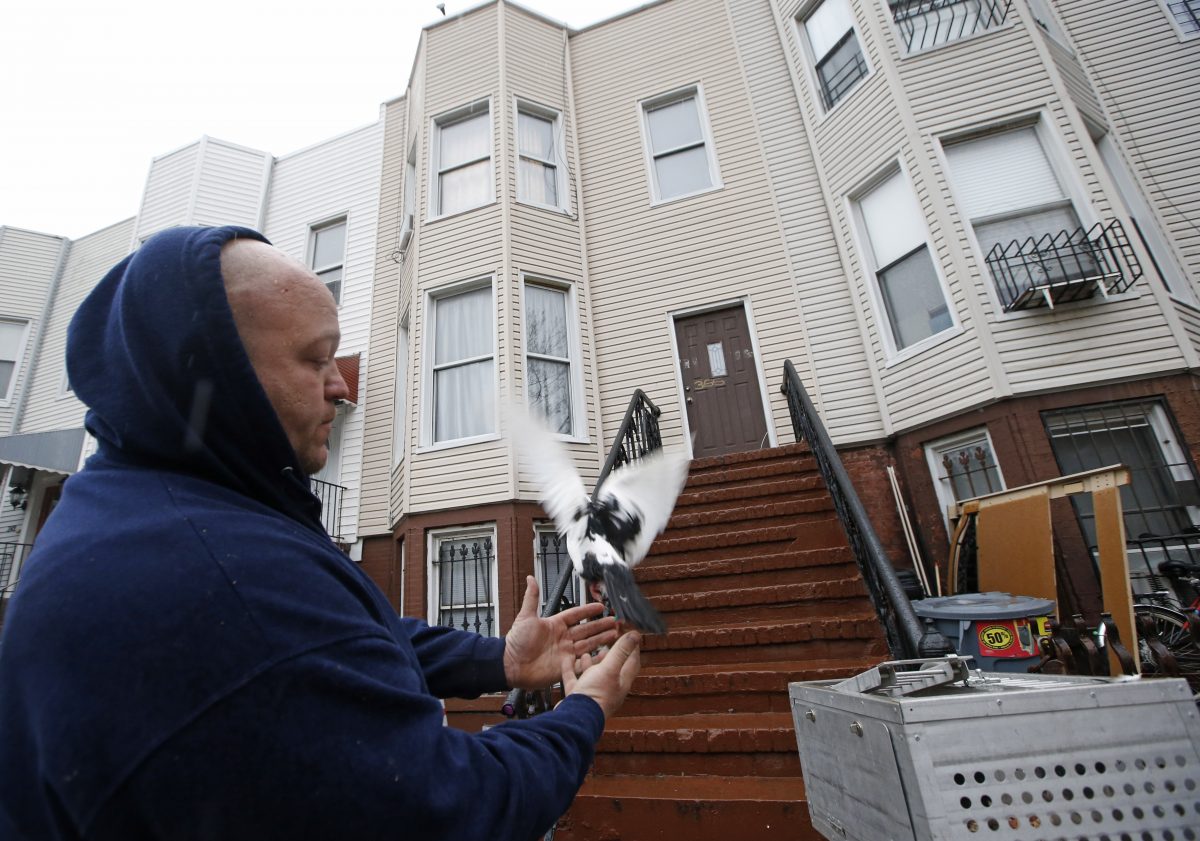
 Pigeon keeper Chris Szwaba holds one of his 400 pigeons in front of the building where he keeps them in a loft on a rooftop on April 4, 2016, in the Sunset Park neighborhood in the Brooklyn borough of New York. (AP Photo/Kathy Willens)
But it’s about more than the quiet contemplation of nature. Pigeon owners work year-round, in good weather and bad, to lug bags of feed to the roof, clean out the coops, and care for the birds by giving them vaccines and dietary supplements.
And then there’s the competition, which begins when keepers release their flocks into the air at the same time. The clouds of pigeons fly at one another, intermingle and then return to their home rooftops. But when they do, they’ll often bring birds from the competing flocks. Those strays are then caught by the keepers, who put new identification bands on their legs and add them to their own flocks.
“You can come in and brag about how you caught X number of pigeons off of somebody else,” said Colin Jerolmack, who teaches sociology and environmental studies at New York University and has written a book about the city’s pigeon pastime. “That’s a huge part of the allure.”
But the tradition of pigeons flying over communities around New York City has dwindled over the years, driven mainly by a large chunk of the keepers and their families moving to the suburbs in the 1970s and ’80s.
Some of those who stayed passed the tradition to kids in the neighborhood, leading to a “cultural transmission” to African-American and Latino communities.
 Pigeon keeper Chris Szwaba taps the top of a pigeon loft to encourage his birds to fly for exercise on the roof of the Sunset Park building, where he keeps about 400 pigeons on April 4, 2016, in the Brooklyn borough of New York. (AP Photo/Kathy Willens)
But the number of pigeon breeders dwindled even further over the past decade, as once-immigrant neighborhoods began gentrifying.
“A lot of these guys had informal handshake agreements with the owners of the building that if they let them keep a coop up there the pigeon keepers would, for instance, tar the roof or do other maintenance,” Jerolmack said. “But when these buildings changed hands, these owners wanted to spruce the place up, closing off access to the rooftop or turning it into a nice deck.”
Many of the pigeon enthusiasts who do remain, a collection of mostly older men with day jobs in the construction trades, gather every Sunday at Broadway Pigeon and Pet Supplies in Brooklyn’s Bushwick section to share war stories and take playful jabs at fellow wranglers. Store co-owner Joey Scott says they all live by a simple motto: “Friends in the street. Enemies on the roof.”
The shop is a little more than a mile from the three buildings in Bushwick gutted by the March 29 that forced more than 30 families from their homes. The coop sat atop one of the buildings, and the 500 birds were killed before they could escape. Edwin Torres, whose family was displaced by the blaze, told the New York Post that he could hear the birds “screaming like babies.”
A group of pigeon handlers plan to donate some of their own birds to Gil Arciliares, the owner who lost his in the fire. In addition, they’re raising funds to buy whatever supplies he needs to create a new coop elsewhere.
“But it’s not the same when you start over, because he’s spent years building and training his birds,” says Chris Szwaba, who keeps his own 400 pigeons on a Brooklyn rooftop.
Arciliares was too distraught to talk about it, said his wife, Gina Cruz: “He’s devastated.”