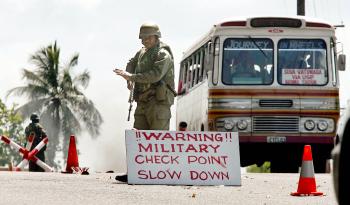
Fiji’s interim prime minister, Cmdre Frank Bainimarama, announced that democratic elections are still planned for 2014, but any elected government will follow the military’s plan for Fiji’s future. The leader says his aim to establish a multicultural nation has some support, but his methods of achieving it have been raising concerns amid democratic nations.
Bainimarama, who took over the country during a 2006 military coup, plans for the military to oversee any newly elected Fijian government, ensuring continued military authority over a wide range of institutions, such as the Great Council of Chiefs and the Methodist Church.
The former naval officer has exhibited few democratic principles so far, while exiling some of his critics and gagging local dissent, including the media.
“Bainimarama has made it clear that he intends to draft a constitution that will reflect the country’s unique culture and history. He has also promised to enact electoral reforms that will establish equal suffrage and to hold free, fair, and democratic elections,” asserted Eni Faleomavaega, the delegate of American Samoa to the U.S. House of Representatives, in a surprising display of support last year.
Regions that opposed Bainimarama’s appointment as prime minister were forced to apologize to the leader, with Bainimarama stating districts should “send away those who visit their villages and make complaints against the work of government.”
“People in Fiji must support reform implemented by the government or will be left out,” reported RadioFiji.
The Methodist Church has been banned from holding their annual conference until the 2014 elections. Additionally, Bainimarama has cancelled pension payments to pensioners who oppose the regime, among them former Fijian Prime Minister Sitiveni Rabuka.
“[The decree] basically means that it will cut off the food line [and] starve those who may be against the government,” said Reverend Akuila Yabaki to ABC Radio. Yabaki heads the Fiji Citizens Constitutional Forum. “It is grossly detrimental to the attempt to have national dialogue, which they are calling for, and will hamper attempts to move the country forward. Such a decree undermines people’s rights, so I think it is not good governance.”