WASHINGTON—The trade deal between Taiwan and China signed last year—Economic Cooperation Framework Agreement (ECFA)—did not lessen China’s buildup of missiles pointing at Taiwan. Nor did it include China renouncing the use of force to reunify Taiwan with the mainland. The disparity in military capability has been widening in China’s favor.
With new generations of fighters, submarines, surface combatants, amphibious assault ships, and ballistic missiles coming into the People’s Liberation Army (PLA) inventories, Taiwan has to keep up or else find some other way to counter China’s advantages.
The United States in turn, which is bound by the 1979 Taiwan Relations Act (TRA) to provide “defensive” weapons, may soon be forced to make critical decisions on its future role.
“From the 1950s onward it had been U.S. policy to at a minimum sustain Taiwan’s military technological edge to sustain deterrence in the face of PLA numbers. … Now after two decades of ‘focused’ PLA modernization and buildup, the PLA is challenging Washington’s ability to sustain Taiwan’s technology edge,” said Richard D. Fisher Jr., senior fellow at the International Assessment and Strategy Center (IASC).
Fisher was speaking Oct. 26 on Capitol Hill at a forum titled, Is Taiwan Defendable? Fisher was joined by two of his colleagues at IASC and another military expert who made the case that Taiwan is defendable, and the United States should not pressure Taiwan to come to terms with China.
Their concern lies in the assumption among some foreign policy observers that in the long run Taiwan cannot be militarily defended from a rapidly growing People’s Liberation Army. In 2000, David Shambaugh wrote a prescient article, “A Matter of Time: Taiwan’s Eroding Military Advantage,” which said although Taiwan’s conventional defenses appeared to be “qualitatively superior and adequate to repel an invasion,” the advantage that Taiwan held, particularly in air and naval platforms, would erode, leaving Taiwan much more vulnerable.
In a nutshell, Shambaugh was saying that if Taiwan cannot resist an invasion, America will be reluctant to do anything there.
Several other military experts make a similar case that Taiwan will not be defensible and will have to come to some kind of political settlement with the communist regime. The war may be over before Washington can respond effectively, some say.
In January 2011, the Miller Center of Public Affairs at the University of Virginia held a three-day roundtable discussion: A Way Ahead with China: Steering the Right Course with the Middle Kingdom and issued a paper. The participants were old ‘China hands’ and included Adm. Joseph W. Prueher former U.S. ambassador to China. They concluded:
“Precisely because the military balance between China and Taiwan is gradually shifting in China’s favor (combined with the growing weapons absorption problem and the nascent arms race) more than ever the ‘Taiwan problem’ cries out for a political solution. Taiwan’s negotiating leverage with Beijing is not all that great now, but it will continue to deteriorate as its defenses and deterrent do. By the end of this decade, Taipei may well find itself trying to negotiate its future at a distinct disadvantage.”
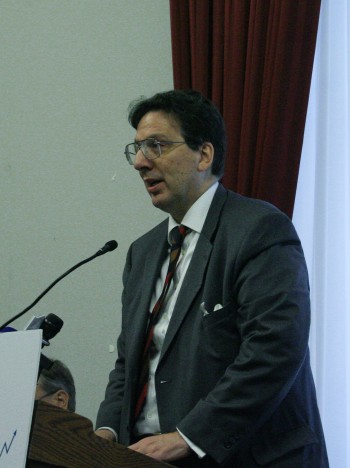
Other wiser foreign policy experts like him, Waldron said, take the view that “China refuses to be normalized to existing international norms, but wants to change things and have other countries play by her rules.”
Then Waldon listed the many violations of international law and human rights for which the communist regime is well known. Two of special note in the Taiwan context are worth repeating.
China is claiming “indisputable sovereignty” over the South China Sea—an area three times the size of France,” said Waldron. It recently stopped India ships on their way back from Vietnam. If other nations made similar claims, it would bring “total anarchy on the seas,” said Waldron.
Another point is that Japan has been mapping China submarine intrusions in its territorial waters and that number is colossal, said Waldron who has seen the maps.
Waldron said that if Taiwan was abandoned, Japan would be isolated and then we could not rely on Japan to remain pro-U.S. He added that if Japan and Korea are defendable, then Taiwan certainly is too.
The “Asymmetric” Deterrent
To defeat Taiwan, the PLA will have to invade with troops on the ground. China is gearing up to that capability, said Fisher.
“By 2020 the PLA could have about 1,000 4th, 4+, and 5th gen[eration] fighters compared to about 350 for Taiwan, and the PLA could also have 2,000 to 3,000 ballistic and cruise missiles for use against Taiwan, … 300,000 to 500,000 troops in the Nanjing, Guangzhou, and Jinan military regions have some degree of amphibious training. … Amphibious and Airborne training has become more intense over the decade.”
Under the 1979 Taiwan Relations Act, the United States is obligated to aid Taiwan in its capacity to resist coercion that threatens its security. But “If the U.S. lacks the resolve to sell new F-16C/D fighters to Taiwan in 2011, will it have the much greater resolve necessary to sell the 5th generation fighters that Taiwan will require in the 2020s?” asked Fisher, who is a recognized authority on the military of the PLA.
The solution to Taiwan’s increasing vulnerability lies in the United States aiding Taiwan in developing “asymmetric” defense options, said Fisher. Instead of trying to match the PLA missile for missile, man for man, and so forth, the asymmetric option would mean pursuing weaponry that would make the result of an attack on Taiwan too uncertain and costly for China.
“There is no other capability that does more to deter Chinese force against Taiwan than diesel-electric submarines,” said USAF retired Lt. Col. Mark Stokes, executive director, Project 2049. (Diesel-electric submarines are nonnuclear submarines.) With submarines, Taiwan would be able to withstand a first strike, and would thwart China’s capability to impose a blockade or launch an invasion, said Stokes.
Even though Stokes is an air force man, he sees the submarine as the best answer for Taiwan’s defense. Because it was considered an “offensive” weapon, it has not been supported. The TRA states that the United States is to provide Taiwan with arms of a “defensive” character. For 42 years Taiwan’s need for submarines has been tossed about. In 2001, the Bush administration reversed a long-standing policy and agreed to assist in providing Taiwan submarines. But the appropriation remains frozen today, said Stokes.
Of course, China objects to any proposal of the United States supporting a Taiwan submarine program.
Stokes said the Obama administration could choose to move forward on the first of a two-phase program for submarine acquisition. Alternatively, Taipei could develop its own program.
Submarines aren’t the only weapons that can be highly effective in making China think twice about invading. “MTCR [Missile Defense Control Regime] compatible (300km range) missiles offer numerous asymmetric advantages,” said Fisher. He offered several reasons, including that these missiles are difficult to detect and shoot down, and “can produce strategic results with tactical means—short range attack missiles can degrade the PLA’s SAM [surface-to-air missile] belt near Taiwan, allowing the Taiwan air force to fly more missions.”
If the United States won’t sell these long-range missiles because they are considered “offensive” weapons, then it might consider sensor fused munitions (SFMs). In 2010 the United States decided to sell India over 20,000 Textron SFMs. Without going into the operations of SFMs, suffice it to say, “20,000 SFMs would have the potential to destroy most of a 1,000+ ship PLA invasion fleet and most of the heavy armored vehicles that would succeed in landing on Taiwan. … SFMs offer the potential to give Taiwan the kind of ‘mass’ that the PLA cannot defeat,” said Fisher.