The rebellion comes amid reports that the glacier volcano is intensifying and a new ash cloud is heading south-east towards the UK and Northern Europe.
The International Air Transport Association (IATA) expressed their frustration at European governments on Monday April 19, criticising Europe’s “unique methodology” for making decisions “with no risk assessment, no consultation, no co-ordination and no leadership”.
“This crisis is costing airlines at least $200 million a day in lost revenues and the European economy is suffering billions of dollars in lost business,” complained Giovanni Bisignani, IATA’s Director-General and chief executive in a statement.
The IATA, which represents some 230 airlines, has called on the UN to co-ordinate a more effective decision-making structure, saying airlines had conducted their own test flights and the results had not shown any irregularities or safety issues.
“Not the slightest scratch was found” on any of the 10 empty long-haul planes Lufthansa flew Saturday April 17 to Frankfurt from Munich, spokesman Wolfgang Weber told Associated Press. The planes flew under so-called visual flight rules, between 3000 and 8000 metres (9800 and 26000 feet), where visibility is the guiding factor rather than instruments.
Eurocontrol, the intergovernmental air safety organisation that represents the 38 member states of the European Community, has remained firm.
On Monday April 19, two days after the test flights and the same day as the IATA statement, Eurocontrol said the skies would remain closed over Northern Europe.
“At the current time, air traffic control services are not being provided to civil aircraft in the major part of European airspace,” Eurocontrol said in a statement, “…including Belgium, Denmark, Estonia, Finland, Germany, Ireland, the Netherlands, northern Italy, Romania, Slovenia, Switzerland, parts of Ukraine and the UK.”
Undeterred, Lufthansa declared it would commence long-haul flights on Monday April 19 anyway, saying that it had special permission from Germany’s aviation authorities.
It also announced that it expected to commence all long-distance flights by Tuesday April 20.
Three KLM flights also left Amsterdam for Shanghai, Dubai and New York early Monday morning (April 19), ABC reported.
Airline Confusion
The lack of confidence in Eurocontrol is creating confusion for international airlines operating in the region.
Despite the clearing from Germany’s air traffic controllers, British air traffic chiefs on Tuesday April 20 said the situation had become worse.
“The volcano eruption in Iceland has strengthened and a new ash cloud is spreading south and east towards the UK,” said the National Air Traffic Services (NATS).
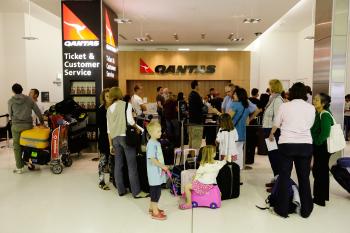
Conflicting information and responses were making it very difficult to determine when and where flights will resume, said Qantas spokesman David Epstein.
“We’ve got two aircraft on the ground there [Heathrow]. We can have them up and running within the space of about three-and-a-half hours,” he told the ABC.
“We’ve been in touch with Heathrow to get slots for them if the airport opens and we’re also in touch with other UK authorities, but at this stage, it’s still wait and see.”
Qantas says about 12,500 of its passengers have been affected by the delays.
Ash Deadly For Planes
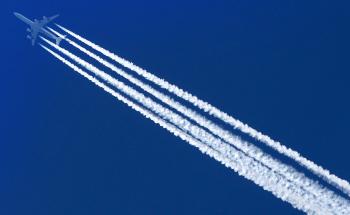
A British Airways Boeing 747 nearly fell from the sky in 1982 as a result of an ash cloud from the Galunggung volcano in Indonesia. All four engines stopped and the plane dived from 36,000ft (11km) to 12,000ft before three of the engines started and it was able to make an emergency landing.
Dr Lyazid Djenidi, an aerodynamics engineer from Newcastle University, said that while turbulence was also a factor as a result of volcanic activity: “You definitely don’t want ash in your engines.”
Dr Djenidi said that if he was responsible for 400 passengers on an aircraft, he would be erring on the side of caution when determining whether it is safe to fly.