Before Do-Si-Do
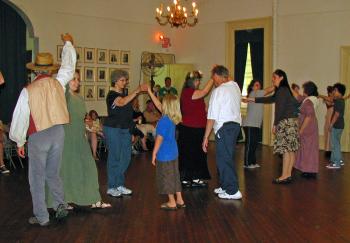
English Country Dance, or ECD, is believed to have origins as far back as the late 1400s; however, the first large scale publishing of dances was John Playford's "Dancing Master" in 1651. The earliest dances appear to have been in large circles, and suitable for dancing outdoors. Dances were performed in circles for three couples or four couples, the latter a precursor for today’s square dance, as well as “petit-squares” for two couples.
There are basic positions and movements that must be learned that are then incorporated into various dances with different degrees of difficulty. Dancer’s learn Corners, First Man and First Lady positions; and movements including Poussettes, Two Hand Turns, Casting, and a bit of pushing and pulling. Dancers spin through formations like Mr. Beveridge’s Maggot, Comical Fellow, Northdown Waltz, and Sunlight Through Draperies.
Usually the dances are “called” by a dance caller who tells the participants the movements to be executed. In some dance circles the calls are made until everyone has learned the dance.
ECD remained a social activity from the late 1600s to the early 1800s when it began to lose popularity due to rising interest in current traditional ballroom dances, like the waltz.
Historical Backdrop
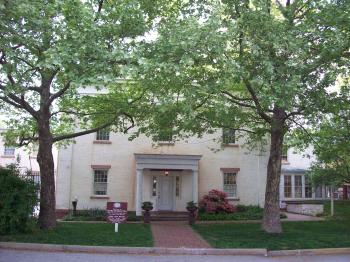
First habited by the Algonquin of the Lenape clan, the area was later settled by the Dutch in the 1600s. The British took control in 1646 and called the area the County of Richmond as a colony of New York. In the 1700s the town began to develop as a center of government. In the early 1800s, as Manhattan became more crowded, people saw Staten Island as a retreat. Wealthy residents built estates and resorts, and more towns were established around new industries as the area grew. Other communities were centered on maritime trades.
In 1837, as business thrived and the small town expanded, a courthouse was built and a small residential development emerged. However, by the end of the 1800s Richmond’s growth had slowed and little happened beyond the court sessions. Even 100 years ago, Richmond became known as an old-fashioned place, reputedly not keeping pace with the rest of Staten Island and greater New York.
Staten Island became a borough of New York City in 1898; some of the county functions were moved, and a new government center was built at St. George, closer on the island to Manhattan.
Not to be left behind, Richmond became the center of a local preservation movement. During the Great Depression of the 1930s, local residents, along with the Staten Island Historical Society (SIHS), which had been founded in 1856, formulated a plan for what Richmond Town should become.
Their work to preserve the entire village was considered an unprecedented volunteer effort. According to the SIHS website, these early preservationists, led by William T. Davis and Loring McMillen, believed that “saving evidence of the past could connect all of us to the real people who lived before us.”
According to the SIHS, in the 1950s the historical society signed a contract with the city of New York, promising to maintain and develop Historic Richmond Town as a museum village.
Read More…Dance Through Local History