
NEW YORK—As the stock market seesawed this week, with downturns motivated by investors’ uncertainty about America’s economy, the city and state proactively focused on New York’s assets and potential growth.
Stocks plummeted on Monday, rebounded on Tuesday, and took a plunge again on Wednesday morning.
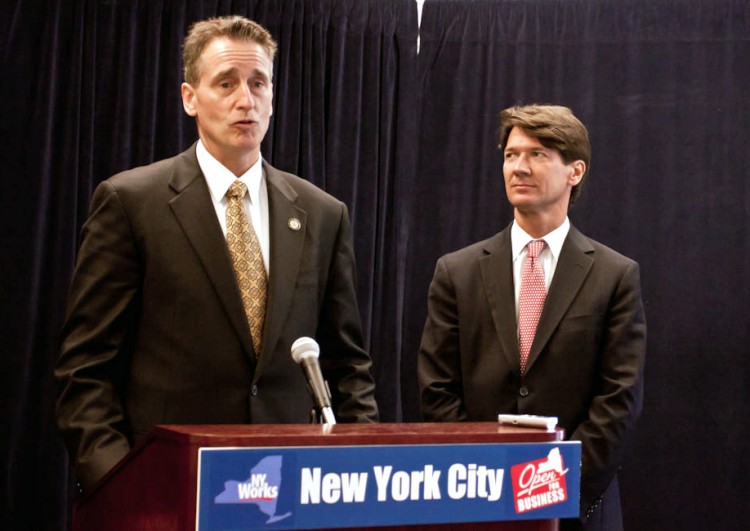
Incidentally, New York City’s new regional economic council established by the state met for the first time Wednesday morning—and not a word of crisis or despair crossed the table, reported Empire State Development (ESD) President and CEO Kenneth Adams.
“We’re taking the long view,” said Adams. “Everybody’s concerned about tumult in financial markets and the national debt crisis, and sort of broader economic conditions. … That is a powerful backdrop, but at the same time there is an acknowledgment that there is a chance, with the governor’s leadership, to build this new system for delivering economic development services and for making the most out of what we have.”
Gov. Andrew Cuomo established 10 regional councils across the state in July. The idea is to determine regional economic priorities and streamline the process of acting on them by bringing together state and city agencies, as well as business, labor, and community leaders at one table. Each region will establish a plan to address its top economic priorities by Nov. 14.
Among those sitting around the board table in Midtown Manhattan on Wednesday were representatives from nine state agencies, the Building and Trades Council, several local chambers of commerce, and City University of New York Chancellor Matthew Goldstein, who is also the regional council’s co-chair.
Although Wednesday’s meeting mostly established the structure and housekeeping of the council, the group began to outline priorities for New York City: job growth, technological industry development, and fostering start-ups. It identified high taxes, labor disputes, and the tangle of red tape that entrepreneurs have to plunge through as the primary obstacles to economic growth in the city.
The council will continue to solidify its goals and then form working groups, which will include community organizations.
Each regional council will compete for a $1 billion pot to realize its goals. ESD will provide $200 million and the rest will come from state agencies. Top projects might get about $40 million, according to Adams.
“This whole regional approach is going to be about synergy, not just competition,” said Lt. Gov. Robert Duffy.
The projects will weave together into a five-year plan for the state’s economic future.
When asked whether hydraulic fracturing, the controversial method of extracting natural gas from shale using massive amounts of water and some toxic chemicals, would be part of that future, Duffy deferred the question, saying Cuomo has not yet taken a definite stance on the matter. Natural gas could bring a flood of jobs and cash to the state, but environmental advocates ask at what cost.
“This works even in tough economic times,” said Adams of the new system of region-state collaboration. “I really do think there are very strong fundamentals in the New York economy. I think we’re just recovering from this incredible credit problem. … Just because of that, you don’t stop—you just have to keep moving forward.”
Mayor Michael Bloomberg had a similar message for New Yorkers when speaking on “Good Morning America” Wednesday morning.
Bloomberg said that now is the time to buy cement, while it’s cheap, and start building. He encouraged investors not to swing too far in the direction of caution now that there is a stigma around risk-taking.
“We need to focus on the future and get ourselves out of this,” the mayor concluded.