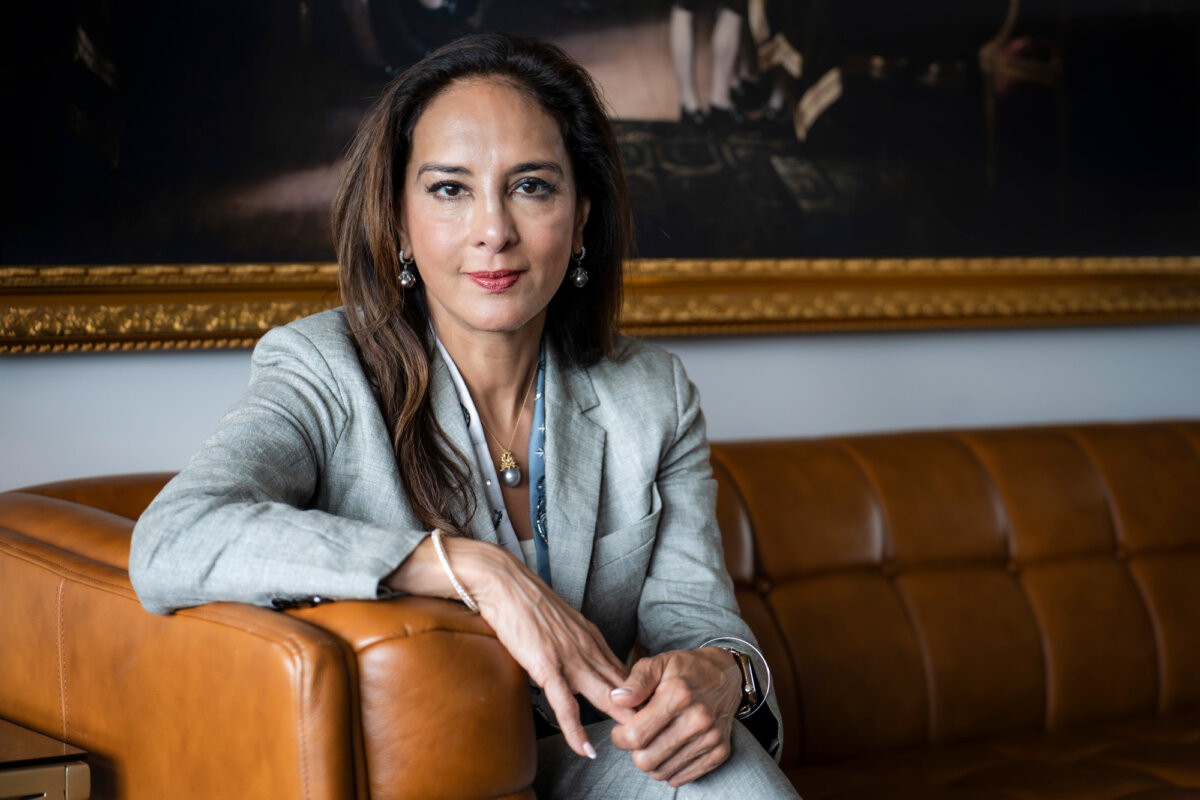
Former U.S. Assistant Attorney General Harmeet Dhillon says she’s not bitter about the circumstances surrounding her controversial departure from the Department of Justice (DOJ) Civil Rights Division.
“I’m not disappointed with anything. I didn’t resign over any policy issues,” she told The Epoch Times in a Nov. 11 interview.
Dhillon highlighted her accomplishments, expressed unwavering support for President Donald Trump, defended her actions, admonished her detractors, and called for change in the Republican Party.
She told then-White House Chief of Staff Susie Wiles in early October that she had accomplished her goals at the DOJ and planned to resign, she said, but Wiles asked her to stay on board until after the Nov. 3 midterm elections.
Dhillon agreed and officially submitted her resignation to Trump on Nov. 5.
She said her main reason for leaving was that she wanted to return to private practice at her own law firm.
Resignation
Dhillon dismissed the claims of two sources who told CBS that Trump demanded she be fired after her “60 Minutes” interview on Oct. 18. CBS cited one of the sources saying Trump felt Dhillon could have been more forceful in explaining the administration’s election integrity efforts.
Former U.S. Assistant Attorney General Harmeet Dhillon
“Most reporters in America didn’t report that B.S. because it’s false,” she said. “I tendered my resignation weeks ago to Susie Wiles, and she asked me to stay through the election. The president never called me or texted me and criticized me. I do not know if that’s even true.”
Dhillon suggested that people at the DOJ who didn’t like her may have used the narrative to undermine her after she unofficially resigned, or the rumor could have originated elsewhere.
“I don’t know, and I don’t care, but only CBS took the bait,” Dhillon said.
None of that matters, Dhillon said, because she told Wiles she was quitting during a one-on-one meeting at her office, before the interview aired. As the “top election lawyer” for the United States, Dhillon said she assured Wiles she’d stay on through the beginning of December, if necessary.
“We had talked about it, and so the fake narrative that whatever backstabbers in D.C. tried to peddle—nobody bought it except for one reporter,” she said. “All of my friends, including many people in the White House, had heard that from me after I tendered my resignation in early October. Everyone knew it.”
Serving the Country
Dhillon said it was always her dream to serve her country, for a while, “but not forever.”
Former U.S. Assistant Attorney General Harmeet Dhillon
“I took a 95 percent pay cut to come do this job. I moved from beautiful California … to not so beautiful D.C., and did it as a sacrifice,” she said.
Her husband and her father both passed away during the 2024 presidential election campaign.
“It was the right time for me,” she said. “I thought it was a good time to take a little break from 18 years of running my own law firm and the nonprofit that I founded and serve my country. I was proud to do it.”
She remains a staunch supporter of Trump’s agenda and the conservative movement and considers it a “tremendous honor” to be recruited by the president for the job.
“I supported and voted for President Trump three times,” she said. “That support hasn’t changed or wavered.”
Accomplishments
Former Civil Rights Division head Vanita Gupta, who served during the Obama administration, accused Dhillon of abandoning the division’s traditional mission to protect minority rights.
But Dhillon cited the dismantling of diversity, equity, and inclusion (DEI) policies at universities, corporations, and in government as a “legendary change of policy” and major accomplishment.
The Civil Rights Division, formed in 1957, has been one-sided in its approach, she said, “viewing itself as limited to protecting only certain people and not all Americans.”
Under her leadership, the department shifted its focus from the civil rights of minorities to those of all Americans, she said.
“We took the view that our civil rights laws apply to all Americans, and that was different,” she said. “The left freaked out about it. But that’s how the laws are written. The laws don’t say certain Americans are protected by the civil rights laws. The laws say they all are, and the court rulings say equal protection means equal protection.”
Dhillon said she accomplished more than any prior Republican head of the Civil Rights Division.
Those accomplishments ranged from personnel changes—including the recruitment of 130 people to join the division—to aggressive policy stances “taken and won” to tackling DEI policies, she said.
Dhillon also established the Second Amendment Section within the Civil Rights Division to protect gun ownership as a core civil right.
“The Civil Rights Division had never historically protected America’s Second Amendment rights, and we did that, and that’s been very popular and important work, and has really made a difference in tens of millions of Americans being able to enjoy the fundamental civil right to protect themselves,” she said.
‘No Purges’
While Dhillon’s critics described turmoil and high turnover in the department as a “purge,” she said, “almost nobody got fired from the Civil Rights Division.”
When asked whether she ran into a wall with holdovers from the Biden administration, Dhillon said, “I didn’t hit it. I blew it up.”
After she announced the department would enforce civil rights laws for all Americans consistent with Trump’s executive orders, about 300 lawyers chose to resign, she said.
“There were no purges. They quit. That’s not a purge,” she said. “They did not like my policies, and they saw that I wasn’t going to be bullied or intimidated.”
Dhillon also faced scrutiny for losing 27 of 31 lawsuits aimed at forcing states to hand over unredacted voter rolls to screen them for noncitizens, and for deploying more than 1,000 federal election monitors to observe the midterm elections.
Civil Rights Complaints
Both the DOJ and FBI have come under fire from many conservatives who have expressed disappointment over what they see as a failure to arrest and prosecute those responsible for the treatment and imprisonment of protesters and observers connected with the Jan. 6, 2021, protests at the Capitol Building following the 2020 presidential election. Dhillon said she couldn’t comment on cases she worked on during her tenure at the DOJ that may still be open.
Former U.S. Assistant Attorney General Harmeet Dhillon
Some conservatives have also criticized Dhillon for not doing enough to both prosecute those accused of civil rights violations during the COVID-19 pandemic and clamp down on schools that have refused to comply with Trump’s executive orders.
Much of the social media commentary from disgruntled conservatives indicates that “many people online are poorly informed and naive about the extent of the powers of the government,” she said.
“The job of the Department of Justice is not doing payback; it is enforcing statutes. Sometimes, there’s no statute that accomplishes what people think they want, sometimes there’s not enough evidence, sometimes investigations and grand juries take time,” she said.
Dhillon said she aggressively sought justice within the limits of her jurisdiction.
“There are dozens of investigations pending,” she said.
What’s Next?
Dhillon said she has returned to private practice at her law firm, Dhillon Law Group, which she has wanted to do for some time, and is considering renewing her involvement with the Center for American Liberty, a nonprofit organization she founded and led as CEO for years before accepting the DOJ position.
Though she is looking forward to new challenges and endeavors, none of those plans include running for public office or an elected position in the Republican National Committee, she said.
“I’m an entrepreneur,” she said. “And I’m really excited about that.”
Former U.S. Assistant Attorney General Harmeet Dhillon
Unlike some who serve in government too long, Dhillon said, she has no desire to burn out at a job, or become a talking head or lobbyist.
“That’s not me. I actually love being a lawyer,” she said. “I went back to the law practice that evening after I resigned, and my email is back on at my law firm. My phone is ringing off the hook.”
Never one to shy away from controversial issues, Dhillon admitted it was difficult for her, at times, to stay silent on issues in her position at the DOJ.
“I’m a multitasker, multifaceted commentator, lawyer, opinionated person, [and] politician. That was my life up until the day that I got sworn in, and then I was suddenly doing one thing, doing it very well, I think, but one thing,” she said.
“I’m really looking forward to doing many things again, because I’m an energetic and excited person, and just love being an American—love being a conservative.”
Vowing to continue the fight to protect First and Second Amendment rights, Dhillon predicted there could be “weaponization against conservatives by the left over the next two years,” and indicated she’s willing to take on those impending legal battles.
“There’s going to be a need for a lot of lawyers out there to defend our friends and our ability to have our opinions without being persecuted for them,” she said.
Gender Ideology
Dhillon, a champion of parental rights and foe of those who advocate medical interventions and surgeries in gender-dysphoric minors, vowed to continue her fight “for the rights of girls to not be mutilated by irresponsible doctors and discriminated against in sports.”
As founder and first CEO of the Center for American Liberty, she led the nation in “detransitioner” lawsuits, including the high-profile case of Chloe Cole against Kaiser Permanente, which is set for trial in San Joaquin County Superior Court on April 5, 2027.
As a child, Cole experienced gender dysphoria and was prescribed puberty blockers and cross-sex hormones, and at 15, she underwent a double mastectomy.
In her role at the DOJ, Dhillon enforced Trump’s executive orders against gender ideology. She helped secure hundreds of millions of dollars in negotiated settlements from American universities that the administration accused of violating the law, deals that also required the schools to change their policies.
Dhillon initiated investigations at 100 universities, rendering about two dozen or more settlements, she said.
“The rest of those cases are going to continue. I’m sure my successor is going to continue them and obtain more settlements,” she said. “There are dozens of investigations pending.”
Trump has tapped Craig Trainor as acting assistant attorney general to succeed Dhillon as head of the DOJ’s Civil Rights Division.
Controversy Over Sikh Prayer
Just days after resigning, Dhillon excoriated critics she says denigrated a Sikh prayer delivered at the mid-July 2024 Republican National Convention (RNC) in Milwaukee.
Dhillon wasn’t at liberty to comment for more than two years because she was committed to the campaign, confirmation hearings, and then work with the administration at the DOJ, but after the midterms, she accused her detractors of denigrating her prayer and said she was “deeply hurt.”
Former U.S. Assistant Attorney General Harmeet Dhillon
“My husband watched me pray in our Sikh faith at the RNC—and one of our last text messages before he died a couple of weeks later was telling me he was so proud of me. He was supposed to be there, but he was also dying from two serious illnesses, and he could not make it at the last minute,” Dhillon wrote Nov. 8 on X. “Our medical staff at home took care of him while he watched me pray in our faith tradition.”
She wrote that those “who have denigrated my prayer to the ONE GOD many faiths believe in, deeply hurt me for the last two years, but I could not comment.”
“It’s over. I won’t be silent any longer. Go read the First Amendment and my extensive record on behalf of ALL people of faith in America. For 34 years. And then let’s measure our respective records on religious liberty,” Dhillon wrote. “I intend to keep fighting for ALL people of faith in America for the rest of my life. But I won’t hide my own faith for one second. It’s protected by our Constitution.”
At the RNC, Dhillon donned a head covering and recited the prayer, called the Ardas, with the intent to demonstrate inclusiveness.
Sarvjit Singh Randhawa, her husband, died in August 2024 after prolonged battles with Parkinson’s disease and cancer. They were married for more than 13 years.
“He was very proud of me,” she later told The Epoch Times. “My family was very proud of me.”
“Showcasing different aspects of America at a political convention is the politics of addition and not subtraction, and that was my point,” she said. “Everyone stood and was respectful. I didn’t see anyone walk out.”
Trump clapped, and she received hugs and thanks from others at the convention, she said.
But soon after she recited the prayer, hateful posts surfaced on social media.
Dhillon said she wanted to represent the Sikh community at the RNC and send a message that people like her were welcome in the party.
“Members of the RNC have, with a couple of bigoted exceptions, been extremely kind to me and prayed with me. We pray together, pray over meals. We don’t all share the same faith. They’re Jews, they’re Christians, they’re Mormons, they’re Sikhs—all different kinds of people,” she said. “It’s a positive culture.”
Dhillon said she’s noticed a significant amount of anti-Indian-American sentiment and ethnic divisiveness in the United States in the past year.
“I don’t consider myself Indian American. I’m American, but I was born in India,” she said.
“I don’t know what extent of that is accelerated by foreign influence peddling. I certainly see a lot of it as bot behavior. I looked at it very carefully. The number of people who comment who have no followers, no likes, so I suspect it’s a paid foreign influence operation.”
Still, there were enough American podcasters and influencers who “decided to get clicks off of hatred against people like me” to raise red flags, she said.
“I found that very disturbing,” she said, stressing that the Republican Party needs to address anti-immigrant rhetoric within parts of the conservative movement.
“The Republican Party has a problem with anti-Semitism, Groyperism, and this anti-immigrant hatred,” she said. “It’s unfortunate.”
Trump won in 2024 by building a coalition that expanded the Hispanic and Indian American vote as well as the votes of all kinds of immigrants who saw a positive message from the party, Dhillon said.
As a California-based Republican activist, Dhillon said she was asked many times over the years to rally Sikh and Hindu voters to support Republican candidates.
“Indian Americans, Sikh Americans, people of my faith, have been in California for over 100 years. They are some of the biggest farmers in the United States, and many of them vote Republican,” she said.