
On Aug. 11, President Donald Trump federalized control over the Washington D.C. Metropolitan Police Department (MPD) and ordered 800 National Guard troops to be activated in the nation’s capital.
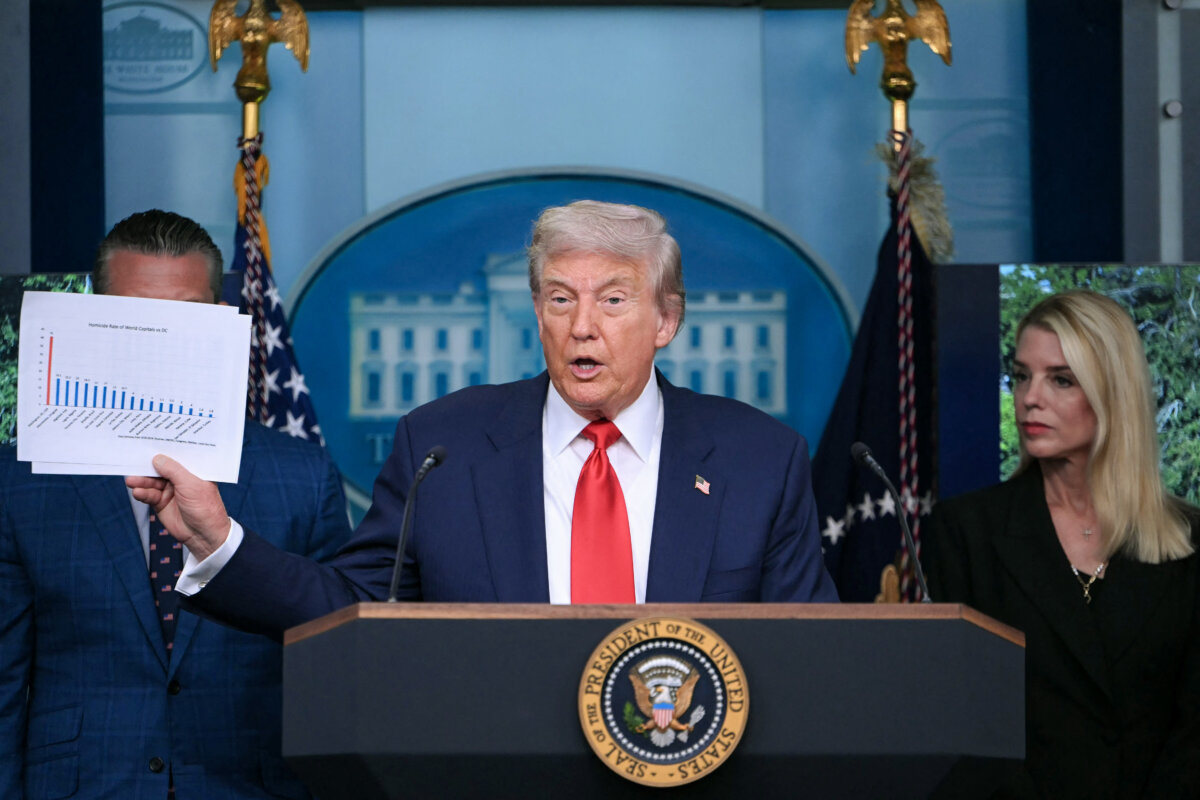
“I’m announcing a historic action to rescue our nation’s capital from crime, bloodshed, bedlam, and squalor, and worse,” Trump said at a White House press briefing. “This is Liberation Day in DC, and we’re going to take our capital back.”
As the president spoke, he compared the crime rate in the nation’s capital to those of some of the most crime-ridden cities around the world, including Baghdad, Mexico City, and Bogotá, Colombia.
In addition to federalizing local police and calling up National Guard troops, the Trump administration has surged about 500 federal law enforcement personnel to assist with the efforts in Washington.
Trump’s initial plan is to call upon about 800 troops, primarily assigned to the D.C. National Guard, to support a force of about 3,000 officers currently working with the MPD.
“I’m deploying the National Guard to help re-establish law and order and public safety in Washington, D.C., and they’re going to be allowed to do their job properly,” Trump said.
Although about 800 National Guard troops will initially be called up for this task, Trump said he’s prepared to call upon “much more, if necessary.”
During his press conference, Trump compared this new law enforcement crackdown in the District of Columbia to his administration’s existing efforts to secure the United States’ southern border.
According to a report recently published by the U.S. Department of Homeland Security, June had the lowest number of border enforcement encounters in recorded history, “just a fraction of what they were under the previous administration.”
Previewing his actions in an Aug. 10 post on Truth Social, Trump vowed that criminals would be jailed and homeless encampments cleared. He said the homeless would be given places to stay “far from the capital.”
During his press conference announcing the law enforcement crackdown in Washington, Trump said the number of carjackings there is triple what it was five years ago and that the number of car thefts is double what it was five years ago. He also said that the annual number of homicides reached a record high in 2023.
“Our capital city has been overtaken by violent gangs and bloodthirsty criminals, roving mobs of wild youth, drugged-out maniacs, and homeless people,” Trump said. “And we’re not going to let it happen anymore.”
Although the U.S. capital’s crime rate remains high, recent statistics indicate it has been on the decline.
Crime statistics released by the MPD indicate that the overall crime rate fell by 15 percent from 2023 to 2024, with homicide down 32 percent, all violent crime down 35 percent, and all property crimes down 11 percent.
Following Trump’s announcement, D.C. Attorney General Brian Schwalb wrote in a post on X that “the Administration’s actions are unprecedented, unnecessary, and unlawful.”
“There is no crime emergency in the District of Columbia,” he said. “Violent crime in DC reached historic 30-year lows last year, and is down another 26% so far this year.”
At an Aug. 11 press briefing, D.C. Mayor Muriel Bowser said the president’s announcement was “unsettling and unprecedented” but said she wasn’t entirely surprised by the move.
Bowser said Schwalb was reviewing the legal matters surrounding Trump’s announcement.
—Ryan Morgan, Joseph Lord, and Jackson Richman
A RACIAL CONSENT DECREE FALLS
History has many cunning passages—but the fall of a racial consent decree may have opened the door to something new, though with a deep history in American law.
A federal judge ended the 44-year-old Luevano agreement on Aug. 1.
It was meant to remedy alleged racial discrimination in a federal civil service test.
Black and Hispanic plaintiffs who had failed the test said it violated the Civil Rights Act, as white applicants passed at a higher rate.
In practice, the consent decree “effectively banned the use of civil service exams by the federal government in hiring,” said Norma Riccucci, a distinguished professor at Rutgers University.
Riccucci and others weighed in on what it all means to The Epoch Times.
Jeremy Carl, a senior fellow at the Claremont Institute, described this moment—the opening of the second Trump administration—as “a golden age for pushing back against these types of discriminatory policies.”
He and Marcus Thornton of Feds for Freedom, an advocacy group, hope competitive testing will soon rise again.
“It’s been a systemic issue across the federal government that we’ve deviated from merit-based approaches,” said Thornton, who is chief of staff at the U.S. Agency for International Development.
Some experts are critical of what has happened, which comes on the heels of other moves by the Trump administration to elevate what it calls merit over diversity, equity, and inclusion (DEI).
James Michael Martinez, a lawyer and assistant professor at Georgia Gwinnett College, said the decree “recognized that traditional measures of ‘merit’ were not always fair and equitable.”
“To the extent that the decree created space for persons of color to gain federal employment that they might not have gained, it was modestly successful,” he added.
Riccucci said that the president “does not want a diverse federal workforce.”
Luevano came almost a century after the 1883 Pendleton Civil Service Reform Act, which made merit the cornerstone of most federal hiring.
Before Pendleton, jobs were divvied out through the spoils system. Presidents handed them out to friends and allies with no guardrails.
“Many federal leaders wanted to create a class of public servants who secured their positions based on what they knew, not who they knew,” Martinez said.
Carl and Thornton hope that the decision heralds additional reforms to the federal workforce.
But Carl foresees resistance in the future.
“You’re going to have a background of people getting hired that is different from the backgrounds of the overall population. And at that point, some of the groups that feel like they’re being negatively affected may begin to start organizing and really pushing back on this aggressively,” he said.
—Nathan Worcester
BOOKMARKS
States are scrambling to redraw their congressional districts years ahead of time, as the GOP and the Democrats look to pick up extra seats ahead of the 2026 midterm elections. Jackson Richman sketches out the details in his latest report.
Trump announced on Aug. 11 that gold would be exempt from tariffs. Fears of a 39 percent tariff on Swiss gold had sparked panic-buying last week.
Ukrainian President Volodymyr Zelenskyy says that he and Canadian Prime Minister Mark Carney agree that Russian President Vladimir Putin is using the upcoming Aug. 15 peace meeting with Trump to stall for time. Zelenskyy’s statement comes from a readout of a phone conversation with Carney, but Carney’s record of the conversation is missing this comment.
Colombian presidential candidate Miguel Uribe Turbay has passed away after being shot during an election rally in June. Uribe’s condition took a turn for the worse on Saturday, after he began to suffer from internal bleeding.
California Gov. Gavin Newsom is asking Trump to halt the redistricting battle that has flared up across the country in recent weeks. “I am writing to ask you to call on the governor of Texas and other red states, who are acting on your request to draw new congressional maps through an unprecedented, mid-decade hyper-partisan gerrymander to rig the upcoming midterm elections, to stop those efforts,” Newsom wrote in a letter to Trump on Aug. 11.
—Stacy Robinson