
Alejandro Rios’s father had a decision to make: It was 1962, his family was living in the United States, and every year they traveled back to Cuba to visit extended family.
But this year was different. The island nation’s leadership had recently been overthrown by communists, and U.S.–Cuba relations were breaking down.
Rios said his father spoke to an official at the Cuban consulate, who warned him: “This is maybe the last time you can go over there and return … but maybe you won’t be able to come back.”
Concerned he might not see his parents again, Rios’s father decided to move the family back to Cuba. It didn’t take long for them to realize something was terribly wrong, but it was too late, and they were trapped.
His family had come to the United States when Rios was five; they returned to Cuba when he was about 12, and it took him three decades to get out again. In 1992, at age 40, Rios fled to the United States with his wife and has lived in Miami since then.
“We lost 30 years of our life,” he said.
Amid the rise of socialism in some sections of American society, Rios and others who escaped communist rule in Cuba and Venezuela sat down with The Epoch Times in a new documentary, “Red Flag,” to detail what life was like under those regimes and to issue a warning to Americans enamored by socialist and communist ideology.
‘From Heaven to Hell’
Fidel Castro toppled Cuban dictator Fulgencio Batista in a communist revolution in 1959.
Ninoska Pérez Castellón told The Epoch Times that, contrary to Hollywood film portrayals, there was no party atmosphere when the revolt broke out in Cuba. Officials were somber, and the people knew something was coming.
“And the next morning, it was like [going] from heaven to hell,” Castellón said.
A mob gathered outside her home—some were armed, and some attempted to ransack it.
The rebels kept returning, searching for her father, who was an official with the Batista regime. At one point, two revolutionaries began to argue over who would take possession of the family’s car; one fatally shot the other.
Castellón said that, although she was only eight years old, she immediately understood.
“If these are the good guys and this is a revolution, something is wrong here,” she said to herself. “Sure enough, they come in a few days later, and they confiscate the house.”
Eggs Per Month
Food scarcity and communism go hand in hand. After the Khmer Rouge seized control of Cambodia, for example, the country was plunged into a famine that claimed the lives of between 500,000 and 1.5 million.
Even more drastic results occurred in the Soviet Union—up to 10.8 million between 1932 and 1933—and in China—36 million between 1958 and 1962.
“That’s the way it works,” Rios said. “For making your life hell, they have a lot of resources for that. They don’t have resources for rice, for sugar, or for food, but they have resources for control.”
In Cuba, he said, people were forced to rely on ration cards to procure food. The cards were meant to promote the idea that everyone was equal by giving everyone the same provisions.
“You have this card, and they say for this month you have three eggs per person,” Rios said. “Okay, but maybe next month it will be six eggs. ‘Oh, we’re better because we have six eggs per person!’ Can you imagine?”
“Don’t praise communism while you’re drinking Starbucks coffee and tweeting on your iPhone,” said Francisco Poleo, a media executive and journalist whose family was forced to flee Venezuela.
“I left 10 years ago, in 2016 … The richest oil country in the world has basically become a state where you needed a connection to find toilet paper.”
—Stacy Robinson; Emel Akan
BOOKMARKS
The United States’ first nationwide surge against food-assistance fraud has led to charges against more than 40 suspects in schemes worth $45 million so far. About $42 million of the alleged fraud involved the Supplemental Nutrition Assistance Program, also known as food stamps.
A company whose polls were listed by a slew of outlets, including The New York Times, has said that all but one of its surveys were fake. Wedgewood Polling said this week that it was developed by people who previously worked in the poll sector and wondered how easy it would be for a fabricated polling firm to gain traction, be taken seriously, and “expose how little scrutinization exists in media and public commentary.”
The Trump administration has petitioned the Supreme Court to allow border wall construction to resume in the Big Bend area of Texas. Troy Myers has more details in his latest report.
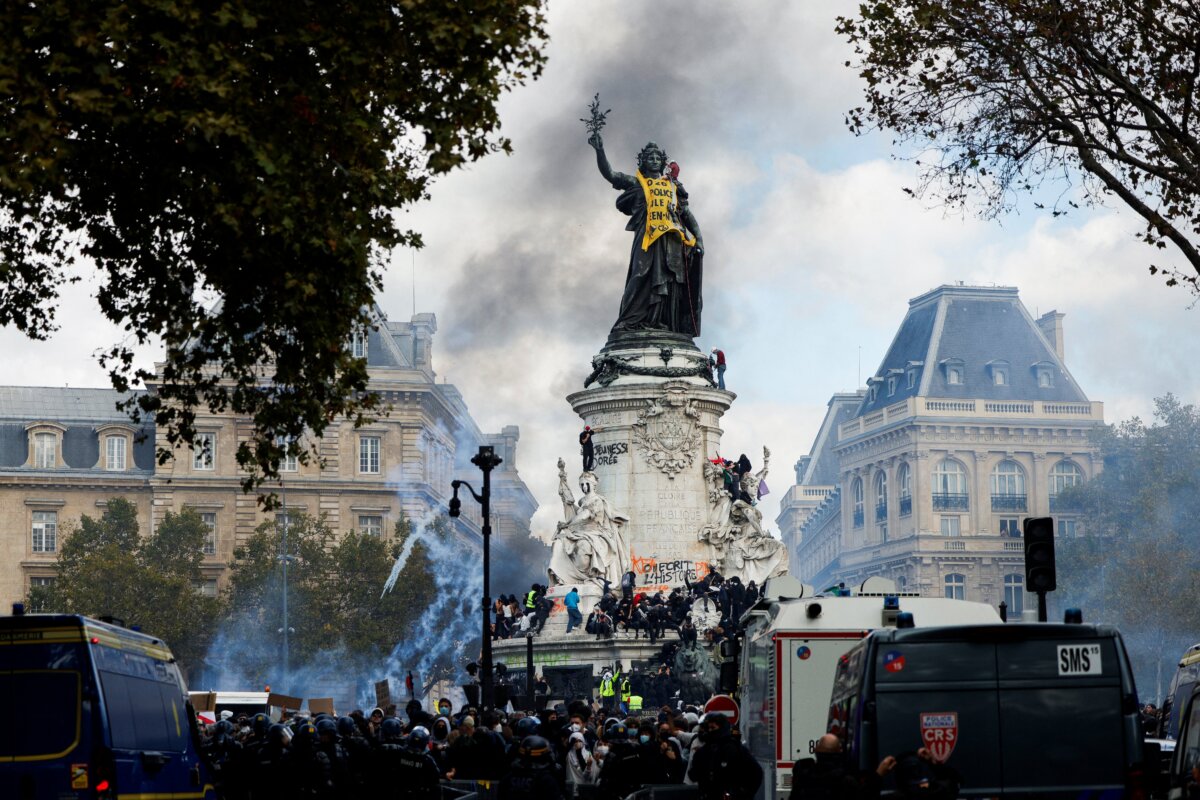
Italy approved new security measures this week, including a crackdown on taking part in violent protests, following recent unrest that swept through its northern cities and France. “Vandalism and theft are not protest, they are criminality,” Prime Minister Giorgia Meloni said in a video posted to social media, as she unveiled the tough new measures.
British Prime Minister Andy Burnham has reversed the Labour government’s previous ban on new oil and gas licenses and approved the Jackdaw gas field in the North Sea, as the UK seeks to boost its energy security. Check out Chris Summers’s latest report for more.
—Stacy Robinson







