
PARLIAMENT HILL—Prime Minister Stephen Harper has made free trade agreements a cornerstone of his economic policy, but most agreements passed to date have been relatively low-impact compared to the big game now being hunted.
This week’s about-face that saw the government change its stance from opting to stay out of the Trans-Pacific Partnership to instead looking for a seat at the table could come with a higher price than any previous agreements.
At stake are selected agricultural sectors under supply management regulations that put a quota system in place to stabilize and protect the hatching egg, chicken, dairy, egg, and turkey industries. The system limits producers and guarantees prices while sheltering those markets from imports by imposing stiff tariffs. But those tariffs could block Canada’s bid to join the TPP, raising concerns that supply management could be on the chopping block.
NDP interim Leader Nycole Turmel slammed the Conservatives’ bid to join the TPP Wednesday, describing the agreement as “wrong-headed.”
“Canadians want to know what’s actually happening behind the closed doors of trade negotiations,” said Turmel. “The Harper government is selling out Prairie family farms by axing the wheat board. We’re not going to let this government take away the tools that Quebec and Ontario farmers rely on to earn their living and feed our population.”
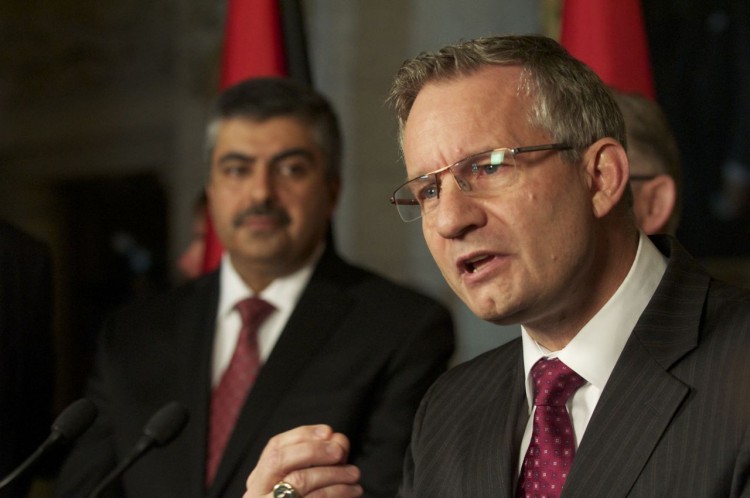
International Trade Minister Ed Fast told reporters that supply management would be vigorously defended. Fast made the remarks during a Tuesday press conference held to announce the final steps to implement free trade deals with Panama and Jordan.
“Canada will seek to defend and promote our specific interests in every sector of our economy, including supply management,” he told reporters.
Fast said the government changed its mind on joining the TPP after reviewing the framework for the agreement.
Free Trade a Controversial Cornerstone
While the government has concluded nine free trade agreements already, those currently in the works are proving more contentious, particularly the Canada-European Comprehensive Economic and Trade Agreement, which could open up municipal procurements to international competition.
Fast said CETA and a potential agreement with India are critical to Canada’s economic prosperity.
“Our government has made free trade one of the linchpins of our economic growth strategy going forward. It’s part of our global commerce strategy and right now there’s opportunities for us to expand … our trading relationships with some of the largest markets in the world.”
He points to India’s 1.2 billion consumers, and the EU’s 500 million as evidence of what Canada has to gain.
“Why would Canada not want to engage with these markets in a more integrated way. We have huge opportunities there.”
In his prepared remarks for that press conference, Fast said history has proven the benefits of free and open trade.
“It creates jobs, it deepens prosperity and it makes our country more competitive in the global market place.”
The Council of Canadians, one of Canada’s largest citizens’ organizations with a long history of opposition to free trade agreements, has also raised concerns about the TPP. The Council frequently argues that such agreements serve corporate interests and undermine member states in their efforts to ensure environmental protection and social justice.
On the Panama and Jordan agreements, Stuart Trew, a trade campaigner with the council, said they were economically meaningless because of the relatively small amount of trade involved. That said, those agreements would make it more difficult for those countries to put in environmental protections that might restrict Canadian mining companies operating there.
Fast said the agreements would remove upwards of 90 percent of tariffs on Canadian goods exported to those countries.
“But the TPP is another matter entirely,” said Trew, adding that the TPP raises many of the same concerns as CETA.
“That’s the extent to which this gets down into local procurement, access to medicines through stronger intellectual property roles that the U.S. is pushing, what kind of investor protections are going to go into this.”
The Council of Canadians and other groups are worried CETA could raise the price of generic drugs, or delay their introduction, by extending patent protections for drug companies.
Labour and environmental groups were originally optimistic about the TPP, said Trew, because U.S. President Barack Obama had promised it would be a next-generation trade agreement.
“What we’ve seen so far in the negotiations is in fact the U.S. trying to push everything it couldn’t get at the WTO,” he said.
Those efforts could undermine the job creation efforts in developing countries, said Trew. Developing countries have gotten strong at the WTO, able to protect themselves, and now the U.S. is using the TPP as a way to side step the World Trade Organization and secure more corporate-friendly trade relationships, he alleged.
Canada may be able to get into the TPP without sacrificing supply management though, or by reducing tariffs enough to satisfy the requirement without destroying the system, according to some analysts.
The TPP includes Australia, Brunei, Japan, Chile, Malaysia, New Zealand, Peru, Singapore, the U.S., and Vietnam and could rival NAFTA’s impact on the Canadian economy.