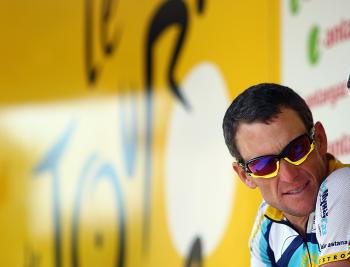
Lance Armstrong came back to cycling after three years off, and stepped right onto the podium at the Tour de France. For a one of the oldest riders in the Tour, this was phenomenal.
“I came; I did my best. That’s all you can ask for. I don’t have many regrets,” Armstrong said. “I came across some guys who were better than me, clearly better … Tactically I got put out a couple of times, but I think for my age, and considering the time away, it’s a good performance. I leave happy.”
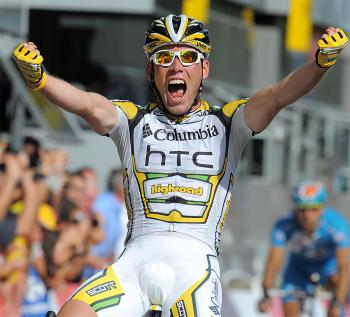
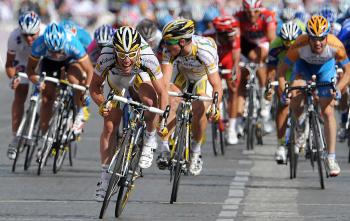
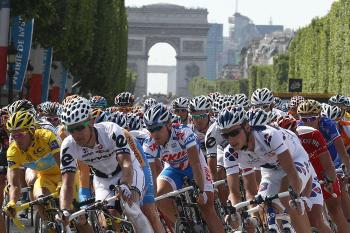
The last stage is always a stately procession until it reaches the Champs Elysees; then, the attacks begin. A seven-man attack formed, but on the final lap, Columbia simply shut them down, riding at 80 kph (50 mph) to take the lead and set up Cavendish.
Garmin made a valiant effort, taking the lead with Christian Vande Velde, David Millar, Julian Dean and Tyler Farrar, but they attacked too early. With a kilometer to go, Columbia attacked, with George Hincapie, Mark Renshaw and Cavendish. 750 meters out, Julian Dean surged up the right with Farrar, but Mark Renshaw rocketed away from the field, launching Mark Cavendish perfectly. No one else had a chance. Cavendish had no one anywhere near him as he crossed the line to take his sixth stage win.
Contador Earns the Honors
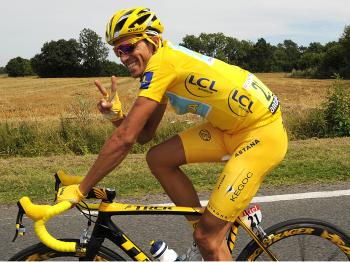
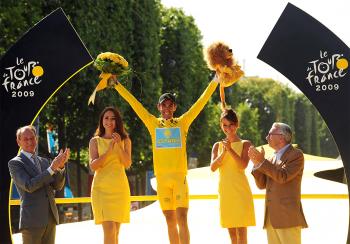
Team Astana rider Alberto Contador won the 2009 Tour de France in convincing fashion, beating the best in the worlds in the individual time trial and also in the mountains, clearly demonstrating that he deserved the yellow jersey in Paris.
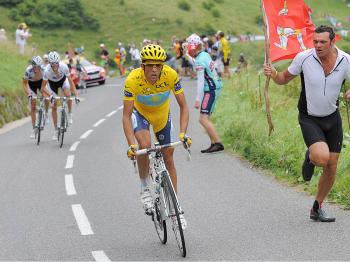
Alberto Contador excels in all types of cycling, but it was in the mountains that he showed his dominance. Starting in Stage Seven, on the Hors Categorie climb to Arcalis, Contador showed his prowess as a climber, launching an unanswered attack against opponents and teammates alike. On the run up Verbiers in Stage Fifteen, Contador took the stage win and the yellow jersey, leaving everyone half a minute behind. The lead was never seriously in question after that; but to show his cycling excellence, Contador came back with a win in the individual time trial, erasing any doubt whether he deserved the jersey.
Alberto Contador rode to win for himself; his impatience to win, after being denied a chance in 2008, led him to leave his team behind. This impatience was further exacerbated by the return of Lance Armstrong. Alberto Contador was hired to be Astana’s team leader before Armstrong announced his return to the sport. Once Armstrong announced he would be riding for his longtime coach and friend, Johann Bruyneel, at Team Astana, the media focused not on Contasdor’s return to the Tour, but Armstrong’s.
With tension within the team over who would actually ride as leader, Contador felt he had to prove himself. He did so often at a cost to his teammates. When he attacked on the climb to Arcalis, he left behind Lance Armstrong, who had been working hard for Contador and the team all day. And when, in Stage Seventeen, Astana seemed poised to go to Paris with a podium sweep, Contador attacked for no reason, dropping teammate Andrés Klöden, one of the real workhorses of the team, who had sacrificed himself to get Contador where he was.
All that aside, Alberto Contador did indeed show that he deserved to lead Team Astana, and to lead them onto the Champs Elysees. One might note Contador’s youthful indiscretions, but only after mentioning his amazing cycling abilities.
Many Winners, One Team
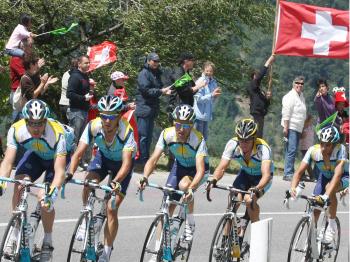
Astana finished with riders in first, fourth, and sixth; they came close to seeping the podium, a feat not repeated since 1914.
If Levi Leipheimer had not broken his wrist in a crash, he might well have finished in the top five. In fact, had he not crashed and had Alberto Contador followed team orders, Team Astana might well have captured the top four spots.
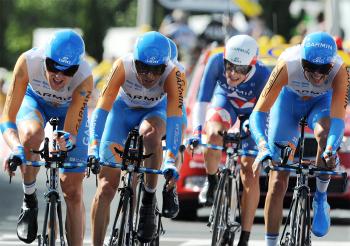
Second in team standings was young American squad Garmin-Slipstream. This team, formed for last year’s Tour with a pledge to ride absolutely drug-free, made a great showing last year, when Christian Vande Velde finished fourth. This year it was another Garmin surprise, Bradley Wiggins, who came from nowhere to challenge for the lead. Wiggins, a track cyclist, had never ridden up a hill a year ago. This year he climbed with the best in the business, and rode an amazing time trial, finishing sixth behind Britain’s national time trial champion, teammate David Millar.
Garmin also has one of the few sprinters who has ever beaten the Manx Missile; young Tyler Farrar has outsprinted Mark Cavendish in the past, and very nearly beat him in Stage Eleven.
This is a team that will only get stronger.
Six Stage Wins for Cavendish
Despite his dominating performance, Cavendish didn’t win the green jersey for the sprinters’ competition; that honor went to Thor Hushovd, who cleverly picked up intermediate sprint points to secure the lead. There was some controversy here: in Stage Fourteen, Cavendish was judged to have interfered with Hushovd in the final sprint, and Cavendish was relegated to the back of the pack, costing him thirteen points. Upon review, it looks like a questionable call at best, and certainly the penalty was extreme. Hushovd won by ten points; Cavendish lost thirteen.
Armstrong and Team RadioShack in 2010?
The biggest news of the 2009 Tour was the return of Lance Armstrong to the sport of cycling, and to the Tour de France. Armstrong retired after 2005, having won the Tour seven years’ running. He returned to promote his Livestrong Foundation, which raises funds to fight cancer and help victims.
As a cancer survivor, Armstrong is dedicated to helping others cope with the devastating disease.
Armstrong showed that despite being one of the oldest riders in the Tour, he is still one of the best riders in the world, finishing third against riders a dozen years younger.
George Hincapie, who was Armstrong’s teammate for his Tour victories, said, “To come back after three years off and make the podium in the Tour de France is an unbelievable accomplishment. [Lance is] probably the most amazing athlete of our time, out of any sport. It’s been impressive to watch”
Next year Lance Armstrong will ride for the newly formed Team RadioShack, and most likely will recruit his old teammates; possibly Levi Leipheimer and Andréas Klöden from Team Astana, perhaps Garmin rider George Hincapie. Johann Bruyneel will most likely be racing director.
This year Armstrong had only a few months of preparation; plus, he broke his collarbone in March in the Vuelta of Castilla and Leon, further hindering his training. Given a full year of preparation, he might well win his eighth Tour next year.
Regardless, everything Lance Armstrong does is covered by the press, and Armstrong has returned to cycling to use that publicity to aid cancer research. Even if he never wins a stage or a race, he has succeeded, and the Livestrong Foundation and all of cycling are the better for it.
No Doping Scandals
The 2007 Tour was a complete mess, with Team Astana’s Alexandre Vinokourov and Rabobank’s Michael Rasmussen caught using performance-enhancing drugs. Team Astana withdrew from the 2007 Tour; Team Cofidis also withdrew when Cristian Moreni was caught.
2008 saw improved enforcement and stricter penalties, as Tour organizers Amaury Sport Organisation (ASO) began calling the police to arrest riders using banned substances. Riccardo Ricco of Saunier Duval, Barloworld’s Moisés Dueñas, and Liquigas’s Manuel Beltrán were all caught and arrested, hauled off in handcuffs, as Tour organizers made the point that doping was not longer acceptable.
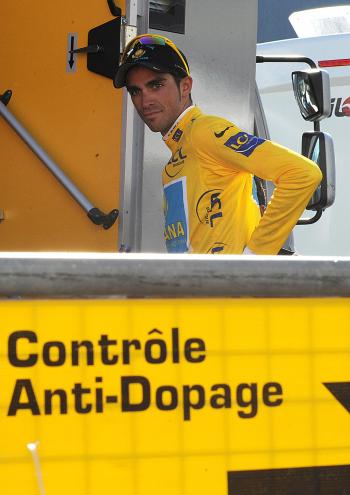
This year has been free of such scandal. Testing is at an all-time high (French officials have tested Lance Armstrong dozens of times) but so far, every test has come up clean. This is a complete reversal of past trends, when designer performance-enhancing drugs, transfusions, blood-cell injections, were widespread and tacitly accepted.
Teams like Garmin-Chipotle have opted for frequent voluntary tests at independent labs throughout the year, to prove beyond doubt that their achievements are untainted. Other teams seem at least to no longer be willing to look the other way.
For cycling enthusiast, this is a huge step forward. For years it was assumed that cyclists were drug users, and that the winners were the ones with the best drugs. Lance Armstrong helped turn that around, winning all his races while passing all his tests (and, as an American and a dominating rider, he was tested constantly) but once he departed, professional cycling had to demonstrate on its own that it was serious about riding clean.
It seems the ASO and UCI (International Cycling Union) have done that this year. And hats off to them for their success. May they remain ever vigilant.
|
Stage 21 Results |
|
Final General Classification |
||||||||
|
|
Rider |
Team |
Time |
Gap |
|
Rider |
Team |
Time |
Gap |
|
|
1 |
Mark Cavendish |
Columbia |
4:02:18 |
|
1 |
Alberto Contador |
Astana |
85:48:35 |
|
|
|
2 |
Mark Renshaw |
Columbia |
4:02:18 |
+00:00 |
2 |
Andy Schleck |
Saxo Bank |
85:52:46 |
+04:11 |
|
|
3 |
Tyler Farrar |
Garmin |
4:02:18 |
+00:00 |
3 |
Lance Armstrong |
Astana |
85:53:59 |
+05:24 |
|
|
4 |
Gerald Ciolek |
Milram |
4:02:18 |
+00:00 |
4 |
Bradley Wiggins |
Garmin |
85:54:36 |
+06:01 |
|
|
5 |
Yauheni Hutarovich |
FdJ |
4:02:18 |
+00:00 |
5 |
Frank Schleck |
Saxo Bank |
85:54:39 |
+06:04 |
|
|
6 |
Thor Hushovd |
Cervelo |
4:02:18 |
+00:00 |
6 |
Andréas Klöden |
Astana |
85:55:17 |
+06:42 |
|
|
7 |
José Joaqin Rojas |
Caisse d’Epargne |
4:02:18 |
+00:00 |
7 |
Vincenzo Nibali |
Liquigas |
85:56:10 |
+07:35 |
|
|
8 |
Marco Bandiera |
Lampre |
4:02:18 |
+00:00 |
8 |
Christian Vande Velde |
Garmin |
86:00:39 |
+12:04 |
|
|
9 |
Daniele Bennati |
Liquigas |
4:02:18 |
+00:00 |
9 |
Roman Kreuziger |
Liquigas |
86:02:51 |
+14:16 |
|
|
10 |
William Bonnet |
Bbox |
4:02:18 |
+00:00 |
10 |
Christophe Le Mevel |
FdJ |
86:03:00 |
+14:25 |
|