
CONGRESS RETURNS
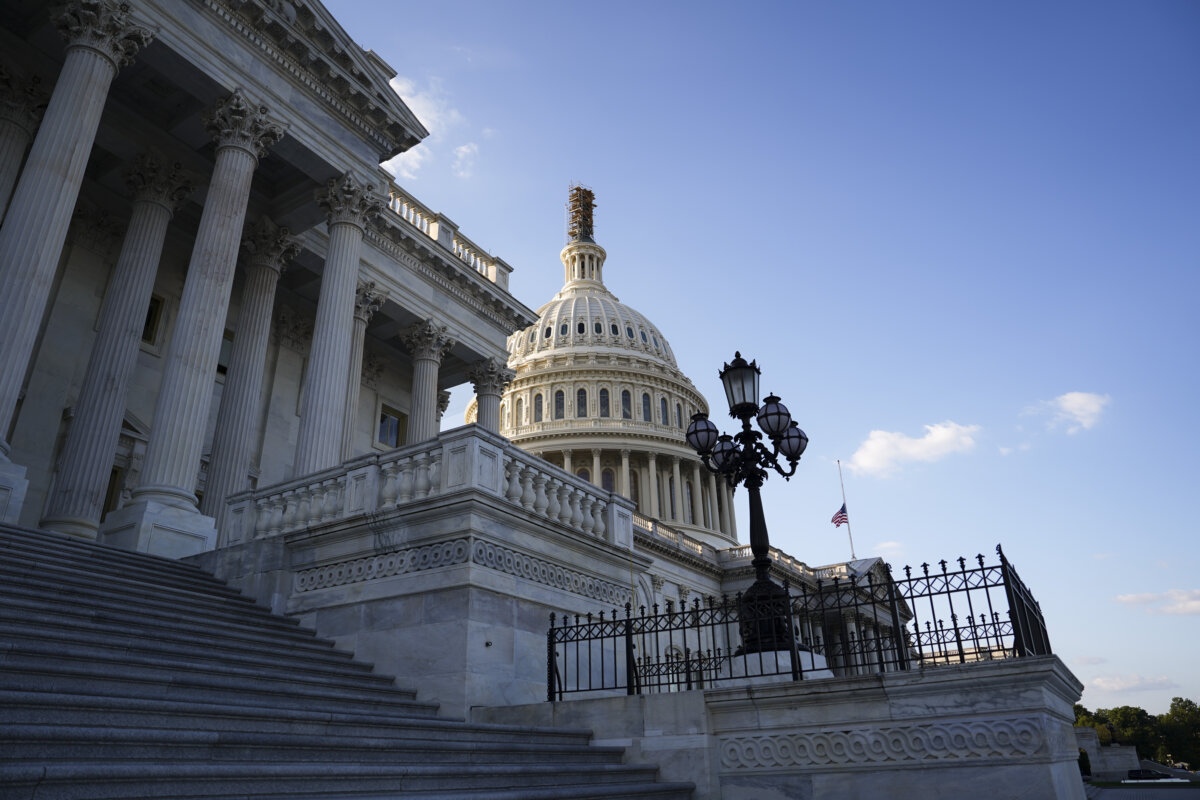
Lawmakers will return to Capitol Hill today with a busy agenda.
During its first session, this Congress failed to pass the 12 statutorily required annual spending bills, to agree on long-term funding for the nation’s air traffic system, or to decide the fate of a controversial 9/11-era surveillance law—all issues that will need to be addressed upon lawmakers’ return.

Lawmakers’ main priority will be averting a government shutdown.
Under a stopgap spending bill passed last year by House Speaker Mike Johnson (R-La.), the government is set to go into a partial shutdown on Jan. 19 if the Republican House and Democratic Senate can’t reach a funding agreement by then.
Yesterday, Johnson announced that substantial progress has been made toward averting a shutdown, with Democrat and Republican leadership agreeing to a topline amount on spending.
That amount comes to $1.59 trillion overall, including $886 billion for defense and $704 billion for non-defense—in line with the requirements of then-House Speaker Kevin McCarthy’s (R-Calif.) debt limit deal struck last year, codified in the Fiscal Responsibility Act (FRA).
However, the deal will likely face criticism from conservative Republicans, who have pushed for steeper spending cuts than those provided by the FRA—meaning Democratic support will almost certainly be necessary for spending bills to pass.
Senate lawmakers also failed to reach an agreement to provide funding for U.S. allies ahead of the break.
In exchange for funding for Ukraine in its war with Russia, Republicans have demanded substantial changes in U.S. policy along the southern border, where as many as 10,000 illegal aliens are entering the country each day.
Senators hoped to reach a tentative agreement on such a package ahead of the holiday recess, but failed.
Continuing these negotiations will be part of lawmakers’ busy to-do list when they return to Washington.
House Republicans will also continue their impeachment inquiry into President Joe Biden, formalized by a vote of the House last month—a move Republicans hope will give the inquiry greater force in court.
During a Jan. 7 appearance on Fox News’ “Sunday Morning Futures,” House Judiciary Committee Chairman Jim Jordan (R-Ohio) expressed confidence that many key witnesses would be brought in to testify this month.
However, Republicans have made no decision as of yet to pursue a formal impeachment against the president, Johnson told CBS News’ “Face the Nation.”
Additionally, Republicans will this week markup a contempt of Congress resolution against first son Hunter Biden, who last month spurned a subpoena to testify behind closed doors before the House Oversight Committee.
Also in Republicans’ sights is Department of Homeland Security Secretary Alejandro Mayorkas.
Mayorkas has faced sharp Republican criticism for his handling of the southern border, and Republicans have long considered impeaching him for dereliction of duty and failure to uphold U.S. immigration law.
Now, they’re poised to make good on those threats, with a formal hearing this week to consider articles of impeachment against the embattled secretary.
Finally, Republicans will today and tomorrow hear testimony from Dr. Anthony Fauci, former chief of the National Institutes of Health and architect of the United States’ COVID-19 policy.
—Joseph Lord and Lawrence Wilson
1 WEEK TILL IOWA
There’s only a week left until the 2024 election season gets well and truly underway with the first political event of the season in Iowa.
Iowa’s first-in-the-nation caucus is scheduled to take place on Jan. 15.
President Donald Trump continues to dominate the field in the crucial contest, where he’s hoping to lock down an early win by a large margin and make good on his claim that he’s the best-equipped candidate to clinch the nomination.
Recent polling has been nothing but good news for Trump’s aspirations to reclaim the White House.
RealClearPolitics averages place Trump at more than 50 percent support, over 30 points ahead of the runner-up, Florida Gov. Ron DeSantis. Trump is polling at 51.3 percent support, while DeSantis is polling at 18.6 percent support.
Behind the two frontrunners, former U.N. Ambassador Nikki Haley has 16.1 percent support.
Behind them, biotech entrepreneur Vivek Ramaswamy is polling at 5.9 percent support, former New Jersey Gov. Chris Christie at 3.7 percent support, and former Arkansas Gov. Asa Hutchinson at 0.7 percent support.
But despite his colossal lead, Trump has warned his supporters not to “sit back and rely on the polls.”
Still, Trump can afford to underperform in the state, as he’s still the nationwide favorite for the nomination, dominating nationwide polls as the double-digit frontrunner.
That’s a luxury some of his competitors don’t have.
DeSantis has gone all-in on Iowa, making an arduous campaign circuit of every one of the state’s 99 counties.
The map is much less favorable for DeSantis after Iowa.
Haley and Christie have poured their chips into New Hampshire, the second state to hold a 2024 electoral contest—and a state where Haley won the powerful endorsement of popular Republican Gov. Chris Sununu.
Afterward, Haley has a home-field advantage in South Carolina, where she previously served as governor.
But despite polling showing him at a disadvantage, DeSantis has told his supporters not to pay attention to the polls.
“The media wants to act like you guys don’t even matter,” DeSantis said. “I’ve looked at polls and past Iowa caucuses, and they never come out right.”
Ramaswamy, for his part, has predicted that the field will narrow after Iowa. But he’s said that he won’t be one of the candidates to drop out. Like DeSantis, Ramaswamy has spurned polling.
Should Trump clinch a large victory from the state, it will solidify his position as the Republican frontrunner in races to come and could prompt others in the race to drop out.
—Joseph Lord
JAN. 6 ANNIVERSARY
It’s been three years since the Jan. 6, 2021 “Stop the Steal” rally ended in the breach of the U.S. Capitol by protestors.
Since then, the event has become one of the most controversial in recent history, with narratives about what happened that day—and why—varying dramatically.
Democrats and the mainstream media have promoted the narrative that the Capitol breach constituted an “insurrection” against the United States government and an “attack on democracy” organized by Trump himself.
This argument, the narrative pushed by the now-defunct House Jan. 6 panel, has been used as the basis of efforts to have Trump removed from the ballot in several states.
That legal case is expected to go before the conservative-dominated Supreme Court, which is expected by legal observers to rule in Trump’s favor.
Republicans, meanwhile, have pushed back that the Capitol breach was at most a small-scale, disorganized riot, and have rejected arguments that the responsibility for it lies with Trump.
But even as the event itself recedes into history, its effects on modern politics and controversies—and those caught in the Department of Justice’s (DOJ) vast net of arrests and prosecutions—remain pronounced.
Over 1,200 Americans have faced arrest and prosecution from the DOJ in the past three years.
More than half of those arrested have faced sentencing on numerous charges.
The vast majority of these people—1,160—have been charged with entering or remaining in a restricted federal building or grounds, including 140 charged additionally with entering the area armed with a dangerous or deadly weapon.
Roughly a quarter have faced charges for “obstruction of an official proceeding,” a charge whose scope, critics claim, has been massively expanded to allow for its use in prosecutions. The Supreme Court is set to consider the legality of the DOJ’s use of this charge in the coming months.
All said, Jan. 6 defendants’ sentences add up to hundreds of years in prison.
But the largest sentences have been reserved for those deemed ringleaders.
Enrique Tarrio, the former leader of the Proud Boys, has been sentenced to 22 years in prison.
Stewart Rhodes, leader of the Oath Keepers, was sentenced to 18 years.
Many of those held on charges related to Jan. 6 have been incarcerated in the D.C. Metropolitan Jail, dubbed the “gulag” by critics for the treatment of Jan. 6 defendants there. Defendants have allegedly been deprived access to attorneys, faced verbal and physical abuse from guards, and had their basic needs and health neglected.
Those critical of the DOJ have argued that it has methodologically deprived Jan. 6 defendants of due process rights, and violated an array of rights guaranteed by the Bill of Rights, a form of law that one critic dubbed “Jan. 6 jurisprudence.”
Even former Attorney General Bill Barr—by no means sympathetic with Jan. 6 protestors’ aims—has said that the DOJ has gone too far in its efforts to prosecute those present that day.
And three years after the fact, many questions linger about the events of Jan. 6. These include the deaths of protestors that day, and still-unanswered questions about whether—and how deeply—law enforcement was involved.
The political effects of Jan. 6 are likely to continue into the election season.
President Joe Biden has echoed his party’s belief that Jan. 6 constituted an attempted insurrection, an argument he’ll likely rely on as he tries to sway voters against Trump this year.
Trump, meanwhile, has acknowledged that Jan. 6 is likely to remain an aspect of the race in 2024, and has predicted rising political persecution over the event as the election draws nearer.
—Joseph Lord
WHAT’S HAPPENING
- The Senate and House reconvenes after the Christmas break.
- Dr. Anthony Fauci appears at a closed-door interview before the House Select Subcommittee on the Coronavirus Pandemic.
- Biden delivers a speech for a campaign event at Mother Emanuel Church in Charleston, South Carolina, a historic black church that was the site of a mass shooting in 2015.
BOOKMARKS
On Jan. 6, 2021, Ashli Babbitt, a veteran and unarmed protestor present at the “Stop the Steal” rally, was fatally shot outside the speaker’s lobby in the Capitol by Lt. Michael Byrd. Babbitt’s death went largely uninvestigated and Byrd was later promoted to captain. Now, The Epoch Times’ Joseph Hanneman reports in an exclusive article that Byrd made a false statement over the radio claiming he was being fired at—a claim disproven by footage of Babbitt’s final moments.
Trump handily defeated DeSantis in two Florida straw polls, The Epoch Times’ Jacob Burg reports. The outcome is a tough blow for DeSantis in his own state, where he won reelection in 2022 by over 20 points, and a sign that Trump maintains a strong lead against the governor.
Secretary of Defense Lloyd Austin, one of the least public Pentagon chiefs in recent history, is facing backlash after he failed to report to superiors that he was hospitalized and unable to perform his duties. In a report on the issue, Politico explored the backlash to Lloyd and calls for him to be disciplined or fired.
Rep. Lauren Boebert (R-Colo.) is facing scrutiny after police were called to investigate an alleged physical altercation between the controversial lawmaker and her ex-husband at a restaurant over the weekend, The Daily Beast reports.
Hamas is being aided in their war against Israel by China, the Telegraph reports, aided by a “massive” stockpile of high-tech Chinese weaponry including assault rifles, grenade launchers, and telescopic sights.