
The Convention on Cluster Munitions (CCM) went into effect on Sunday, however, it has only been ratified by one-third of the countries that are signatories to it.
Under the convention, signatory countries are prohibited from the manufacturing, using, and stockpiling cluster munitions. The pact was negotiated in Dublin in May 2008. So far 107 countries have signed the treaty, but only 38 have ratified it.
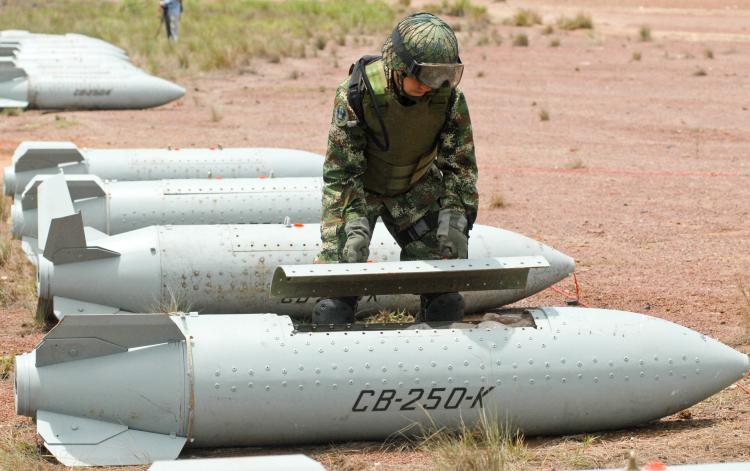
Cluster bombs, weapons containing hundreds of smaller munitions that spread over a large area when fired, are used by military forces against infantry as "anti-personnel" explosives.
The munitions are highly controversial because upon detonation they spread over a large area and cannot distinguish between military and civilian targets. Bombs that fail to explode when they hit the ground act as landmines causing large numbers of civilian casualties, according to the Cluster Munition Coalition, a campaign against the use of cluster bombs and other similar devises.
Some countries that hold large stockpiles of the weapons and have not signed the treaty include the United States, Russia, China, Israel, India, and Pakistan.
Washington has insisted that cluster munitions are legitimate weapons. However, in July 2008, the United States announced that by the end of 2018 it would no longer use cluster munitions that had a failure rate of more than 1 percent,.
The convention establishes important commitments assisting victims to clean areas contaminated with the bombs within 10 years, and to destroy stockpiles within eight years, according to NGO Landmine Action.
Remnants of war such as unexploded ordinances (UXO) have led to high level contamination in areas across the world, including the Middle East, Southeastern Europe, the Caucasus, the Horn of Africa, Central Africa, and Asia-Pacific countries.
Oftentimes, UXOs are triggered when people tamper with them—either by moving them to continue farming, or when young children play with them out of curiosity. World Education reported that nearly half of all UXO victims are children.
Clearance operations are still ongoing in Laos, more than 30 years after the “secret war” there that left 75 million unexploded cluster bombs across the country, according to the U.N.
"This new instrument is a major advance for the global disarmament and humanitarian agendas,” U.N. Secretary-General Ban Ki-moon said in a statement.
"[It] will help us to counter the widespread insecurity and suffering caused by these terrible weapons, particularly among civilians and children."
Ban Ki-moon called on all member states to support the November meeting on the convention by taking part in it, while urging those nations that have yet to join the treaty “to do so without delay.”
"Nations that remain outside this treaty are missing out on the most significant advance in disarmament of the past decade," Human Rights Watch said in a statement.