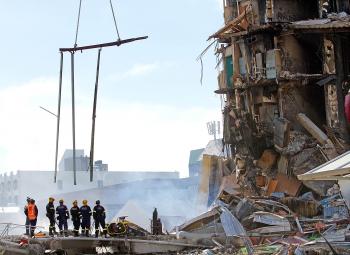
As rescuers continue to sift through the devastation that remains of Christchurch’s central business district (CBD), experts are looking, not only at what had been effective in reducing fatalities, but also at ways to mitigate future loss of life.
Dr Robert Heath, a specialist in crisis management at the University of South Australia, said the quick action by Australian and New Zealand rescue services had been vital in the critical hours and days after the crisis.
“The synchronisation and meshing of multiple agencies across large regions seems to work very well,” he said. “We are practised at being able to send off assistance thousands of kilometres.”
Academic Dr George Walker, a specialist in earthquake engineering, building codes and disaster risk management, says the loss of life, which is likely to reach over 200, was largely due to building collapse and there were areas in New Zealand’s building codes that would need to be reviewed. Dr
Walker did his doctoral thesis on earthquake engineering in New Zealand and is now an adjunct professor of building and construction at Australia’s James Cook University in Queensland.
He said New Zealand had one of the most advanced earthquake building codes in the world, saying: “It virtually incorporates everything we know about earthquake engineering.”
The Christchurch earthquake, however, had identified areas that need to be strengthened.
“Pre-modern” buildings
New Zealand, unlike Australia or indeed most countries that are vulnerable to natural disasters, had taken a radical step some years earlier “to mitigate disaster” by requiring that all old buildings built before the 1970s be assessed on their ability to survive an earthquake. If they appear sound, they may be left, but if not, they must be strengthened or even demolished.
“I think it will turn out that nearly all the people who have been killed have been killed as a result of failure of what we might call “pre-modern code buildings”, he said. “In other words, buildings that would come under the scope of this legislation about looking at old buildings.”
“As a result of this [the recent quake], they may well have to review that part of the legislation or one of the procedures,” he said.
Another area that was vital to review was “foundational design”.
Liquefaction
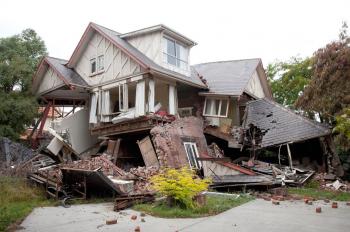
Dr Walker said one surprising effect of both Christchurch earthquakes was the amount of liquefaction occurring.
Liquefaction is where water-logged sediment seeps up from the ground, usually indicating a lot of air and instability in the ground.
In this event, it seems to have indicated that there were areas of ground throughout the Christchurch region that were alluvial, not compacted and unstable.
Dr Walker said he believed that the Hotel Grand Chancellor, which was relatively knew and one of the tallest buildings effected in the quake, was damaged to the point that it will have to be demolished because of liquefaction occurring at its foundations
Alluvial soils, however, were not the problem, he said, as there are many cities around the world built on river flats.
“Engineers have tests for determining this sort of thing,” he said, “The issue is being able to recognise that the ground is susceptible.
“Maybe the tests need revisions. That would seem to be more the likely thing”.
Awareness Critical to Survival
“They tend to occur in groups,” he said, citing clusters of quakes that had impacted regions throughout New Zealand during the last century.
“If history repeats itself, we could expect over the next 10 years maybe two or three more somewhere in NZ,” he said.
While this may be nerve-wracking for New Zealander’s, Dr Heath said there were certain advantages in being aware of the threat.
While it is difficult to predict exactly where a quake will hit, there are areas that are more vulnerable to earthquakes than others and one of the biggest dangers was complacency.
He said awareness on both individual and community levels is critical to survival, saying people should know about what needs to be done and what procedures are in place.
Communities and organisations that are vulnerable should have emergency plans in place, annual “tabletop” drills of coordination at once every three years, “a field-type exercise”.
For individuals, emergency packs were essential, he said, and should minimally contain a radio with spare batteries, a mobile phone and spare battery, a torch, water, food, essential medication and, if possible, a bucket, drop sheet and a change of clothes.
In the more earthquake vulnerable areas of Japan, there are emergency packs at every front door, he said, replete with a hard hat.
Know Your Community
Dr Heath said that with the benefit of hindsight, not only after the first Christchurch earthquake in September last year, but with experience from other disasters in Australia, emergency services were now able to swing into action quickly.
“They are able to pull together and pool information across the region and that allows them to then start deploying where they are best needed,” he said.
While this had proved effective in helping people in the CBD, it drove most of the attention to the city area, leaving communities outside Christchurch without help for some days.
With this in mind, staying in contact with local communities and looking out for each other would be vital in earthquake-prone urban areas, particularly in larger cities of 1.5 million or more, he said.
“We have to keep reminding people, no matter how practiced we are, how resourced, how webbed the world is so that people come to our help from offshore, ultimately, for the first 24 hours to 72 hours, especially if you are in the suburbs, you may be on your own.
“You need to start thinking about how you work amongst your neighbours, how to help others, how to keep yourself going till help can arrive,” Dr Heath said.