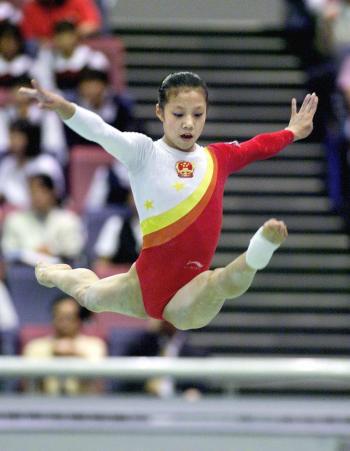
The International Gymnastics Federation has ruled to “cancel” a Chinese gymnast’s bronze medal from the 2000 Sydney Olympics for being under regulation age, but the International Olympic Committee (IOC) has yet to make a final decision whether to strip her of her medal.
Following a year-long investigation, the Switzerland-based international gymnastics body known as FIG (Federation International Gymnastics) has ruled that Dong Fangxiao’s age was falsified and that she was only 14 years old when she competed in Sydney. The legal age for gymnasts is 16.
Dong now faces being stripped of her bronze medal, which she claimed together with three other athletes in the women’s team event.
“Clearly, we need to take time to consider the findings before the executive board can consider the matter,” said IOC communications director, Mark Adams. “We would like to thank the FIG for their work and we would refer further enquiries to them.”
When Dong registered to compete in the Sydney Olympics, her birth date was listed as Jan. 20, 1983. When she applied for accreditation to work as an official at the Beijing Games in 2008, she listed her birthday as Jan. 20, 1986.
Other evidence considered by FIG included the fact that on her personal blog she said she was born in the Chinese Year of the Ox, which corresponds to the year from Feb. 20, 1985 to Feb. 8, 1986.
Beijing Games Age Scandal

The FIG investigation was triggered by more recent suspicions that Chinese gymnasts at the 2008 Beijing games were also underage. The row attracted international attention from both media and sporting bodies, who have called for more scrutiny to be applied to age verification.
The two girls in question in 2008 were He Kexin and Yang Yilin. He Kexin won gold in the uneven bars and Yang won bronze on the uneven bars and another bronze for her overall individual competition. Both gymnasts were also part of China’s women’s team gold medal.
Multiple sources found Chinese Web sites that indicated that He Kexin and her teammate Yang Yilin were 14 years old at the Beijing games.
The Epoch Times found at least nine articles published on state-run Chinese sites that listed a birth date for He Kexin—making her 14, not 16 as Chinese authorities claimed. Soon after the scandal erupted, most of the incriminating data disappeared from the Internet. Some evidence was retrieved in cache versions of the sites.
If the documents are accurate, then China’s communist regime has issued passports to the girls with fake birth dates, to allow them to compete.
The FIG has determined that there was not enough evidence to confirm that the athletes’ documents presented at the games had been falsified and so it dropped the case.
Beijing Olympics Bid Rigged
Doubts remain if the IOC will investigate the two gymnasts’ ages, particularly after it was revealed that the 2008 Olympic bid process was tainted by accusations of corruption by a former Chinese volleyball coach, Yuan Weimin. In his new book, Yuan reveals that the Chinese regime struck a deal with European IOC members to vote for Beijing, in exchange to get China’s support for Belgian Jacques Rogge as IOC president.
The IOC has denied the accusation made in the book Yuan Weimin and the Sports World.
“Jacques Rogge was elected IOC president by a large majority,” the committee said in a statement from Lausanne, Switzerland. “As a candidate, he built his campaign on a strong program that was widely welcome by IOC members. Any insinuation that deals would have been made is absolutely false.”
Yuan wrote that, while there was no written agreement from either the Chinese or the European group, multiple meetings yielded a mutual understanding of support if Rogge won the election.
Click www.ept.ms/ccp-crisis to read about the most recent developments in the ongoing power struggle within the Chinese communist regime. In this special topic, we provide readers with the necessary context to understand the situation. Get the RSS feed. Get the Timeline of Events. Who are the Major Players?