
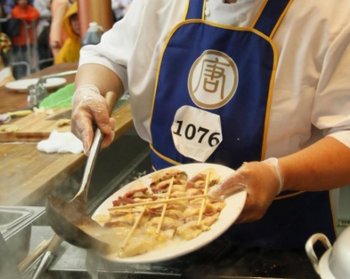
Sandwiched between gargantuan Broadway musical billboards and blinding LED screens, on Friday Oct. 3, NTDTV’s 3rd Annual International Chinese Culinary Competition transformed New York’s most iconic destination into a scene straight from the ancient Tang dynasty capital of Chang’an.
Contestants cooked their dishes in five cooking stations specially designed for the occasion. The stations, complete with classic ceramic roofs and high BTU units to fire up iron woks, was truly an amazing feat of design and engineering. Men and women clad in traditional clothing served the dishes to the panel of judges and the VIP patrons. Finished dishes were carried from the cooking stations to the judges in portable wooden tables used in antiquity for preparing the emperor’s meals when he went hunting.
At the sound of the gong, 35 master chefs from around the globe started work in the final rounds on Friday. Seventeen of them survived the first round of elimination at the preliminaries held on Thursday, while the other 18 passed the preliminaries for the Asia-Pacific region held earlier this year in Taiwan.
Five Distinctive Cuisines
NTDTV, an independent Chinese language television network with a mission to revive traditional Chinese culture through their Global Competition Series, required its contestants to use traditional Chinese cooking techniques and ingredients to cook dishes from five regional cuisines of China: Szechuan, Shandong, Cantonese, Huaiyang, and Northeastern.
Szechuan cuisine specializes in the spicy, with over 9 different varieties of spiciness in its stock of over 20 basic flavors, the most out of the 5 cuisines, according to the competition’s website. The peppercorn is often used in dishes to leave a sensation of numbing hotness on the eater’s tongue.
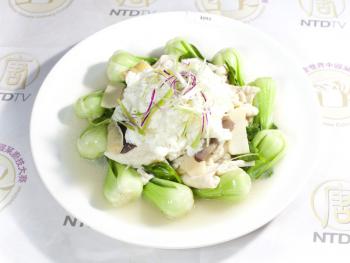
Due to its subtropical, humid climate, Cantonese cuisine is light in its flavoring and involves the use of local fresh ingredients, often seafood. Cantonese cuisine is perhaps the most familiar for the West, as many Chinese restaurants serve Cantonese food.
Huaiyang cuisine gets its name from its location in the lower reaches of the Huai and Yangtze River valley. It emphasizes retaining the natural flavors of the ingredients and thus involves a lot of braising, stewing, roasting, and boiling.
Northeastern cuisine is usually cooked in hot pots and casseroles, as the region is exceptionally cold. Many of the dishes’ ingredients are wheat-based, as the climate there is too cold to grow rice. Many of its cooking techniques derive from the imperial court, as the Ming and Qing dynasty court was located at the Forbidden City in Beijing.
Continued on the next page…