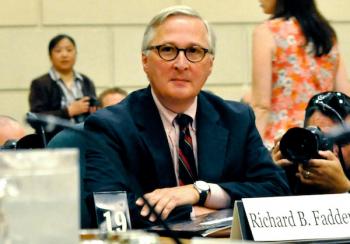

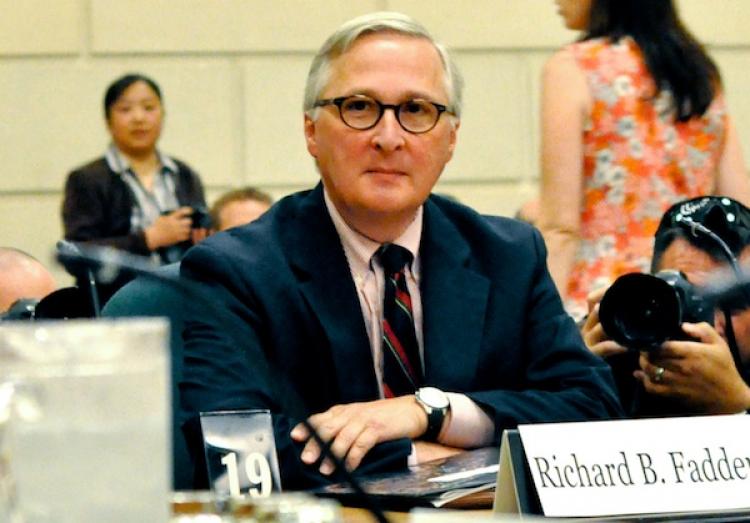
That's the opinion of a former chief of strategic planning at Canadian Security Intelligence Service (CSIS)—the Canadian equivalent of the CIA—following a parliamentary committee that grilled CSIS Director Richard Fadden over comments he made in a controversial interview where he said some Canadian elected officials are under foreign influence.
Former chief, David Harris, is also one of Canada's leading experts on terrorism. Harris watched the committee on Monday and left with concerns over why politicians barely touched the substance of Fadden's remarks, instead focusing almost exclusively on the political implications of what he said.
Harris said the lack of interest in whether foreign regimes were infiltrating Canada's basic democratic institutions was a sad commentary on the state of some parliamentarians.
"Are we finding our basic public policy, political, foreign policy, trade, economics subject to manipulation by foreign agents? That should be the big question. It wasn't especially addressed at this meeting and Canadians should be concerned about the reasons for that."
Fadden faced tough questions and calls for his resignation on Monday over comments he made in an interview with the nation's public broadcaster on the eve of Chinese leader Hu Jintao's visit to Canada. In his comments, the spy boss said some politicians, including two provincial Cabinet members, were suspected of being under the influence of a foreign regime.
He also said Canadians of various ethnicities could be used in such efforts and singled out China as the country most aggressive in recruiting political prospects starting at the university level.
Fadden also said some politicians and public servants have a long-standing relationship with Chinese operatives and have no idea they are being used to advance Beijing’s interests.
When asked if he thought he owed an apology to the Chinese community, Fadden replied “no” saying cases were extremely rare and those people being used to gather intel were the victims.
“I don't think they are the problem, I think the foreign power is the problem.”
Some members of Parliament from the Bloc Quebecois, a separatists party that aims for the political secession of Quebec from Canada, expressed particular outrage at Fadden, accusing him of sullying the reputation of Canada's entire political class, a statement Fadden said was exaggerated.
While a motion to call for Fadden's dismissal was rejected because it required debate, the chair suggested the committee would reconvene for that discussion. It is not clear if they will undertake a detailed review of foreign influence.
In the United States, two congressional commissions examine China and issue an annual report to Congress. No such equivalent exists in Canada.
It was only toward the end of the hearing, and in a few rare moments, that parliamentarians directed themselves toward the issue of foreign influence.
MPs from the governing Conservatives and official opposition Liberals, the two dominate parties in Canada, both brought up the example of the Russian ring recently broken up in the United States.
That spy ring included undercover Russian agents posing as Canadians. The U.S. Justice Department says the group was instructed to “search and develop ties in policymaking circles in [the] U.S.”
The group worked to ingratiate itself with former politicians, financiers, government officials, and others in positions of power and influence, a phenomena remarkably similar to that laid out by Fadden.
Fadden said the intelligence agency decided to voice concerns over foreign influence because the issue is too often overlooked. He told MPs that if not for his most controversial remarks, his warning would not have brought them back from summer break for a hearing.







