
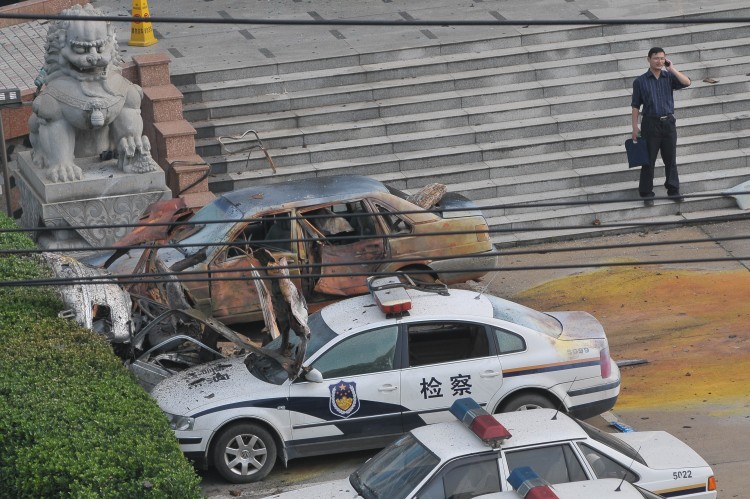
The last words posted on his microblog were, “I, Qian Mingqi, have suffered this injustice for 10 years. Finally, I will take action to make equality and justice happen.”
According to the official death toll, he and two others were killed. The unofficial death toll is 18.
The very same day, columnist Yao Bo of China Daily announced that he would join others to run as a representative for the local People’s Congress. One day before his announcement, authors Li Chengpeng of Chengdu and Xia Shang of Shanghai made similar announcements through weibo (microblogs).
Li was a former sports commentator and is now one of the most followed microbloggers. According to a June 15 article by Zeng Jinyan in Probe International, more than 30 independent Chinese netizens announced their plans to run. Zeng is the wife of Hu Jia, the imprisoned activist and the 2008 winner of the Sakharov Prize for Freedom of Thought.
Once every five years, elections are held for the district-level People’s Congresses, and this autumn there will be such an election. The 30 independent candidates are using microblogs to run their campaigns for office and are betting that by doing so they can make a change in the system.
Some see hope in these independent candidates. Xiao Shu, another famous writer, compared the two new phenomena: bombs being set to attack government buildings and candidates announcing they will run for the People’s Congress.
On his microblog, Xiao Shu suggested that voting could be used to defuse the possibility of bombings. He believes that to create a good society, the public should act to save itself. One example would be running as a local, independent representative of the People’s Congress.
Reasons Behind the Bombs
To consider whether the bombings that are starting to appear in China can be defused, one needs to look at the reasons behind them.
There were several explosions after the Fuzhou incident. On June 9, the police station in Leiyang City, Hunan Province, exploded. Another explosion happened the same day at a police station in Zhengzhou City, Henan Province. On June 10, two homemade explosives were detonated in front of the Tianjin City government building.
Many commentators have said that China has left the era of self-immolations and entered the era of bombing government buildings. Of these cases, the first one, the Fuzhou explosion, was the best known and most discussed. The person alleged by the police to be responsible, Qian Mingqi, posted his story online and announced right before the explosion that he was going to take action.
Qian’s story is typical in today’s China. He was a self-employed businessman. His house, used for both his home and business, was demolished 10 years ago. He rebuilt his house with the compensation for his old house.
Then that house was demolished. Only this time, he was unable to rebuild. The district Chinese Communist Party (CCP) official put the compensation for the entire development that included Qian’s home—10 million yuan (US$1.5 million)—into his own pocket, according to Qian’s online account.
Qian and another nine families with the same situation in the same case became petitioners. They visited local government offices, the city procuratorate office, and even Beijing.
Ten years passed, two old petitioners passed away, and the case was still not solved. Qian was afraid that he would die before justice was done, just like the two other petitioners in his case. He didn’t want that happen to him, he said in his microblog.
He didn’t want to become another Xu Wu or Qian Yunhui either. Qian Yunhui, a petitioner in Zhejiang Province, died under the wheel of a construction truck. Most people believe that he was murdered by local authorities.
Xu Wu, also a petitioner, was locked up in a mental hospital for four years. In April 2011, Xu managed to escape, only to be captured in Guangzhou City by Hubei police and sent back to the mental hospital. A new term to describe his situation became popular on China’s Internet: “mentally disordered.”
Qian Mingqi had actually tried everything. He didn’t succeed as a petitioner. He knew what he was facing—being murdered or being “mentally disordered.” He made his choice and built his bomb. The question is, would he have made that choice if he had someone in the local People’s Congress to represent him?
Not Representing the People
The People’s Congress is called a rubber stamp for a reason. In reality, since no independent candidates are allowed, even though they are not formally banned, at least 95 percent of the representatives are either CCP or state officials or appointed by those officials. The independent candidates who have actually gotten elected are very rare, probably less than a dozen in the past 30 years.
Even if an independent candidate is elected, what he or she can accomplish is very limited. There are two main duties for the local elected people’s representatives: to elect the local government officials and to initiate a motion.
For the former, the CCP has a way to make sure its appointed representatives are in the absolute majority. For the latter, any motion that the CCP doesn’t like can be easily made to disappear.
I was a representative at the local district People’s Congress about 30 years ago when I was a college student. I initiated a motion about reducing air pollution caused by a factory near our college. When the motions were collected and posted, there was no “environmental protection” category, and my motion just disappeared.
Next: Local Power Groups
Views expressed in this article are the opinions of the author and do not necessarily reflect the views of The Epoch Times.






