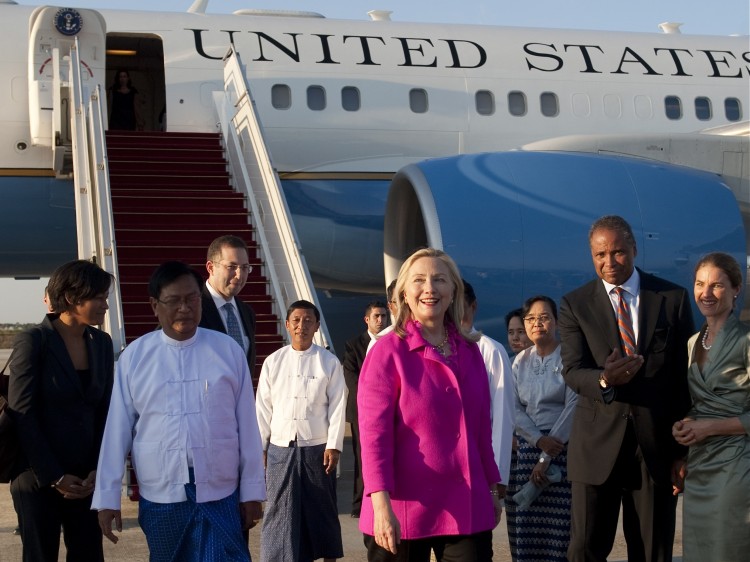
Secretary of State Hillary Clinton’s visit to Burma this week, the first of its kind since 1955, might turn out to be Burma’s coming out party; a significant geopolitical player in the struggle for regional influence.
According to professor David Williams, Burma expert and executive director of the Center for Constitutional Democracy at Indiana University, Burma’s sudden tilt toward liberalization may be closely linked to the new government’s decision to start looking to the West instead of relying on an ever-more intrusive Chinese Communist regime.
Far from being an unwitting pawn in the Sino-American struggle for dominance, Williams says Burma has become aware of its strategic significance—and of its options.
“Burma is learning to play geopolitics,” he said.
For a long time, Burma was not high on the U.S. agenda. Considered too far away and too much in China’s backyard, it also lacked the natural resources that would make it a core strategic interest. The oppressive rule of the military junta also showed no signs of the kind of liberalization that would make it a viable partner.
Instead, China has been the main partner of the hardline Burmese regime that otherwise kept itself fairly isolated. But it has been a partnership that has served China—including a massive oil and gas pipeline project, along with other projects, especially in northern Burma—and the Burmese regime, which has been provided with vital military supplies.
When Kurt Campbell became the assistant secretary of state for East Asian and Pacific Affairs, an initial flicker of change appeared when the military regime, called the State Peace and Development Council (SPDC), approached the United States and indicated it wanted closer relations.
Campbell went over in November 2009, and on the surface, the encounter was not fruitful. The junta showed no interest in democratic reform or negotiations and Campbell went home, disappointed. A year later, something began to change.
In November 2010, the country held its first elections in 20 years, which the ruling generals championed as a transition to democratic rule and critics denounced as a sham, a vehicle for the military elite to retain its power. To most observers’ surprise, the civilian government has turned out to be a potential vehicle for real change.
“The military junta clearly intended to keep power, but it is clear that the once-powerful generals are now much less powerful. They may not even be capable of perpetrating a coup if they wanted to,” says Williams. “This has made President Thein Sein a very important figure.”
The junta may simply have miscalculated, Williams argues. When the SPDC decided to force some of its own into “retirement” to serve as politicians, this amounted to a demotion since it cut them off from economic opportunities.
“The new Legislature is angry with the SPDC, they feel like they have been given a bum deal,” says Williams.
This resentment may have been an important factor in the post-SPDC civilian government (the SPDC officially dissolved in March 2011) looking for new deals with new players, such as the United States, since China was so closely linked to the military regime. And if Burma wants to play with the West, it needed to open up and at least move toward a more liberal climate.
When President Thein Sein revoked the multibillion-dollar dam deal with China in September—which some commentators suggested was more or less at the behest of Washington—it was an important show of independence, since it jeopardizes the vital military supply chain from China.
“It is a very interesting development. He is saying ‘Cut me off if you need to,'” said Williams, who did not rule out that Clinton and Thein Sein may discuss the issue of military supplies at their meeting.
Williams’s analysis is that China has turned out to have less power over Burma than anyone anticipated, and it will now be interesting to see what Beijing’s response will be to the U.S. overture.
“They will want to stop Burma’s tilt to the West—but how? One thing they can do is offer better terms, more money, and promise more respect for Burma’s sovereignty. This is not to say that they may not attempt more heavy-handed tactics, but this would be a miscalculation,” says Williams, predicting that such an approach would only push Burma more quickly into the arms of the West.
On Monday, Burma’s military leader Gen. Min Aung Hlaing visited Beijing, and some commentators have seen this as an attempt to reassure the Chinese regime, still the biggest foreign investor in Burma, of its continued friendship.
Another player in this drama is India, which was initially supportive of the democracy movement in Burma, but has in recent years “been playing a much more cynical game” in doing business with the Burmese regime, according to Williams.
One part of Burma’s strategic importance is that it could provide China with a base on the Indian Ocean, something that India would not like to see. Although Williams thinks that India will want to counter the U.S. influence, he predicts that it will generally welcome it, since it is at China’s expense, and India has a more relaxed relationship with the United States than it has with China.
Despite the policy shift, Williams thinks we probably won’t see a rapid shift from China to the United States, just as we should not expect very quick progress in the democratic reforms.
In a well-timed teleconference with the Council of Foreign Relations in Washington on Wednesday, Aung San Suu Kyi was hopeful, but also indicated that reforms still had a long way to go. The government would have to ensure rule of law, freedom of the press, and unfettered political parties among other hallmarks of democracy.
Williams thinks that Thein Sein and the executive branch will remain firmly in control for the foreseeable future, and that the change will be incremental.
Nevertheless, the tide of change may already be unstoppable.
“Often, when strongmen open up a little bit, they think they can control the process, but they can’t, it moves beyond their grasp. There will come a day when the pace of events will quicken, but it will not be in the next year,” Williams said.
In the teleconference, Suu Kyi announced she will certainly run in the next elections. If Suu Kyi and her National League for Democracy (NLD) party get into Parliament—provided they are allowed to run—they will certainly push for change.