WASHINGTON—A new bipartisan Senate bill that has won rare backing from both business and labor presents an opportunity to rebuild America’s roads, bridges, ports, sewers, levees, and airports.
The Building and Upgrading Infrastructure for Long-Term Development, also known as the BUILD Act, proposes a new bank specifically to fund infrastructure projects.
Unlike similar proposals out there, namely one on offer by the president, BUILD does not include any offer of grant money. The bank is modeled after the profitable Export-Import Bank model.
A $10 billion dollar initial government investment would be used to establish the bank so it can begin leveraging private investment.
The bipartisan proposal requests just one-fifth of the appropriation that the president has proposed for funding transportation projects.
Projects would be chosen based on their ability to provide a regular revenue stream to ensure the loans get paid back. Ultimately the bank is required to be self-sustaining.
Bill co-sponsor Kay Bailey Hutchison (R-Texas) said she worked with sponsor, Sen. John Kerry, (D-Mass.), to craft the bill in such a way that it offered the greatest chance of success, even in a Congress that is in no mood to spend or invest more money.
“It is essential to think outside the box as we work to solve national challenges, particularly in this fiscal crisis,” Hutchison said when the bill was introduced in March.
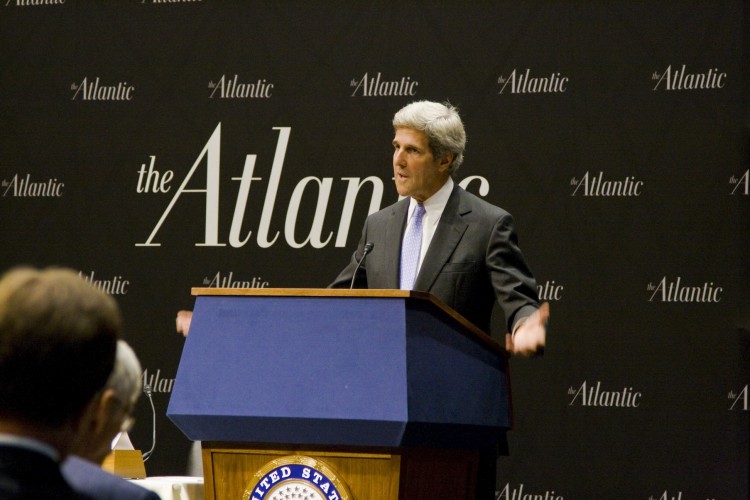
Sens. Kerry and Hutchison spoke of their proposal while attending a forum on Wednesday sponsored by The Atlantic magazine. An audience of over 200 people took in the event, which listed an impressive set of supporters.
Economic Growth Engine
Sen. Kerry predicts that up to $600 billion in private capital will be unleashed and millions of jobs would be created over the next 10 years. It is essentially a job-creating enterprise, since infrastructure built in America, would be built by Americans.
In the last 100 years, U.S. companies have built up first class infrastructure in America and around the world, from the national highway project, to the railway, to air traffic control.
“We are builders. It is part of our DNA,” said Sen. Kerry.
The bank, which has the support of the Chamber of Commerce, as well as the nation’s biggest union, the AFL-CIO, would be a government-owned entity—but it would operate independently and outside of the purview of any federal agency.
Supporters say that the United States needs to create opportunities for quality, stable investments that can bring regular returns. Global pension funds, private equity funds, mutual funds, and sovereign wealth funds are potent investors that require low-risk places to park their cash.
Robert Dove, managing director with the American giant asset management firm, the Carlyle Group, says he has a $1.2 billion investment fund that he would love to invest in the United States, but can’t under the current circumstances.
“Our nation’s policymakers have to agree that it is essential to access private capital for public infrastructure,” said Dove at the conference.
When it comes to infrastructure investment, many businesses are reliant on long-term, low-interest loans or loan guarantees of the kind that only a government sponsored entity can provide.
The European Investment Bank (EIB), a similar bank operating in Europe, “makes projects viable that would not otherwise be viable,” Dove said.
Making America Competitive
Tom Donohue, president and CEO of the U.S. Chamber of Commerce, stood beside labor leader Richard Trumka from the AFL-CIO at the press conference announcing the BUILD Act in March.
“A national infrastructure bank is a great place to start securing the funding we need to increase our mobility, create jobs, and enhance our global competitiveness,” Donahue said.
Big business and investment firms point out that in today’s global market, the United States is competing with every other country for the trillions of dollars in investment capital known to be sitting on company ledgers right now.
The U.K., China, Australia, and Brazil already have attractive infrastructure-focused incentives in place, and in most cases companies find it more attractive to invest there than in America.
At the same time, America badly needs the investments. The American Society of Civil Engineers gives the country’s infrastructure a D grade. The society predicts that if Congress doesn’t act within five years, the infrastructure deficit—the amount required to get us to a B grade—will top $2.2 trillion.
Anyone who drives down pothole-ridden roadways, deals with broken elevators and escalators, or tries to get to an airport, understands the reality of the nation’s state of disrepair.
Sen. Kerry is inviting Americans and Congress to consider what the country’s future will look like without the significant investments in infrastructure he says the country needs.
“Where are the great infrastructure projects of our generation? What have we built for the future?” he asked.
“This is not the future of the United States with the road we are on,” he said, “uh … the path we are on,” realizing the unintentional pun.
“It’s hardly a road.”